
This article discusses which animals deserve moral consideration, and whether some species are more deserving than others.
Moral status of animals
On this page
- Moral status of animals
- Moral hierarchy discussed
- Sentient and insentient organisms
- Problems with this approach
- The problem with self-awareness
Page options
Moral status of animals
Which animals deserve moral consideration?
 Peter Singer ©
The idea that non-human animals have significant moral status is comparatively modern. It owes much to the work of philosopher Peter Singer and his 1975 book 'Animal Liberation'.
Animal lovers would say that all animals deserve moral consideration.
This doesn't help resolve cases where the moral interests of different animals are in conflict.
Philosophers have made valiant attempts to offer a systematic answer to this question. But all their attempts are subjective and have a human bias:
- they involve human values in the way they approach the subject
- they involve human value judgements in applying them to particular cases
A moral classification of animals
The approach below is what philosophers call consequentialist. It does not argue that animals have rights. Although this line of thinking is both useful and persuasive it does lead to one rather unpleasant conclusion.
Outline
Organisms can be arranged in a moral hierarchy in which the lowest group deserves no moral consideration at all, and the top group deserves more moral consideration than the second group.
- Sentient organisms that are aware of their own existence and would prefer to continue to exist
- Sentient organisms that are not self-aware and don't have any idea of continuing to exist in the future
- Inanimate objects and insentient organisms
Moral hierarchy discussed
It's helpful to look at the three categories in more detail.
Sentient organisms that are self-aware
Sentient organisms that are aware of their own existence and would prefer to continue to exist deserve full moral consideration because:
- They experience pain and pleasure
- They are aware of their own existence and context
- They prefer to experience pleasurable lives
- They prefer to stay alive
This group includes most human beings and the higher animals. Using this criterion leads to a conclusion that would shock most people.
Sentient organisms that are not self-aware
Sentient organisms that are not self-aware and don't have any idea of continuing to exist in the future deserve some moral consideration because:
- They can feel pain and pleasure
- They prefer to avoid pain
- They prefer to experience pleasure
- It is wrong to cause pain to members of this group
- Killing and replacing individuals in this group is not significant
- because one individual is not significantly different from another
This group includes animals like fish and rodents.
Inanimate objects and insentient organisms
These deserve no moral consideration because it doesn't make sense to talk of treating them badly or well. This is because:
- They can't feel
- Nothing can matter to them
This group includes insects and simple animals, plants and inanimate objects.
Sentient and insentient organisms
Sentient organisms
Sentient organisms are creatures that have subjective experiences.
Some writers argue that "only organisms that have subjective experiences deserve moral consideration."
Let's unpack that thought:
Only organisms that value one experience more than another deserve moral consideration.
Such organisms must have 'interests', because only organisms with 'interests' are able to value one experience more than another experience.
These organisms have an 'interest' in avoiding painful experiences and an 'interest' in seeking out pleasurable experiences.
So, organisms must be able to experience pain or pleasure if they are to value their experiences.
Such organisms are described as "having subjective experiences".
Insentient organisms
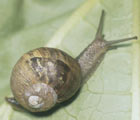 Both snail and plant are considered insentient
 Insentient organisms don't have subjective experiences.
Organisms that don't have subjective experiences don't experience events as good or bad, and so, in moral terms, it doesn't matter what happens to them.
As Peter Singer puts it: where "a being is not capable of suffering, or of enjoyment, there is nothing to be taken into account."
The organisms and things that don't have subjective experiences and so don't deserve moral consideration are:
- non-living things
- plants
- very simple organisms
- insects
- molluscs
All other animals - human and non-human - deserve moral consideration.
Self-aware organisms
Sentient organisms (see above) can be divided into two groups:
- those that are merely conscious
- those that are aware of themselves as
- beings that are alive
- beings that have been alive in the past
- beings that would prefer to stay alive
The first group experience pain and pleasure but don't think about themselves in any meaningful way.
This kind of being is, in a sense, impersonal ... in killing it; one does it no personal wrong, although one does reduce the quantity of happiness in the universe. But this wrong, if it is wrong, can be counterbalanced by bringing into existence a similar being which will live an equally happy life
Peter Singer, Practical Ethics, Cambridge University Press, 1979
Members of the second, self-aware group, which includes human beings, are aware of their own existence and concerned about what will happen to them in the future.
This awareness and preference to go on living, makes them deserve greater moral consideration than the first group.
Problems with this approach
There are several problems with this way of looking at the moral status of animals:
How can we understand the mental landscape of any other sentient creature?
- by inference from the animal's behaviour or physical structure
- by imagining what the creature is feeling
How can we tell whether an animal has a preference to continue living?
- we probably can't
- an animal's attempt to avoid being killed painfully will appear exactly the same to us whether the animal is attempting to avoid being killed or whether it is merely attempting to avoid a painful experience and has no concept of death
How do we compare the relative interests of different animals in the same category?
Interests, needs and wants come in different varieties with different weights; how do we include the relative weights of different interests when we are faced with moral choices?
Weights of interest
- Basic interests: interests concerned with survival.
- Serious interests: needs - interests that have a major effect on the animal's quality of life.
- Trivial interests: wants that are nice to have satisfied, but the animal can manage perfectly well even if they are frustrated.
How do we judge an issue where satisfying the trivial interests of a higher animal frustrates the basic interest of a lower animal? For example: to protect the basic interest of a fish to survive, a human's trivial wish to eat it must be frustrated.
What about the problem of human animals that are not self-aware?
The problem with self-awareness

There is a serious difficulty with using self-awareness and the preference to stay alive as criteria for full moral status.
Young babies, people in comas and people with certain types of brain defect do not show these characteristics. And this means that these 'marginal' human beings deserve less moral consideration than other human beings, and even than some non-human animals.
Most people would regard this as a totally immoral idea, and would want to reject the theory that leads to this conclusion.
The easy way to solve the problem is to cheat and put human beings in an even higher moral category, and simply state that even human beings who aren't self-aware and have no preference to go on living should be regarded as deserving full moral consideration.
This is speciesism, which, despite much criticism, is a perfectly coherent moral position to take.
Elsewhere on the web
BBC iD
BBC iDBBC navigation
BBC links

BBC © 2014The BBC is not responsible for the content of external sites. Read more.
This page is best viewed in an up-to-date web browser with style sheets (CSS) enabled. While you will be able to view the content of this page in your current browser, you will not be able to get the full visual experience. Please consider upgrading your browser software or enabling style sheets (CSS) if you are able to do so.

