
Abortion was accepted in ancient Rome and Greece. Through much of Western history abortion was not criminal if it was carried out before the foetus moved in the womb (around 18-20 weeks into the pregnancy).
Historical attitudes to abortion
On this page
Page options
Abortion in ancient history
Ancient Greece and Rome
 Roman couple; 1st-century fresco from Pompeii ©
Abortion was accepted in both ancient Rome and Greece.
The Romans and Greeks weren't much concerned with protecting the unborn, and when they did object to abortion it was often because the father didn't want to be deprived of a child that he felt entitled to.
The early philosophers also argued that a foetus did not become formed and begin to live until at least 40 days after conception for a male, and around 80 days for a female. The philosopher Aristotle wrote:
...when couples have children in excess, let abortion be procured before sense and life have begun; what may or may not be lawfully done in these cases depends on the question of life and sensation.
Aristotle, Politics 7.16
Aristotle thought that female embryos developed more slowly than male embryos, but made up for lost time by developing more quickly after birth. He appears to have arrived at this idea by seeing the relative development of male and female foetuses that had been miscarried.
Bible times
The Old Testament has several legal passages that refer to abortion, but they deal with it in terms of loss of property and not sanctity of life.
The status of the foetus as property in the Bible is shown by the law that if a person causes a miscarriage they must pay a fine to the husband of the woman, but if they also cause the woman to die then they are liable to be killed.
The New Testament doesn't explicitly deal with abortion.
Western history
Through much of Western history abortion was not criminal if it was carried out before 'quickening'; that is before the foetus moved in the womb at between 18 and 20 weeks into the pregnancy. Until that time people tended to regard the foetus as part of the mother and so its destruction posed no greater ethical problem than other forms of surgery.
England and America
England
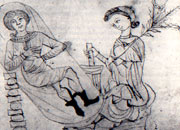 13th-century depiction of a herbalist preparing pennyroyal, a traditional herbal abortifacient ©
English Common Law agreed that abortion was a crime after 'quickening' - but the seriousness of that crime was different at different times in history.
In 1803 English Statute Law made abortion after quickening a crime that earned the death penalty, but a less serious crime before that.
In 1837 English law abolished the significance of quickening, and also abandoned the death penalty for abortion.
In the 1920s English law added a get-out clause that stopped abortion being a crime if it was "done in good faith for the purpose only of preserving the life of the mother."
This change officially recognised a little-stressed feature of anti-abortion laws; they were often intended to protect women from a dangerous medical procedure, and not to protect the life of the foetus.
In 1938 the important case of R v Bourne decided in favour of an abortion performed on a 14 year old girl who had been raped - the court felt that the girl's mental health would have suffered had she given birth - and this established that the mother's mental suffering could be sufficient reason for an abortion.
The judge (Mr. Justice Macnaghten) put it like this:
...if the doctor is of the opinion, on reasonable grounds and with adequate knowledge, that the probable consequence of the continuance of the pregnancy will be to make the woman a physical or mental wreck, the jury are entitled to take the view that the doctor ... is operating for the purpose of preserving the life of the mother.
And the principle the judge set down in that case governed British thinking about abortion for nearly 30 years.
America
Abortion was common in most of colonial America, but it was kept secret because of strict laws against unmarried sexual activity.
Laws specifically against abortion became widespread in America in the second half of the 1800s, and by 1900 abortion was illegal everywhere in the USA, except in order to save the life of the mother.
Some writers have suggested that the pressure to ban abortion was not entirely ethical or religious, but was partially motivated by the medical profession as a way of attacking the non-medical practitioners who carried out most abortions.
Abortions were made legal in the United States in a landmark and controversial 1973 Supreme Court judgement, often referred to as the Roe v Wade case. (Read the BBC News page about Roe v Wade.)
In 2003 the plaintiff in Roe v Wade asked for the decision to be reversed and put forward evidence that abortion is harmful to women.
Abortion rights faced restriction in 2003 after the US House of Representatives and the US Senate voted to ban late-term 'partial birth' abortions.
The Abortion Act of 1967
What the Act actually stated
The Abortion Act of 1967 revolutionised the situation in England by allowing doctors to perform an abortion where two other doctors agree:
that the continuance of the pregnancy would involve risk to the life of the pregnant woman, or of injury to the physical or mental health of the pregnant woman or any existing children of her family, greater than if the pregnancy were terminated,
or
that there is a substantial risk that if the child were born it would suffer from such physical or mental abnormalities as to be seriously handicapped.
Sufficient grounds
It's easier to understand what the act allowed if you list the possible situations. Any one of the reasons below gives sufficient grounds for an abortion:
- the continuance of the pregnancy would involve risk to the life of the pregnant woman greater than if the pregnancy were terminated
- the termination is necessary to prevent grave permanent injury to the physical or mental health of the pregnant woman
- the continuance of the pregnancy would involve risk, greater than if the pregnancy were terminated, of injury to the physical or mental health of the pregnant woman
- the continuance of the pregnancy would involve risk, greater than if the pregnancy were terminated, of injury to the physical or mental health of any existing child(ren) of the family of the pregnant woman;
- there is a substantial risk that if the child were born it would suffer from such physical or mental abnormalities as to be seriously handicapped
Two grounds apply in an emergency:
- to save the life of the pregnant woman
- to prevent grave permanent injury to the physical or mental health of the pregnant woman
Although it is often said that the 1967 Abortion Act gave women in Britain the right to have an abortion, it actually didn't do that - abortion remained a crime under the earlier law, and the 1967 Act provided a defence for those who had carried out an abortion under certain conditions.
Around the BBC
BBC iD
BBC iDBBC navigation
BBC links

BBC © 2014The BBC is not responsible for the content of external sites. Read more.
This page is best viewed in an up-to-date web browser with style sheets (CSS) enabled. While you will be able to view the content of this page in your current browser, you will not be able to get the full visual experience. Please consider upgrading your browser software or enabling style sheets (CSS) if you are able to do so.

