
The court case that set the current form of American abortion law was Roe v Wade. This article explains its importance.
Roe versus Wade
Roe versus Wade
American abortion law owes much of its present form to the case of Roe v Wade in 1973.
In Roe v Wade the Supreme Court held that a pregnant woman has a constitutional right, under the Fourteenth Amendment, to choose to terminate her pregnancy before viability as part of her freedom of personal choice in family matters.
There's a BBC news page on Roe v Wade that explains this in more detail.
In 2003 the plaintiff in Roe v Wade asked for the decision to be reversed and put forward evidence that abortion is harmful to women.
2006 midterms: abortion ban rejected
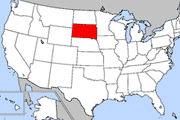 South Dakota on a map of the USA ©
In a state referendum alongside the November 2006 US mid-term elections, voters in South Dakota rejected a near total ban on abortion, which had been signed into law in March but had not yet taken effect.
The law would have allowed abortions only to save a pregnant woman's life - and was designed to draw a legal challenge and ultimately overturn Roe v Wade.
State referendums, known as ballot initiatives, are proposed state laws that must be decided by voters. Correspondents said no measure galvanised political activists across the country like the South Dakota abortion measure.
Around the BBC
BBC iD
BBC iDBBC navigation
BBC links

BBC © 2014The BBC is not responsible for the content of external sites. Read more.
This page is best viewed in an up-to-date web browser with style sheets (CSS) enabled. While you will be able to view the content of this page in your current browser, you will not be able to get the full visual experience. Please consider upgrading your browser software or enabling style sheets (CSS) if you are able to do so.

