How are radio audiences measured?
An organisation called the Radio Joint Audience Research Limited (RAJAR) is responsible for going out to households across the country, and asking people to keep adiary of listeningfor seven days. Approximately 130,000 diaries a year are completed. Respondents are asked to record which stations they listened to at what times, and also where they were listening. The diaries are collected and processed, and then every three months a quarterly set of audience figures for each station is released. Where a station is local rather than national, it is able to find out how it has done in its particular transmission area, rather than being lost in the national figures. RAJAR is jointly owned by the BBC and the Commercial Radio Companies Association, and its research is carried out by a company called IPSOS-RSL. It was founded in 1992 to establish an industry standard for audience measurement, which would not be in-house or prejudiced towards certain stations. You can find out more about RAJAR at its website: http://www.rajar.co.uk/
(The BBC cannot be held responsible for the content of external websites) 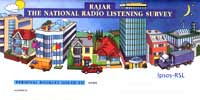 | | The front of a RAJAR diary. |
Although data is released every three months, most of our BBC Local Radio stations rely on six months of data at a time, because their smaller transmission areas require longer to establish a reliable sample from the diaries. It's only national stations and the stations based in heavily populated areas (like London or Manchester) that tend to use three months of data. | 


