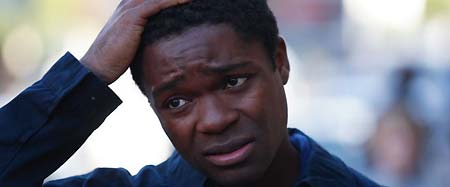
Can you tell us about Joe?
The film opens on this successful IT programmer, Joe, deciding that he wants to try to make a difference by becoming a teacher in a city school. He's inspired after seeing stories in the press about black boys failing.
He starts teaching in this school and initiates a few unorthodox teaching methods, wrongly or rightly. For example, he hands out a lot of detentions to the black boys in his class so that he can have extra teaching time with them.
He ends up getting convicted of assault after he taps a school boy on the shoulder. The incident is blown out of all proportion and he loses his home and his job, and continues on a downward spiral.
Through his recovery, the film basically looks at the blame culture within the black community, and we see that through the eyes of Joe. His paranoid schizophrenia manifests as a hatred of black people - in his depression he sees them as the cause of all the problems in his life.
It's a journey of self discovery but also what it means to Joe - a middle class, professional guy - to be black in 21st century Britain.

What kind of a man would you say he is? Throughout the film the viewer's allegiance changes - sometimes we're very much on Joe's side and other times not.|
"Joe's a three dimensional human being who at times we like, at times we hate."
|
I don't think he's always a particularly sympathetic character and that's what I love about him. He's a human being, a three dimensional human being who at times we like, at times we hate, at times we misunderstand and at times we understand.
I think there are far more people like Joe than most would care to admit, people who are slightly perplexed about their identity. 'Am I British? Am I black British? Am I West Indian? Am I African?' All these questions that black British people ask about themselves. Also how does that identity fit into being working class or middle class? Or how do I feel about black women trying to look more western or trying not to look western? It raises all sorts of very pertinent questions.
What did you think when you first read the script? It's quite hard-hitting.
My first thought when I read it was how brave of the BBC to be making this, secondly that this is a real hot potato, thirdly that there are going to be people that dismiss it without seeing it because of the issues it raises, but also that I desperately wanted to be involved.
I don't agree by any means with everything that Joe says, but I think some of what he raises are things that we have got to really look at in society. It does what good drama should - it provokes, it prods, it pokes - it ultimately raises a debate.
I agree with Joe's notion that we cannot continue to blame the legacy of slavery for not moving forward as a community. There are many, many communities, many ethnic minorities, many civilizations that have been brutalised by others and you have to move on. You cannot perpetually stay in that place of blame, otherwise it's just a downward spiral. I one hundred percent agree with that notion.
The writer Sharon Foster said she's based a lot of the events in the film on her own experiences or those of friends and family. Are there things in your life that you can relate to the film?|
"I can relate to Joe feeling slightly betrayed by his own community, because I sometimes felt that was happening to me when I didn't conform at school."
|
Definitely. I was sometimes called 'coconut' [as Joe is] when I was at school.
I was at an inner-city black school, not dissimilar to the one featured in the film. I did my work, I tried to be respectful and respectable. That was to do with my upbringing in
Nigeria, where the culture is very much one of respecting your elders and really valuing education as a gift, especially if your government has decided it's something you should get for free.
So I can really relate to Joe feeling slightly betrayed by his own community, because I sometimes felt that was happening to me when I didn't conform at school.
Sharon really wants to put these controversial issues out for debate amongst the general public. Is this something you agree with?
Very much so. In a way it had to come from a black writer, it had to come from a black lead actor and to some degree I think to had to come from a black director. I don't think some of the things said in the film would be able to be said if it was by a white person.
I think it would go the wrong way. The black community would have the excuse of, "Oh this is how you see us." I'm very happy to stand by the film in terms of the issues it raises. These are valid issues that the black community has to address. It's a great piece of entertainment, but there's no getting away from the fact that there are political statements in it. The way to start the conversations is to have the film aired.
You said earlier that when you read the script you thought it was very brave. Can you explain more? There will be people that are up in arms about it. But when that's all settled down, there will hopefully be people who'll look at it and say, 'OK, fine, that was near the knuckle, but how much of this is/isn't real, how much is/isn't valid? I really don't know how it will be received.
Do you think it will offer viewers outside the black community an insight into the black community?|
"It's a black British world that I think is recognisable to anyone who lives in Britain today."
|
What the film achieves beautifully is that it doesn't make you feel like this is an unrecognisable world, no matter who you are.
There are people who will identify with Germal [the pupil who accuses Joe of assaulting him], there are people who will identify with Joe, and there are people who will identify with Heather. It's a black British world that I think is recognisable to anyone who lives in Britain today.
Do you have a final word for the viewers? I have never seen a drama like it; I've certainly never been in one like it. I hope people take the time to watch it and think about it before making judgements.