Back in the days before Doctor Who returned to our screens, we interviewed Barry Letts about his time working on Doctor Who and his thoughts on the show. The interview originally appeared in 2004 and we present an abridged version here.
If you were to produce Doctor Who today, what sort of character would the Doctor be? And would his adventures take place mostly on Earth or on other worlds?
Barry Letts: Brilliant but fallible; good-hearted but sometimes irascible; moral but ruthless; etc. That is, the mixture as before. Anything else? Show me the actor and we'll discuss it further. Variety is not only the spice of life, it's the secret of success in telling stories - especially long-running series.
Can you shed a little light on your day-to-day role as executive or 'caretaker' producer of Doctor Who in season 18, the first season with John Nathan-Turner as producer?
Barry Letts: I wasn't in any sense a 'caretaker' producer. Every series had always had an Executive Producer, but in my time as producer (in the Pertwee era) he wasn't called that, as he was the Head of Drama Serials, and responsible for all the shows coming out of that department.
His input was firstly to read the final scripts and make any editorial comments that came up - like Ronnie Marsh telling me that we couldn't have the Master raising Azal, the Daemon, inside the village church, as it would offend too many people; which is why we invented the cavern under the church. He also saw the final edited version of each episode, for similar reasons. Obviously, if he thought the standard was slipping he would say so, forcibly.
Luckily we seemed to be on an upward curve in that respect! He would also be involved in discussing any major casting decisions, like the replacement of the Doctor. But the producer was in charge of everything to do with the making of the show. Now, JNT's taking over happened to coincide with the merging of two large Drama departments, Series and Serials. Graeme Macdonald, my boss, then current Head of Serials, suddenly found himself with a double work load: twice as many shows to oversee, and twice as many people to be a father-figure to.
So he asked me to take on his role vis-á-vis Doctor Who, temporarily. He also felt, that as there was also a new script editor, I could supply an element of continuity. And that was it. John was the absolute producer from the start.
To be honest, if I'd been less egotistical and had just done the job without putting my name on the credits, very few of these questions would have been raised. I know John always felt fed-up that people were apt to assume that he wasn't in total charge during that first year, and I don't blame him.
If you could remake one of the stories you produced, with today's technology which one would you chose and why?
Barry Letts: Planet of the Spiders for the scenes on Metebelis, which never looked right. The Green Death for the cavern scenes using Chromakey (the blue-screen process, known to the BBC as Colour Separation Overlay; though on Doctor Who we used yellow, rather than blue).
But most of all, Invasion of the Dinosaurs to get rid of those horrible lumping puppet things. Just imagine what it would have looked like if we had had the resources of Walking with Dinosaurs!
How do you go about creating a Doctor Who companion like Sarah Jane Smith? Is there always a concerted effort to do something new, or does the character just evolve through the actor/actress?
Yes there is, and yes it does. Sarah Jane herself was deliberately made into a feisty independent journalist, not a companion as such, to reflect changing attitudes to women, and to provide a contrast to the somewhat scatty Jo Grant. But as the writers got to know Lis in the character, they tailored their input to suit her.
What qualities did you look for when casting for a replacement for Jon Pertwee as the Doctor and what qualities would you look for if casting for a new Doctor today?
Barry Letts: A good actor, with enough gravitas to make you believe that he could be a Time Lord. The show could easily deteriorate into a trivial pantomime; a personality and something of an eccentric in his own right, so that you would always want to watch him, even if he hadn't got much to do; somebody willing to commit themselves to the series for at least three years.
After your long and successful time producing Doctor Who, was it difficult handing over the reins to Philip Hinchcliffe?
Barry Letts: Not at all. I was quite pleased to be moving on after so long, and it was clear that Philip, with Bob Holmes as his script editor, was going to do the job well.
Looking back, what do you think of The Paradise of Death and The Ghosts Of N-Space now?
Barry Letts: Is this a loaded question? Are you talking about the radio serials or the books, or both?
The Paradise of Death was cited by the publisher, to new writers for the series, as an exemplar for the Missing Adventures; The Ghosts of N-Space was voted in a survey as the least favourite book of the readers of the series!
Both got large audiences on the radio and have sold very well indeed as recordings. I know (being as objective as I can) that they are both well written, so what was all that about?
Well, Paradise was a very straightforward story, very much in the vein of the Doctor Who stories we used to do with Jon Pertwee. Whereas, in Ghosts I had fun, playing around with the concepts of serendipity and synchronicity - fortunate accidents and meaningful coincidences, without any cause - and also had a complex plot structure which hopped around amongst three different periods, quite apart from visiting the after-life. It all seems very clear to me - but Jon and Nick Courtney both said that they hadn't a clue what was going on! Perhaps I went too far for the genre.
One technical point: In Paradise I found a writing device so that, in the radio version, action could be legitimately described by a watcher, seeing through somebody else's eyes. (In The TAO Connection mobile phones give me the same facility). In Ghosts Sarah was reduced to speaking her thoughts out loud, describing for the audience what she was seeing. Not good radio writing.
What were your favourite books, films, and TV shows when you were young?
Barry Letts: Books? Wind in the Willows; Professor Branestawm; the Just William books; the Arthur Ransome Books; every sci-fi book I could lay my hands on. Films? All the Fred Astaires; Snow White and Pinocchio; The Wizard of Oz; Things to Come.
TV? Don't forget the war. Only a few of the rich had TV between 1936 and 1939. Then it stopped. I saw my first TV programme in 1947, when I was 22 (yes, I'm a real old codger now). It was a production of George Bernard Shaw's play Androcles and the Lion, in which my sister Pauline was playing a principal role. It was done live from Ally Pally.
TV sets were so few and far between that I had to go to a viewing room in Broadcasting House to watch it (very few tickets available). I didn't have access to a TV set for regular viewing until 1957. By that time, I was married with two children and appearing regularly on the box myself!
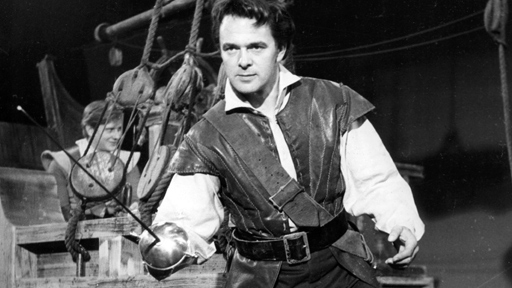
You can see Barry Letts in one of those early starring roles in the image above.