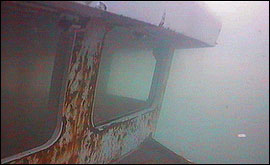
| Browse through the Scylla photo gallery |
A former Royal Navy frigate has been scuttled off the South West coast to create Europe's first artificial diving reef. (Saturday 27th March 2004).
Devon schoolboy Daniel Green joined environmentalist David Bellamy in pushing the plunger that sent HMS Scylla to her watery grave.
The pair stood side-by-side on board a press boat as they set off the charges that sank the decommissioned Royal Navy warship.
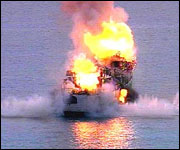 | | Explosives were detonated on board by 12-year-old Daniel Green. |
Twelve year old Daniel, a keen diver from Ivybridge, hopes to visit HMS Scylla at the bottom of the sea this summer.
Thousands of people watched from Whitsand Bay near Plymouth as Scylla was scuttled on Saturday 27th March 2004.
Five years of planning came to an end as the explosives were set off just after 3.30pm. Many of those watching sounded their boats' horns as the bow of the vessel sank slowly below the surface half a mile off the shore.
| |
| |
It took only three or four minutes for the ship to disappear beneath the waves after a series of controlled explosions were triggered on board the vessel.
Among those observing the Scylla's final descent was Captain Mike Booth, the Scylla's last commanding officer.
Any sadness was outweighed by the excitement of the moment, he said.
He added: "All the other ships I have served on have been scrapped or sold into some other navy.
"Scylla has been sitting at the top of Portsmouth dockyard for ten years rusting away. Now she will be a useful vessel for the next 30 or 40 years."
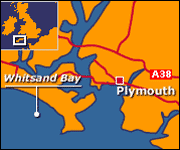 | | The Scylla lies about 800 metres from another wreck, the James Eagan Layne |
It's hoped the vessel, bought by the National Marine Aquarium, will bring £1m a year into the local economy.
The NMA - with funding from the South West Regional Development Agency (RDA) - paid around £200,000 for the Leander Class Frigate.
HMS Scylla was built in the late 1960s and was the last warship built in Devonport. She was taken out of active service in 1993
Similar projects to create artificial reefs across the world have generated millions for their local economies and the team behind this project are confident the same will happen here.
THAT SINKING FEELING
The ship will be used for divers to explore, as well as for it to be colonised by local species of fish.
The Director of the National Marine Aquarium, Kelvin Boot, says the first creatures will start making Scylla their home from day one.
"It's a great experiment - we don't really know what's going to happen," he says. "We'll be monitoring it for weeks, months and years to come.
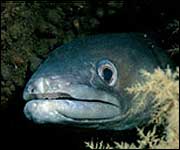 | | Conger Eels like smaller tube-like homes. Picture courtesy Paul Naylor ** |
Kelvin thinks the first animals will start investigating the ship within 24 hours of her hitting the seabed.
"Maybe we'll see conger eels coming to have a look - and the crabs and lobsters will soon start to move in.
"It's like having a big block of flats on the seabed, each one with different exposure to currents, different light levels, different sizes and each of the creatures will find different parts more inviting.
"For example the conger will live in the smaller tube-like areas whilst a fish called a bib - which is a relative of the cod - will probably live in the darker areas.
FISHY TAKEAWAY
Kelvin likens the reef to an oasis in the regular, mainly flat seabed. "There's some interesting stuff out there," he says. "We know it's a nursery area for flat fish and we'd love to see a thing called the Pink Sea Fan move in - it's the sort of jewel in the crown of British marine nature.
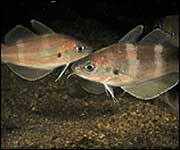 | | Bib prefer the darker places.Picture courtesy Paul Naylor ** |
"We have our fingers crossed that maybe it will colonise and we can learn lessons, for example about how long it takes to grow and what conditions it likes to live in."
Kelvin Boot says the reef may also attract some larger animals. "Who knows? As the months go on we may have sharks, seals or dolphins cruising around because it will be a bit of a focal point - a bit like a fishy take-away!"
Once HMS Scylla is on the seabed, there are plans to attach web cameras to the 2,500-tonne vessel.
The National Marine Aquarium hopes to share its findings with other project around the world via the internet.
"The more lessons we can learn the better advice we can give to others who may like to follow suit in the future," says Kelvin.
| Browse through the Scylla photo gallery |
|