A Devon-based scientist is warning that action is needed now to safeguard the future of the UK's seas. The director of the University of Plymouth Marine Institute, Professor Laurence Mee, says the future of marine life is in serious jeopardy. He is calling for a huge team effort to protect the future of our seas, if we are to avoid catastrophic damage. Prof Mee fears for the future of the marine eco-system, which if seriously harmed, will have wide-ranging consequences for our coastline - and for the industries which rely on the sea, such as fishing. 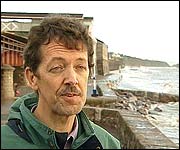 | | Prof Laurence Mee |
The warning comes in a keynote speech to MPs and other senior officials at a top-level presentation evening in Whitehall on 21 February 2007. Research by the University of Plymouth Marine Institute has shown that the current ad-hoc approach to management of the seas is putting the marine eco-system at risk, as well as increasing the threat of flooding and storms that could radically change the face of the British Isles. Prof Mee has already voiced concerns that our coastline could become increasingly battered by stormy seas - and points to the stretch of coast at Dawlish as an example. Prof Mee said: "The current system for protecting our marine environment cannot cope with the pressures imposed by modern society. "Basically we are facing a choice: either we team up in the UK to sustain marine life or we face a future of catastrophes and lost causes - fisheries, biodiversity, coastal landscapes, and the jobs and human values that depend on them." He added: "We all benefit from our beautiful and productive seas and now as the extent of damage to marine eco-systems becomes ever clearer, we urgently need a new planning system based on serious joined-up thinking and the participation of everyone." 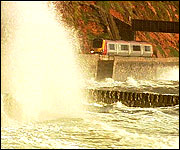 | | Stormy seas at Dawlish |
Professor Mee is co-ordinating scientific input from the Marine Institute and others, ahead of the government's white paper on the UK's future Marine Act, which is currently under development. The institute is part of the Plymouth Marine Sciences Partnership whose members are Plymouth Marine Laboratory, the National Marine Aquarium, the Marine Biological Association of the UK and the Sir Alister Hardy Foundation for Ocean Science. The institute has joined the Global Legislators Organisation for a Balanced Environment (GLOBE) and the Advisory Committee on Protection of the Seas (ACOPS), to organise the presentation at Whitehall. It's an opportunity for MPs to question scientists and for a wider discussion on the implications of the latest research on marine science for policy-making at a crucial stage of the development of the Marine Bill. |