| 28 October 2014 |

| |
| BBC Homepage | | |
| |||
| Contact Us | | |
WalksYou are in: Derby > Places > Walks > Ashbourne History Walk 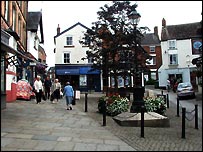 Victoria Square, Ashbourne Ashbourne History WalkBy George E Shaw Follow in the footsteps of Bonnie Prince Charlie, discover a link with Shakespeare and walk along a Roman Road. Discover Ashbourne's historical secrets with this short walk around the town. There are plenty of cafes and pubs to stop at on the way!
Our walk starts in the Market Place (outside Spencers the Bakers). Looking across the Market Place, we see the Wright Memorial, erected in 1874 in memory of Francis Wright, one of the most prominent figures in Ashbourne last century. Just in front of the Wright Memorial was the Bull Ring, and it was near this spot that Bonnie Prince Charlie proclaimed James 'King of England' during the first Stuart rebellion of 1745. It's the only place in England where a 'Pretender' to the throne has been proclaimed. The Bull Ring was also used for bull baiting - one of the 'sports' of mediaeval times. In the nearby corner, now a chip-shop, was the Brown Lion. The Tourist Office was the 'Tub-thumpers' workshop of the Wibberleys the barrel makers - one of the trades carried out in the Market Place in the 19th Century, producing barrels, butter churns and other wooden utensils.  Market Place looking towards the Vaults The surrounding area of the Market Place has seen a number of changes of name. King Street was Mutton Lane; Union Street was The Poultry; Buxton Road was The Piggery, while at the bottom of the market was the horse and cattle market. In Frith's Yard (between Elliots and Aurora) was the workshop of Davenports, the clockmakers. Walking to the west of the Market Place we have The Old Vaults pub. Before that it was called The Anatomical Horse, with a skeleton of a horse as its sign, though the origin of this sign is still a mystery. The Vaults is one of several meeting places for Up'ards before the start of the annual Shrovetide football game. Above number 10 (the Bookmaker's office to the left of the Vaults) can still be seen one of the few sundials left, another being on the Green Dragon in St John Street. Next to Peach's butchers shop is Shakespeare's Yard. This Shakespeare was also a butcher last century, and claimed to be a descendant of the Bard! He was reputed to be an accomplished musician and poet. This yard was also that of yet another public house, The Boot and Shoe. The Lamplight restaurant (to the right of the Vaults) was also once a pub, the Tiger Inn. Note the shape of the frontage of this building, which is one of the old Elizabethan buildings. Its timber frame can be seen from Tiger Yard. Up Tiger Yard (immediately to the left of the Lamplight Restaurant) there was once a Baptist Chapel, later turned into the Literary Institute. During the 'Pew Wars' of St. Oswald's Parish Church in 1846 this became an Anglican chapel and at the turn of the century it was used as an Infant school. 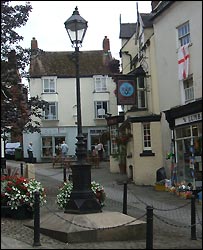 Victoria Square Lamp Post This lower part of the market was the Shambles, where animals were slaughtered. For many years it was known as Butchers Row, now Victoria Square, but still commonly called the Butchery. The lamp post you can see in Victoria Square was originally erected at the bottom of The Market Place where now is the traffic island. Around the base of this lamp post can still be seen the names of Mr Wise, the chairman, and the committee members of a group of business men who met in 1839 to discuss the setting up of a gas company. Restoration of this lamp has replaced some of the old ironwork with copper and it is now powered by electricity instead of gas. Tucked away in the bottom right-hand corner of Victoria Square is the approach to Coxon's Yard. Adjacent to this and opposite Barclays Bank, once was the first Post Office in use last century (now an off license). On the side of the shop can be seen a small recess in the wall, which was once a small hatchway for handling the mail. Above and to the left of this recess can be seen a round space once containing a clock. From here, turn right and pass Bookthrift and Dorothy Perkins before reaching the Natwest Bank on the site of the Wheatsheaf Hotel which, during the stagecoach era, was one of the busiest inns in the district. The premises covered a large area, stretching right up to the cottages on Belle Vue Road behind. Continuing along Church Street, we next have St Oswald's house, now a dentists' surgery, and built in the 1740s by the Goodwin family. Opposite, we have the Clergy Widows' Almshouses, built in 1753 under the will of Nicholas Spalden, dated 16th April 1710. He left money to build four clergy widows' almshouses and ten others for the poor of the town. The brass plate from his coffin may still be seen on the wall of the south transept in St Oswald's Church. 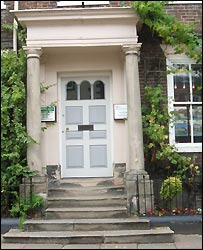 The Vine House Still on the right-hand side of Church Street we come to Vine House, now Bagshaws, the Estate Agents. This is a good example of how in the 18th Century the frontage of the building was 'modernised' to a Georgian façade, but to the right of the steps can still be seen the stone mullions of the cellar window of the old building. Sadly, recent alterations have destroyed the 18th-century interior. This was the home of the Alsopp family. On the other side of the road, now Ashbourne Antiques centre and Top Drawer Living, was the town house of the Beresford family in the 18th Century. In the 1920s No.28 Church Street was known as Dial Garth, and rented by Mrs Victoria Howell who, under the pseudonym Hoel Caerlion, published a book of verse 'Sun Dial Songs', a copy of which was accepted by Queen Alexandra. Through the doors of number 23, Manion Antiques, can be seen the remains of the 18th-century malt house. Still further along Church Street, number 33, now Poole & Sons, was the old Britannia Inn, while outside number 37, there used to be one of the many old water pumps. Next comes Smith's Yard up which there used to be one of the Brass Founders of the town, and next to it there was the Old Bear Inn. 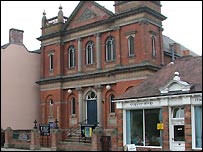 Ashbourne Methodist Church Looking across the road can be seen the present Methodist Church, but near that site was a school for poor children, provided under the will of Nicholas Spalden. Back on the north side of the road look for Tunnel Yard, its name derived from the nearby railway tunnel in 1892, but this was originally known as Frost's Yard. Tomlinson's Yard and Burton's Yard both vanished when the tunnel was built. Note the different style of the 18th-century cottages here. Number 47 is now an antiques shop but it is interesting to see the old Elizabethan cruck beams inside. At number 49 can be seen 'The Ivies', once the home of 'Old Mrs Dale', noted in 'Journal of a Tour to the Hebrides with Samuel Johnson', by James Boswell (more on dr johnson later). By the front door can be seen the 18th-century 'voice-pipe' or speaking tube. 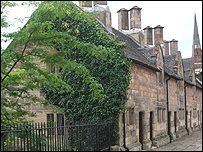 Owlsfield Almshouses Next comes 'The Chantry House ' where a Chantry School was set up "to teach boys to assist the clergy and to sing mass for the souls of the departed". There were at least three chantries in St. Oswald's Church. Across the road can be seen the gable-end of the Pegge Almshouses built in 1669, on which the arms of the Pegge family- 'a chevron betwixt three piles'. A 'pile' is a peg so the Pegge arms are a 'rebus' – a pun on the name. Next come the Owlfield Almshouses originally built in 1610, with a second storey added in 1848. In 1986, further substantial restoration was carried out and pairs of cottages were turned into one. Back on the north (right hand) side of the road, in numbers 53, 55 and 57 can be seen the outlines of the old doors and windows. Nearby numbers 59 and 61 were originally the coach-house of The Grey House. The coachman lived in number 59 while the coach was kept in number 61, where the high doors in the curved recess may be seen, giving access for the coach. 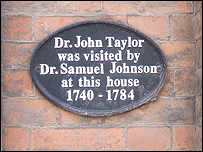 Plaque on the Mansion Next is the original site of Queen Elizabeth's Grammar School, granted a Royal Charter by Queen Elizabeth I in 1585, and celebrating its 400th anniversary with a visit by Queen Elizabeth II in 1985. The original Charter document is one of the town's proud possessions. Although there is a popular belief that this was the first school in the town, there is also strong evidence that Chantry schools existed in the town from the 14th Century. Across the road again, is The Mansion, built by the Taylor family in 1685. The most famous member of this family is Dr John Taylor, the life-long friend of Dr Samuel Johnson, and over the door, in Latin, is a quotation by Dr Johnson giving his feelings for the house. This must surely be the most famous house in the town as it was built in the 17th Century by Benjamin Taylor and updated by his grandson. 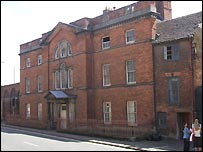 The Mansion It was actually Joseph Pickford, the Derby architect, who converted the house into a miniature mansion with an entrance hall containing a beautiful wrought iron and marble staircase set on marble pillars, topped by a ceiling fresco by Zucci. Next to The Mansion is The Old House, the home of the Hollick family for most of the last century. Dr Hollick was often seen planting daffodils, and his grave in the churchyard does not have a gravestone because every year it is carpeted by the flowers. Now, walk around the churchyard of St Oswald's Church and admire the magnificence of the architectural style. The present church was begun about 1160 with the east end, the chancel. The present beautiful perpendicular, period east window, added in 1385, replaced the original three lancets. The church was consecrated in 1241, but building continued on the transepts and nave until 1280. From 1300 to 1350 the south aisle and spire were completed and in 1520 the nave clerestory was added. In the 1870s a high-pitched lead roof was added in the north transept. 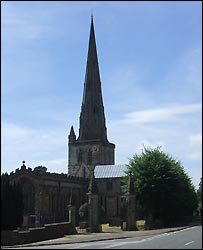 St Oswald's Church Reaching the south side of the church, by the path leading to the small chancel door is a flat slate grave slab. The words are a little difficult to read, but tell the story of John Peterson, a native of Norway, who had been press-ganged into the navy when a French Man-of-War went to his village. John was captured and sent to Ashbourne where he remained after the war was over. If you have an hour to spare, go into the church (guide book on bookstall) and investigate one of the finest churches in the county. The road by the church gates, now called School Lane, was originally Schoo Lane, after the river Schoo which runs along the bottom of the road. The river is now known as Henmore, deriving its name from that of a field above the fishpond. But long before all this, the road was part of Hereward Street, the Roman road from Wirksworth to Rocester along which the Romans would have carried the lead mined in the Derbyshire Hills. Going down this road, next to the churchyard, are the Spalden Almshouses dating from 1723. Carrying on, and crossing the bridge over the river, just pause, and look back at the church, and imagine the changing scenery over the centuries. During the Roman invasion, this would have been a cross-roads, an ideal site for a religious meeting place. Under the church tower is a 30-foot well, possibly a holy well for the Druids. Across the fields is the site of the former Nestlé factory and the well that was the site of the borehole for 'Ashbourne Water'. The factory (orginally the Anglo Swiss Condensed Milk Company) was built around the old Nutall's Cheese Factory in 1912. The factory was demolished in 2006. Over the bridge is the site of the old North Staffordshire Railway. The line opened on the 29th May 1852. On the 4th August 1892 the Royal Assent was given to a Bill extending the railway from Ashbourne to Buxton. Turning left, we find the Leisure Centre At one time this area was part of the grounds of the Mansion. In fact, the current car park was once Taylor's Serpentine complete with peacocks and Highland cattle. Make your way through the car park towards the main road (Note: over to the far left of the car park is a path which would take you to the entrance to the railway tunnel - which runs under Tunnel Yard which you saw earlier. This is the start of the Tissington Trail). last updated: 13/05/2008 at 09:53  Find out all about this ancient Ashbourne tradition |
| | About the BBC | Help | Terms of Use | Privacy & Cookies Policy |