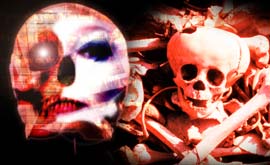
Halloween, Samhain, El Día de Los Muertos, All Saints' Eve. Call it what you like, it's still the last day of October and always a good excuse for a party - but why? Samhain (pronounced 'sow-in') was the end of the Celtic year, and like all good new-years-eves a good excuse for a party and get-together. However this was more than just a good time together. It was of major importance to the Celts. Samhain marked the end of summer and the start of the cold, dark winter and was a day when the druidic priests of the Celts belived that the dead could come back to the earth and cause trouble for the living. To counter this, the druids built large, sacred bonfires to chase away the dead and for the people to sacrifice possessions and food to the Celtic gods. It was also believed that if you lit a new fire in your house, from the embers of the sacred bonfire, that no evil could enter your house, whilst the fire stayed lit. Roman additions When the Romans invaded the British Isles they added their own customs and traditions to those of the Celts. Two of the most notable were
the celebration of Feralia - the Roman comemoration of the dead and the day of honour for Pomona, goddess of fruit and trees. Feralia was held on a day in late October or early November, so tied in with the existing Samhain festivities and beliefs. Whilst Pomona celembrated the harvest with her fruit - the apple. A possible reason for 'bobbing for apples'. Church connection As Christianity took hold of the Celtic world, the church took many of the existing pagan festivals and re-invented them as Christian holidays and celebrations. In the 7th Century, Pope Boniface IV dedicated the Pantheon in Rome to the Virgin Mary on 13 May. This holiday was then changed to 1 November by Pope Gregory III and the Pantheon rededicated to the honour of 'All Saints in the Vatican Basilica', as an attempt to remove the Samhain festivals from the Celtic calender. Later, in the 11th Century, 2 November was made 'All Souls' Day' - a day of honouring the dead. Celebrated in the same manner as Samhain, with bonfires, parades, costumes and feasts. The whole celebration now lasted three days, from 31 October to 2 November and was known as Hallowmas. Feature by Adam Flett and Mark Robertson | 








 Hear the latest news bulletin from BBC Radio Cumbria.