| Could this be Paradise ? | |
| 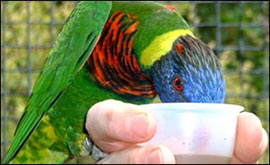 | | The Rainbow Lorikeets make use of the visitors at feeding time |
| | With over 200 bird varieties to see, an assortment of shows and the chance to feed Rainbow Lorikeets straight from your hand, Paradise Park literally is 'paradise'.
It is a day out which is simply not to be missed! |
| | | The family run park opened to the public in 1973 with just 70 birds, which now boasts over 650 from over 100 species.
The idea for Paradise Park came from founder, Mike Reynolds who wanted to create a place which could be home to his growing collection of birds.
Originally from Kent, Mike Reynolds enjoyed many holidays in Cornwall, but it was only at the age of 40 that he decided to give up the rat-race in london and search for a suitable place to open a bird park.
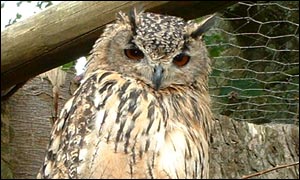 | | There are a stunning variety of owls to be seen |
When he found Glanmor House in Hayle was for sale, it proved to be the perfect place. Mike decided to uproot his family, get out of the rat-race and relocate to start his dream and as they say, the rest is history...
29 years on, the Park is now run by Mike's son and daughter, Nick Reynolds and Alison Hales.
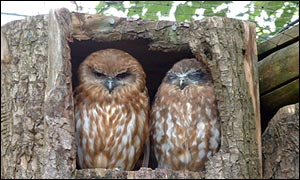
Two owls huddle up together |
Alison estimates that around three million visitors have visited Paradise Park in the 29 years it has been open.
She now hopes that the influx of people coming to Cornwall to visit The Eden Project, will also carry on down to Paradise Park.
Stretching over 14 acres of sub-tropical gardens, the Park has much to see and do.
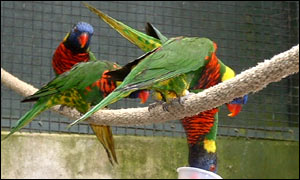
The Lorikeets shriek loudly trying to reach the nector |
Feed the Rainbow Lorikeets during Flight of Rainbows at the Australian Aviaries. If you buy a pot of nectar the Lorikeets will feed from your hand. If you are lucky, you may end up with several of them clinging to you!
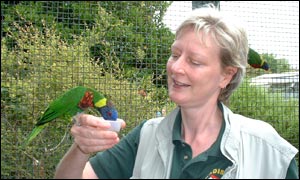
Co-director of the Park, Alison Hales with a Rainbow Lorikeet |
The birds come screeching out of their enclosure, landing in the trees or clinging to the cages, searching for the little nector pots that the visitors are holding.
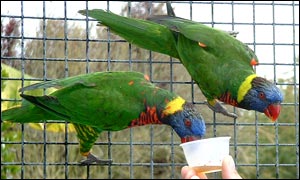
The Rainbow Lorikeets wait for the nector to come to them |
| | | |
|
|