| |
| 疑难解答 | |
 | | | | | | | |||||||||||
| | ||||||||||||||||
The History of the Game Part 2 足球历史第二节 | |||||||||||||||||
In this second part of our special history of football, we examine the grim 残酷的 history of violence in the world's most popular game. As we saw last week, football has always been a violent affair 运动/活动 in which players have occasionally been killed. But the violence that has plagued 充满/充斥 the professional game has generally taken place off the pitch. In the early days of soccer, English fans occasionally attacked the opposition side's players, or the referee. But in Glasgow, hostility 敌视 was often directed towards the other team's fans and there were a number of riots and pitch invasions 冲入球场 before 1910. A writer in the Glasgow Examiner at the time stated that although these fans dressed like gentlemen they didn't act like them. He compared the fans to drunken cannibals 喝醉了的食人动物.
Football hooliganism 足球流氓 in England increased after the railways made it easier for fans to travel to away matches 客场比赛. From the late 1960s, British hooligan firms 有组织的足球流氓社团 launched pitch invasions, tore up seats and threw bottles. Many hooligans went to matches carrying weapons and looking for a fight. The nadir 最低点/最糟糕的一次 of British hooligan violence was undoubtedly reached in 1985. In March, Millwall fans clashed 发生冲突 with police and Luton supporters. On 11 May, riot police were called in to stop fighting between Leeds and Birmingham City fans. That day, 96 police officers were injured and a 14-year-old boy died. Then on 29 May, 38 fans died in an event known as the Heysel Stadium disaster, in which Liverpool fans attacked Juventus supporters, many of whom died after a wall collapsed. After this incident, English clubs were banned from European competitions until 1990. So why does hooliganism occur? Some sociologists 社会学专家 link the increase in football violence in the UK to the decline 下降 of traditional manufacturing work. Whereas young men used to take pride in their work, they began to identify 认同 more with their team and firm. Clashes with opposition sides were opportunities to demonstrate their masculinity 体魄/刚毅 in a society which attached less and less importance 其重要性被看得越来越淡 to physical labour. Fortunately, British football violence has decreased in the last ten years. But even today, foreign visitors to UK football matches may be surprised by the segregation 分隔 of fans onto different buses and trains and into different pubs after the game. You are likely to see a heavy police presence 大量的警察出动 with many mounted officers 骑马的警官.
As the scourge 灾难 of hooliganism has declined, there has been an increase in violent threats against players and referees. Occasionally, things go further than threats. In 1994, Colombian defender Andrés Escobar scored an own goal 将球(误)射入自己的球门 in a World Cup match against the United States. Shortly after this slip 疏忽, Escobar was shot and killed in what many people view as a related incident. But could a whole war have been caused by a football match? In 1969, tensions between the neighbouring countries of Honduras and El Salvador had been simmering 孕育 for some time, but they reached boiling point during a three-match series of qualifiers 资格赛 for the 1970 World Cup.
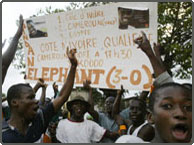
In his book, 'The Soccer War', Ryszard Kapuscinski describes the second match, held in El Salvador. Instead of raising the Honduran flag before the match, the Salvadoreans raised a tattered dish rag 破烂的洗碗布. A four-day war between the two states began two weeks later. The football matches were not the real cause of this war but they certainly aggravated 加重了 a tense situation. Football, then, has a bloody 血腥的 history. But it can be a means of peace as well as violence. In 1914, Britain and France were at war with Germany. The two sides were dug into long trenches 壕沟 with a no-man's-land 无人区 in-between. With Christmas came a unique and unrepeated moment of harmony. The soldiers put down their guns and went into no-man's-land to exchange gifts, sing songs, and yes, play football. More recently, football has helped unify countries where there has been internal conflict 内部冲突. The people of South Africa united behind their sports teams after apartheid 种族隔离. Some people also believe the Ivorian football team has helped unite a nation that was torn by civil war 内战.
The organisation Football 4 Peace uses football as a tool for reconciliation 和解 both in Israel and Ireland. A different charity, Goal 4 Africa, is trying to harness fans' passion 利用球迷的热情 for the game to raise money for African children in the run-up to next year's World Cup. Football will continue to be an instrument of both violence and peace, suffering and joy. | 相关内容  The History of the Game Part 1 足球的历史第一节 The History of the Game Part 1 足球的历史第一节2009年6月08日 | 英语教学 Learning English Chelsea Lift FA Cup 切尔西夺冠足总杯2009年6月01日 | 英语教学 Learning English Sad Day for Newcastle 纽卡斯尔惨痛的一天2009年5月26日 | 英语教学 Learning English United Make It Three in a Row 曼联创造三连冠2009年5月18日 | 英语教学 Learning English Sulky Stars 球星发脾气2009年5月11日 | 英语教学 Learning English Ronaldo Out, Ribery In? 罗纳尔多让位里贝里?2009年5月05日 | 英语教学 Learning English Profile: Ryan Giggs 档案:瑞恩•吉格斯2009年4月27日 | 英语教学 Learning English Pitch Woes at Wembley 温布利草地献丑2009年4月20日 | 英语教学 Learning English | ||||||||||||||||
| |||||||||||||||||
| |||||||||||||||||


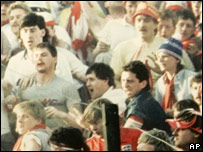
 …the most of them are at any rate dressed like gentlemen. I am afraid the resemblance ends there. A worse exhibition than these gents favoured us with has never been given in Scotland. It was worthy of a band of drunken cannibals.