| |
| 疑难解答 | |
 | | | | | | | |||||||||||
| | ||||||||||||||||
The History of the Game Part 1 足球的历史第一节 | |||||||||||||||||
In a special series for Off the Pitch, we take a look at the rich and varied 多样化的 history of the world's favourite game. Anyone who has ever seen something small and round in the street and been seized by a sudden impulse 被一种冲动所驱使 to kick it must appreciate the inescapable 难以回避的 attraction of football. So it comes as no surprise to learn that ball-kicking games developed spontaneously 自发的 in many cultures around the world. In China, there is evidence of a practice called cuju (蹴鞠). Thought originally to have been designed for military training, the game began to be played more widely during the Han Dynasty 王朝/朝代. It was often played within the imperial palace. During the Tang Dynasty cuju evolved 演变 into a game not dissimilar to modern soccer, with two teams of between 12 and 16 players trying to score goals with a feather-stuffed 装满了羽毛的 ball. However, the game continued to develop and by the Song Dynasty matches were won or lost by the accuracy of passes rather than scoring goals. The game died out 消失 in the Ming Dynasty.
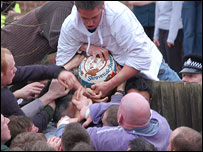
In these games, the ball could be carried, kicked or thrown and the players would violently grapple 扭打/格斗 with one another. Entire villages, including women and children, competed against each other, the object 目标 being to get the ball into a goal located in the opposition's village. Crowds of villagers would form enormous scrums 簇拥/拥挤 in roads, fields and ditches 水沟 to try to gain possession of the ball. Sometimes folk football was played within a single village. These contests would often pitch 对阵 unmarried against married players.
A chronicler 编年史家 in Cawston, Nottinghamshire, described the act of dribbling 带球 the ball at one of these games, writing that players would move forward or "propel" the ball with their feet. The violence of folk football puts modern football hooliganism 足球流氓 in the shade 把…置于次要位置. In his book 'Signification du Sport' Michel Bouet says the players of the French version of this game were "like dogs fighting over a bone." Sometimes people were killed during the games and property was frequently damaged. In England repeated attempts were made in the 14th century to ban football, but they failed. In 1605, Shakespeare's character the Earl of Kent in 'King Lear' calls an enemy a "base football player", base meaning very bad, dishonourable.
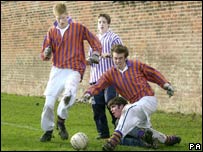
Despite these origins the game of football was slowly becoming gentrified 上流化. By the time Shakespeare wrote 'King Lear', young gentlemen attending English public schools 贵族学校 were playing versions of the game. These schools, which included Eton, Rugby and Aldenham, began to codify 使…规则化 the sport, developing new rules, such as the off-side 越位 rule. Each school developed football rules which suited its own grounds 场地 and the tastes of its students. So while at Rugby and Marlborough the ball was carried, it was kicked and dribbled at Eton and Harrow. After the coming of the railways in the 19th century, it became possible for schools to compete against one another. But how could games be played when nobody could agree on the rules? The solution was to divide football games into two. One half was played by the rules of the host school and the other by the visitors’.
1863 saw the inaugural meeting 成立大会 of the Football Association which then published a set of rules called 'The Laws of Football'. Although some rules now seem odd (it was possible for players to catch the ball, for example), this was the beginning of the modern sport of associated football. The word 'soccer' is an abbreviation 缩写 of 'associated'. Other variations on public school football resulted in the development of rugby and Australian rules football. Soccer has not really been welcomed by public schools. Today boys at these very old schools still play that school’s original take on 原始的形式 football. And anarchic 无法无天的,混乱的 games of folk football are still played in a handful of 为数不多的 British towns once a year. | 相关内容  Chelsea Lift FA Cup 切尔西夺冠足总杯 Chelsea Lift FA Cup 切尔西夺冠足总杯2009年6月01日 | 英语教学 Learning English Sad Day for Newcastle 纽卡斯尔惨痛的一天2009年5月26日 | 英语教学 Learning English United Make It Three in a Row 曼联创造三连冠2009年5月18日 | 英语教学 Learning English Sulky Stars 球星发脾气2009年5月11日 | 英语教学 Learning English Ronaldo Out, Ribery In? 罗纳尔多让位里贝里?2009年5月05日 | 英语教学 Learning English Profile: Ryan Giggs 档案:瑞恩•吉格斯2009年4月27日 | 英语教学 Learning English Pitch Woes at Wembley 温布利草地献丑2009年4月20日 | 英语教学 Learning English England Set To Qualify? 英格兰出线有望?2009年4月14日 | 英语教学 Learning English | ||||||||||||||||
| |||||||||||||||||
| |||||||||||||||||



 The game at which they had met for common recreation is called by some the foot-ball game... It is one in which young men... propel a huge ball not by throwing it into the air but by striking it and rolling it along the ground, and that not with their hands but with their feet.