



 | | | | | | | |||||||||||||||||||||||||||||||||||||
| | ||||||||||||||||||||||||||||||||||||||||||
|
Haiti: six months on | ||||||||||||||||||||||||||||||||||||||||||
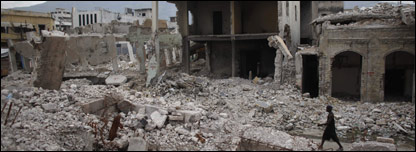
Many Haitians, when they speak of the earthquake, refer only to "before". Before they lost, in 35 seconds, so much - friends, family, homes, schools, churches and their visions of the future. What happened in the capital, Port-au-Prince, on 12 January was a disaster of a magnitude that would have set any country reeling. More than 222,570 people died, 300,572 were injured and at one point a staggering 2.3 million - nearly one quarter of the population - were displaced. The government lost thousands of civil servants and most of its key infrastructure was destroyed. Diaspora response Today, as foreign aid trickles in, it is from the Haitian diaspora - relatives abroad - where much of the support is sought. Michel Philistin, is the financial brains behind the British-based United Haitians in the UK (UHUK). Although retired, Mr Philistin's British pension financially supports entire families who have moved into the house of his grandson in Haiti which was still standing after the quake.
Mr Philistin told BBC Caribbean: "Every month, my grandson, he's been phoning. We have a word in creole 'ticob'...l'argent.....I mean money. He always want something so obviously I have to give. I am retired now but I have to keep him going so I have to share what I have with them." Myrian Breton Jones is the PR consultant for UHUK. "Billions were pledged but only less than one per cent was received so we have to put that into context," Ms Breton Jones told BBC Caribbean. "Haiti can't rebuild itself yet. Until all of that money is received...Haiti can't rebuild itself." American visas In the US, where the largest Haitian diaspora live, the emphasis is on allowing displaced Haitians to stay. Six months on, advocacy groups in the US are lobbying the US Immigration Department to allow quake victims to remain in the country. Following the disaster that claimed an estimated 200,000 lives, the Obama administration announced that all undocumented Haitians who were in the US on 12 January would be allowed to remain for 18 months without the threat of deportation. Under the programme they are required to register with the immigration department by 20 July.
However the new migrants do not qualify and will therefore have no access to social services or employment. They entered the US on a visitor’s visa and are only allowed to stay for six months at a time, at the end of which they can apply for one extension at a cost of $300 per person. Director of the rights group, Haitian Women for Haitian Refugees, Ninaj Raoul, says that’s a major setback for her organisation and the new migrants. Not able to work “I have family members there were six of them in one household so that was $1800 that my cousin had to pay just to extend their visas for six months. “You don’t have permission to work, so you’re not working, you’re not eligible for any benefits here. It’s a big struggle and a strain on the families who take them in,” Ms Raoul told BBC Caribbean. She added that advocacy groups are lobbying for some concession from the immigration authorities for earthquake victims. “I would want them to extend at least Temporary Protected Status immediately to the earthquake victims, even if the cut off date has passed … at least it would take care of the people who are already here. “It’s not going to be an ideal situation but at least allow them to work and support themselves. Some people don’t feel comfortable where they are, some have been kicked out from where they are,” she said. Aid concerns Another concern for Haitians in New York is an apparent lack of progress in reconstruction efforts. As the diaspora in New York marks the six month anniversary, many remain concerned that millions of dollars in promised aid has not reached the country. Hervey Coty, who hosts a weekly community television programme in Brooklyn, told BBC Caribbean that he visited Haiti in May and he was not satisfied with the work of the aid agencies in Port-au-Prince. He also believes that Haitians should try as much as possible to be self reliant. “I always say that each individual Haitian they’re supposed to take their own responsibility to rebuild the system. If they’re going to wait for the NGO or the big countries or the government, forget about it,” Mr Coty said. But while some Haitians may not have much confidence in the aid agencies at the moment, other smaller groups are continuing to work on their behalf. Last week the Grenadian organisation, Grencap, donated over $10,700 dollars to the Adventist Development and Relief Agency (ADRA) a charity working in Port-au-Prince. ADRA representative Derris Krause said they are now building 2500 new hurricane- proof homes for quake survivors - a gift that will no doubt be welcomed by the survivors, the majority of whom are still sheltered in tents, with fears of even more destruction and loss of life, should a storm strike during this hurricane season. Rebuilding back home? Back in Port-au-Prince, humanitarian needs are still acute. More than 1,300 camps remain, housing 1.5 million people. The response there delivers water to 1.2 million people daily, maintains 11,000 latrines and ensures that basic medical healthcare is free for all survivors. Mass starvation was averted and perhaps most significantly there has been no outbreak of disease in the camps. For Prospery Raymond, who heads the Haiti office of the British charity Christian Aid, a key issue is getting land to first clear and then begin the rebuilding process. "There are some problems with the land. It is the state and the church which own most of the land in Haiti," he told BBC Caribbean. "And we are trying to challenge them in order to get land for poor people. "This is a decision that a NGO cannot take. It is the state whch has to take up the decisions. "It is really important and we don't have this from the government." |
EXTERNAL LINKS The BBC is not responsible for the content of external internet sites | ||||||||||||||||||||||||||||||||||||||||||
| |||||||||||||||||||||||||||||||||||||||||||
 | |||||||||||||||||||||||||||||||||||||||||||



 Laughter the best therapy for Haiti's children