



 | | | | | | | |||||||||||||||||||||||||||||||||||||
| | ||||||||||||||||||||||||||||||||||||||||||
|
Petrocaribe deal questioned | ||||||||||||||||||||||||||||||||||||||||||
Venezuela's Petrocaribe oil deal with several Caribbean states - and other similar arrangements elsewhere by President Hugo Chavez - are coming under fire in some quarters. Under these arrangements, Venezuela, through its state oil company PVDSA, provides oil on concessionary terms to client governments. The oil-on-preferential-terms package has been welcomed by the participating Caribbean governments. The United States has already cast doubts on its sustainability and has said President Chavez is using it to gain political leverage in the region. Now one of Brazil's leading business publications is also raising questions about Petrocaribe. Petro-charity? In a report in which it quotes a number of experts, the Brazilian business publication Valor says Petrocaribe and its sister arrangements are already affecting the business strategies of other international oil companies in the region. It says Mr Chavez is using state resources to open up a business front in which profit-making is giving way, to what Valor calls a policy of "petro-charity". Valor estimates that in the Caribbean alone, the agreements should provide revenue to Venezuela amounting to 1.6 billion dollars annually to supply nearly 220,000 barrels of oil a day to the region.
However it says that calculation, made by the international energy consulting firm Cambridge Energy Research Associates (Cera), is conservative, because it considers the price of a barrel to be 50 dollars. Valor also says that Venezuela's strategy also includes the direct use of the money from oil to buy political sympathy. It quotes Luiz Alfredo Salomao, managing director of the School of Public Policies and Government at Rio de Janeiro's University Institute of Research as saying " while the objective appears to be to assemble a bloc of allies to create difficulties for the United States, the actions are not sustainable and sooner or later with a drop in oil prices, that will end." When President Chavez took over the government, a barrel of oil cost 9 dollars, compared with the current 70 dollars. In the opinion of Adriano Pires, from the Brazilian Centre for Infrastructure (CBIE), "the greatest problem caused by the Venezuelan policy is that it creates unfair competition in two areas: in the economic and political sectors." Enrique Sira, of Cambridge Energy Associates predicts that in the medium and long term, the Venezuelan expansionist policy in the region could be a failure. "In a scenario of low prices, and without raising production, it will be difficult to back the agreements that PDVSA, the Venezuelan state oil company, has been signing with the countries of the region", he said. | |||||||||||||||||||||||||||||||||||||||||||
| |||||||||||||||||||||||||||||||||||||||||||
 | |||||||||||||||||||||||||||||||||||||||||||


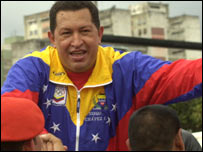
 Venezuela's strategy also includes the direct use of the money from oil to buy political sympathy.
 Archive