| see also | |  | | Cambridge Film Festival
Check out the who, the why and the what...
Audio interviews with Peter Greenaway
Hear the man in his own words...
| | | | internet links | | | | The Tulse Luper Suitcases
Go to this site. We can't tell you anymore...
Greenaway
Art-work, exhibitions and more...
Greenaway
The man and his mind...
More on Greenaway
Born, bred and biog stuff...
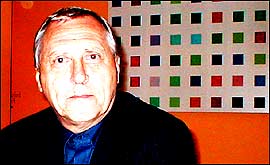
The BBC is not responsible for the content of external websites. | | | | facts | | | | Sitting in B bar in Cambridge we challenged Peter on the extreme audience reactions to his work from love, to hate to (alleged) suicide. "Well, we have a man sitting out on the verandah here called Mr Cox who said I was the 'worst film maker in the world'". [Smile] Director Alex Cox (Repo Man, Sid & Nancy, Revengers Tragedy...) delivered a keynote address at The Cambridge Film Festival looking at current film policy in the UK!
Other film credits for Peter Greenaway include:
A Zed and Two Noughts The Belly of an Architect
The Cook, The Thief, His Wife and her Lover
Prospero's Books
The Baby of Macon
8/12 women
Daddy's Girl
Drowning by Numbers The Draughtman's Contract
Despite the enormity of the project, despite heading up a production crew the size of a small country and despite the often violent reaction to his work Peter confided that he does sleep well at night. Very well!
| | | | print this page | | | | View a printable version of this page | | |
 |
| | "...it's a social and political manifesto about the future of cinema." | Greenaway on Tulse Luper |
The Tulse Luper Suitcases Part 1: The Moab Story marks a new phase in film artist, Greenaway's prolific life. The first of a magnificently large-scale multi-media project encompassing film, television, books, a play, the internet and an eventual collection of 92 DVDs, each filled with the contents of one of the suitcases that adventurer Tulse Luper (JJ Field) packs on his travels.
LUPER explodes with multiple possibilities, the screen divided into squares, the soundtrack fragmented with competing commentaries, other films and casts (through audition clips), mixed into these busy frames. It's a whirlwind ride that confounds, stupefies, astounds and is way beyond the usual tools you call on to decode a film.
|
You're here in Cambridge for the UK premiere of The Tulse Luper Suitcases - can you tell us all about it?
Well I think, without wishing to be blasphemous to those people who are still nostalgic about European arts cinema, in a way, the film's only an excuse to promote the website.
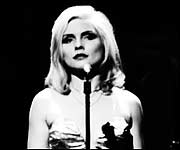 | | Deborah Harry features in The Tulse Luper Suitcases Part 1: The Moab Story |
Now that does sound heretical, because, up until now, the ancillaries were always regarded to support the feature, but I hold some pretty blasphemous ideas about the notion of cinema anyway, because I sincerely believe that cinema is dead. It's not really a radical experimental area for activity anymore. To paraphrase the old French notion about royalty, the cinema is dead, long live the cinema.
So, I think that it's imperative that film makers, film practitioners, film journalists, should really seriously grab the nettle and find new ways to reinvent this extraordinary medium that once upon a time used to be called cinema. The technological revolutions are pretty obvious. Celluloid cinema is essentially dead, no self respecting film maker really films on celluloid anymore.
There are new audiences, certainly there are audiences related to, I suppose 14-30, who have essentially grown up with a computer, that strange marriage of a typewriter and a television screen. Which means interactivity, which means choice, which means not going to those strange architectural places like this [Arts Picturehouse] called cinemas anymore, so these places are entirely redundant.
"I'm against illusionistic cinema; the notion of a window on the world, and I regard cinema as being an incredible artificial phenomenon, and not a form of escapism..." | Greenaway on cinema |
So there are many, many, many, many political and social things we have to do, but we also, of course, have to make product for it and I'm beginning to want to make a multi media project, which isn't just related to cinema screens, but I suggest that films really are an investment for everything else. I don't want to give up the old audiences, that would be stupid. But I need to make an embrace to those who have grown up essentially with a lap top. Circumstances, audiences, attitudes, perspectives have moved on and if we really want the notion of the moving image to live, then we've got to move with it too.
This project is not just a series of films, I hope it will be deeply fascinating and intriguing. And hopefully profound as well. But it's also a manifesto, it's a social and political manifesto about the future of cinema.
Tulse Luper, the main guy in your movie, is your alter-ego?
When I was about 14 or 15, I'd have been far too shy to talk to you through a microphone in a situation like this. And so I think, maybe of children much younger, in order to express yourself, you would invent some alter ego. Somebody who has a license like a Court Jester to say things that you never dare to say in public yourself.
Well, I've learnt now how to conduct myself in public, so things are a little better. But I still like this particular concept and idea because I think that all culture probably does this is some strange way. If you go back to the most simplistic version of it, when you were a small child at the breakfast table and you knock over the milk and you'd say 'oh I didn't do it, my friend did it'. And if the parents are very wise, they enter into the conspiracy too, because that's how things get done. There was also a way that Tulse Luper peopled a lot of my early films. Along with his mistress's and his wife's and his associates and his academic enemies. So I have resurrected them all, plus a lot more, in order to revitalize a personal mythology and hopefully make it an entertaining public mythology.
What's your next project? Where could you possibly go from here?
Well, we've just finished film one, it's being premiered, I suppose in about five screens in Festivals all over Europe - we started with Cannes and we've just come back from Moscow.
It hasn't yet been seen by a so-called distribution public audience, I think that happens all over Europe in September and October. We've shot most of the second film and we're now editing it. We're about to shoot a lot of the third film, and maybe more.
We are a huge co-production organization which involves Hungary, Russia, Spain and Italy, the Benelux countries and Japan. There are going to be versions of the film for all these different countries, because if you've seen the film you'll know that it's about language and it's about text and it's about what is narrative and how does everybody perceive the notions of different sorts of narrative.
One of the main metaphors of the production is that there's no such thing as history, there's only historians. So I want to be able to tell you my story many, many different ways. And there are, in the very least, 92 stories in every accordance in every event. So you can image 92 X 92 becomes one of the methodologies that we need to be able to work with.
And again if you have seen the film, you will know that there are 92 suitcases. Every suitcase contains 92 ideas or objects which or phenomenon. Philip Glass is already working on an opera based upon the contents of suitcase 32, we have a Tokyo soap television series on the contents of suitcase 49, and we've just had a play on in Frankfurt about the contents of suitcase 46...so every single suitcase itself will spawn another project...
And with that, the man who stirs passions so deep they hurt, was off. Charming, elegant and profound, Peter Greenaway delivered his doctrine on the future of film with wile, wit and a
wicked grin... |

|