Learn about ladybirds

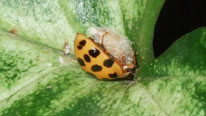
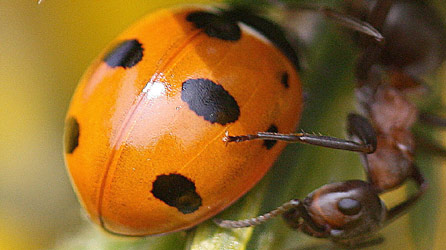
Scarce 7-spot ladybird and ant, courtesy Ken Dolbear

Information about the 46 different ladybirds in Britain: Identification | Lifecycle | Natural enemies | The harlequin ladybird


Get clued up about ladybirds

Breathing Places would like you to turn over leaves, roll back stones and peer inside window frames in the hunt for ladybirds.

Populations of some native UK ladybirds are in decline, possibly due in part to an invasive newcomer - the harlequin ladybird.

Do One Thing for nature and learn about ladybirds - the different types, their lifecycle and natural enemies.

Read on for how you can encourage ladybirds into your wild spaces and take part in the UK Ladybird Survey.

Ladybirds in Britain

Ladybirds (sometimes called ladybugs) are beetles. There are 46 different types in the UK, but only 26 look like a classic ladybird, brightly coloured and patterned.

Many species are named after a number of spots. 2-spot, 7-spot and 10-spot ladybirds are all common. Counting the spots is not always a good way to identify them though, as the number of spots can vary a lot.

Not all ladybirds even have spots; some have stripes, patches or streaks.

What kind of ladybird is that?

If spot number alone isn't a good indication, what else is? Here are useful characteristics to observe:
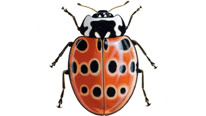
Eyed ladybird artwork, courtesy RSPB ©Chris Shields
  • Wing case colour
  • Colour and shape of spots or markings
  • Leg colour
  • Body length
  • Colour of the pronotum - the small section of casing between the head and the wing cases. (It's black and white in this drawing of an eyed ladybird.)

Breathing Places' ladybird partner, the Centre for Ecology & Hydrology, has an interactive online Ladybird Spotter application to help you identify different types.

Ladybird lifecycle

A ladybird's lifecycle has four stages: egg, larva, pupa and adult.
  • Egg - Ladybirds lay eggs one or more times a year (species vary), in batches of up to 40. They are yellow or orange and will hatch within 4-10 days.
  • Larva - The larvae vary in colour and markings. Many are grey with mottled spots but yellow, buff or brown larvae are also found. A larva sheds its skin four times over a 3-6 week period, before attaching itself to a leaf or stem and becoming a...
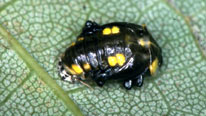
  • Orange ladybird pupa, courtesy Mike Majerus
  • Pupa - The sleepy pupal stage (photo right) usually lasts up to two weeks. A lot is happening inside - the ladybird is going through metamorphosis.
  • Adult - Newly emerged ladybirds are bright yellow. Over the first few hours, the wing casing hardens and the distinctive colour patterns develop.
  • Natural enemies

    Threats to ladybirds include predators, parasites and rival ladybirds.

    Most other animals find that ladybirds taste terrible. The bright colour acts as a warning. They also 'bleed' an unpleasant substance when attacked.

    Parasitoid harlequin ladybird, courtesy Francis Bakos

    Birds such as swifts and swallows do eat ladybirds, as do some spiders and beetles.

    Parasites attack ladybird pupae and adults. You can investigate this if you take part in the UK Ladybird Parasite Survey.

    When aphid (greenfly) populations are high, they supply ample food for hungry ladybirds. But in colder months, food is less abundant and ladybirds must compete for food. Sometimes ladybirds attack each other - harlequin ladybird larvae are known to eat other ladybird larvae, pupa or eggs.

    Harlequin ladybird

    Harlequins were introduced into mainland Europe from Asia, to control plant pests. They appeared in Britain in 2004, and seem able to thrive here, possibly outcompeting some native ladybird species.

    They can be difficult to identify as they have many forms - including orange with up to 21 black spots, and black with two or four red spots.

    Do One Thing for ladybirds

    Join the Breathing Places 2010 Do One Thing and tell us what native and non-native ladybirds are up to in your local area.

    There are two surveys you can join in with: the UK Ladybird Survey and the UK Ladybird Parasite Survey.

    Or revisit the summer activity from 2008 to make somewhere near you into a minibeast home for ladybirds and other tiny wildlife.

    Success Stories

    quarry and lakeWest Kilbride Green Centre

    The transformation of a disused quarry into a thriving nature haven.

    children pond dippingSt Johns Primary School, Jersey

    Creating an amazing wildlife area in the schools grounds.

    Elsewhere on Breathing Places

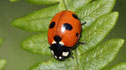
    Scarce 7-spot ladybird, courtesy Ken DolbearWildlife surveys

    Help science and make Britain an observation nation

  • Ladybird Survey
  • More surveys you can do any time

    Elsewhere on the web

    BBC Springwatch blog - Ladybird quizBBC Wildlife Finder - Ladybird info and videoThe Royal Society - Ladybird life in LondonBuglife - All about bugs

    More from Breathing Places

  • Home
  • Places to go
  • Nature activities
  • SchoolsDownloadsAbout usPartners