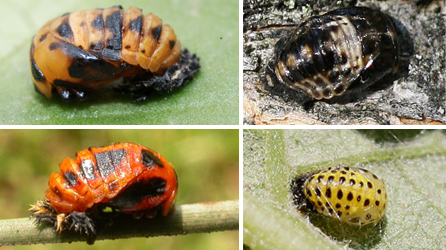
Watch a ladybird pupa hatch when you join the parasite survey. What will emerge?
UK Ladybird Parasite Survey
Scientists at the Centre for Ecology & Hydrology (CEH) and University of Cambridge are working together to better understand the natural enemies that attack ladybirds. They would like your help.
This Ladybird Parasite Survey is different to the UK Ladybird Survey and is an investigation that lasts about two weeks. To take part you need to:
There are also helpful guides and teacher resources you can download and print.
Read more about ladybird pupae and their lifecycle.
Find a ladybird pupa
Look around on the leaves of broad-leaved trees, conifers and low-growing plants. If you protect yourself properly, stinging nettles are worth checking too.
Record the date you find the pupa as well as notes about its location and the surroundings:
Collect the pupa
Avoid touching the pupa and don't pick it off its leaf or stem. Instead, cut off the leaf or plant stem.
Back indoors, trim the plant cutting to about 2cm in size.
Place it and the pupa (face up and visible) in a container with a lid that you can see clearly through. (Cling film over a yoghurt pot is fine.)
Do not make any airholes - they're not needed and the tiniest parasites may escape.
Take a close-up picture of the pupa.
Put the container in a light place at room temperature - avoid direct sunshine and too much heat.
Observe how it develops
Check the pupae every day to see what is happening. Lift the lid so fresh air gets in.
If the pupa turns into something else, note the date when that happens.
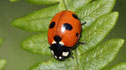
A healthy ladybird pupa will become a ladybird within about two weeks. If that happens, use the interactive Ladybird Spotter to identify the type it is. Take a second picture.
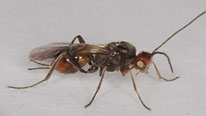
If the pupa was attacked by parasites, something else may emerge instead of a ladybird. The size and number of parasites gives a strong clue what they are.
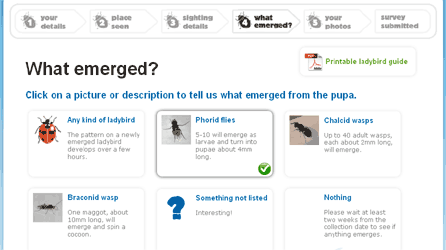
Phorid flies are tiny and develop from maggots about 4mm long that emerge from the pupa. You should see 5-10 emerge.Chalcid wasps are 2mm long. Up to 40 adult wasps are likely to appear.Neither of the wasps can sting you.
Take a photo of the parasite.
You may find that nothing happens to your pupa. For some reason, the ladybird has failed to develop. Good science relies on collecting all relevant data so please report this outcome to CEH anyway. There's no need to take a second photo of the pupa, unless it looks different.
Release whatever emerges
Anything that emerges from the pupa is part of nature. Once you have recorded and photographed it, you must release it back into the wild.
If you cannot return to the place you collected the pupa, try to find a similar habitat.
Report your results
Once you have the results of your experiment, it's time to send your data to the Ladybird Parasite Survey scientists.
Each pupa needs to be reported separately.
Check you have: