Pontefract Castle is certainly something that Cromwell's soldiers knocked about a bit. During the English Civil War it was held by the Royalists throughout three sieges and was the last royal castle to fall to the Parliamentarians. Today, although a scheduled ancient monument in the care of Wakefield Council, it is still the property of Her Majesty The Queen as part of the Duchy of Lancaster. 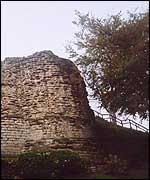 | | The Keep of Pontefract castle as it is today |
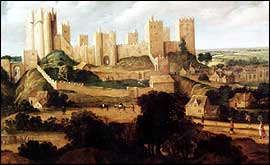
The history of Pontefract Castle begins with the Norman Conquest as an earth and timber fortress built by Ilbert de Lacy in the 1080s. Ilbert had come over from Normandy with William and fought at Hastings. He was rewarded with more than 100 estates in the West Riding alone and it was only natural he would want a prominent castle from which to control his estates. When a revolt against the Normans broke out in Yorkshire Ilbert was happy to "lay waste" large areas in the Conqueror's name. The castle was rebuilt in stone in the 12th century and other buildings were added as time went on. A painting in Pontefract Museum (above) shows how imposing the castle still looked in the 17th century before the Civil War. Only the cellars now remain of the Great Hall which was once the heart of the castle. As the castle was strengthened so was the power of the de Lacy family. Following very successful marriages they became Earls of Lincoln and eventually estates their were transferred to the powerful House of Lancaster. 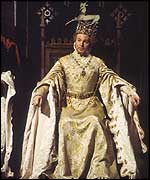 | | Derek Jacobi as Richard II from the BBC Television Shakespeare, 1978 |
While life as a foot soldier or peasant in the Middle Ages might be brutish and short, even the rich and powerful had to be careful about how they chose their friends. Thomas, Earl of Lancaster, was tried for treason at Pontefract Castle and executed on the hill adjacent to nearby St John's Priory. There were other important prisoners - James I of Scotland and Charles Duc D'Orleans (captured at the battle of Agincourt in 1415) but the most famous incarceration in Pontefract Castle has to be that of Richard II, immortalised in Shakespeare's play. In 1399 Richard was forced to abdicate by a group of barons led by Henry Bolingbroke, Duke of Lancaster. Henry imprisoned the deposed king in his fortress at Pontefract but risings in Richard's support proved something of an embarrassment and it appears that by the end of February 1400 Richard was dead, probably killed by starvation on Henry's orders. It is likely he was held in Gasgoigne Tower, also known coincidentally as the "red" tower. 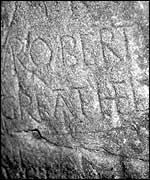 | | Robert Greathed carved his name on the wall of the castle magazine in 1648 while he was a prisoner there. |
The most immediate link the castle has with the past is the underground magazine. Originally the cellars of the Great Hall (part of today's magazine date from the 11th century) this area was used as a military store and during the Civil War as a prison. The Royalists held the castle though three sieges and prisoners carved their names into the magazine's walls. Although one prisoner, unsure of his fate, even carved gallows therel, they were eventually returned to their own side. Surviving written records tell us a bit more about some of these men. Robert Greathed, a captain, pretending to be his brother and a private soldier, bought himself out while Robert Brear asked if he could take a couple of days to sort out some private affairs. Castle custodian, Steve Coulson, says Brear is the only person ever known to "escape" from Pontefract Castle. Perhaps their fellow prisoners were less cunning. Having defeated the King's supporters Cromwell was determined that castles - far too handy for anyone planning a rising - should, where possible, be reduced to rubble. But the history of Pontefract Castle did not stop there. It was used for growing liquorice and in Victorian times was a pleasure garden and a municipal park. More recently the castle has been excavated, some of the medieval stonework restored and a Visitor Centre opened. Thanks to continual conservation work the remains of the castle stand as a reminder of the glory that was once Pontefract's. Pontefract Castle | | | | Pontefract Castle |
|