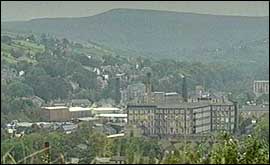
While at its beginning at least, World War One may have been popular, it might be said to be a different story in at least one West Yorkshire town. In Huddersfield there was a significant number of conscientious objectors, men who fought hard not to go to war. 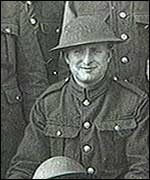 | | Arthur Barraclough as a young soldier |
Arthur Barraclough was one of the thousands from West Yorkshire who willingly volunteered, signing up in Bradford as a teenager. He says: "I was proud to be an Englishman. If you played football or rugby you were a sportsman, and if anything like this came along you'd go without argument, but if you were a yellow-belly you'd do anything to get out of it." But "getting out of it" wasn't an option in 1916 when mass conscription was introduced for the first time. More men were needed for the front line and tribunals were set up around the country to see why some were unable or unwilling to join up. Cyril Pearce, a lecturer at Leeds University and Huddersfield resident, has uncovered transcripts of tribunal hearings held at Huddersfield Town Hall. He says: "In March 1916 one of the key figures in the war resistance movement in Huddersfield, Arthur Gardiner, came to the military service tribunal to argue his case for exemption from military service and the town hall was packed. "Remember this experience was absolutely brand-new in British history and had never happened before. There had never been conscription in Britain before, and there had never been any reason to establish tribunals to adjudicate on people's conscientious objections to it." The tribunal members were drawn from local councillors and the military authorities and they were unsure how to deal with this situation. Arthur Gardiner talked to them about his anti-war attitude in times of peace as well as in times of war. 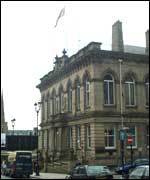 | | The military tribunal took place in Huddersfield Town Hall |
His son, Don Gardiner, says of his father: "He was used to speaking, able to express himself and had quite a sharp mind so he had prepared what he was going to say. Perhaps some of the others hadn't thought it though thoroughly. The tribunal were rather taken aback by this."
Arthur Gardiner told the tribunal: "I have no country. I realise the interests of the workers in Germany are identical to those of the workers of England. For that reason I can not march against them and I will not."
More usually the conscientious objectors that came before the tribunal were Quakers with ethical objections to killing. Cyril Pearce says: "Arthur came in with a totally different set of arguments because he felt he had more in common with working men and women throughout Europe than he had with the people in Westminster who were telling him he ought to be fighting." Gardiner was followed by a succession of other men who objected to what they saw as a capitalist war in which they did not want to have any part. 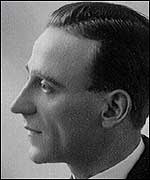 | | Arthur Gardiner |
The tribunal decided that Gardiner was a conscientious objector and he was granted exemption for two months but, at the end of this period, his appeal was rejected. He was drafted into the army with five other prisoners and they were all given a rousing send-off by sympathisers at Huddersfield Railway Station who sang the Red Flag as the train pulled away. Although Gardiner and his fellow conscientious objectors may have been seen by some of their fellow citizens as heroes, in the eyes of the authorities they were nothing more than criminals. Many of the conscientious objectors were sent to places like Richmond Castle before being shipped off to France and the front. After the war many of the conscientious objectors did have difficulty being accepted back into their communities but Arthur Gardiner went on to become mayor of Huddersfield.
More information can be found in Comrades in Conscience – the Story of an English Community’s Opposition to the Great War by Cyril Pearce published by Francis Boutle.
|