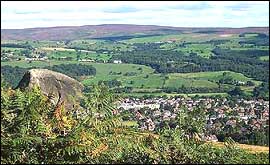
| Perhaps it is because people once came to Ilkley to take the waters that it has gained a reputation as one of Yorkshire's, and certainly Bradford's, most genteel towns. It is also the West Yorkshire town that is most obviously in the Pennines with the town rising steeply towards the moor. The Dales Way starts here - a 72 mile stroll will take you to Bowness in Cumbria. 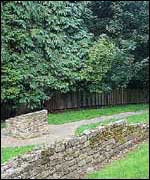 | | What the Romans did for Ilkley... |
Ilkley is an ancient town. The Romans recognised its attractions and built a fort which they called Olicana. The remains of a wall can still be seen behind the Manor House and the interpretive boards around the site might just help you imagine what life was like in Ilkley in 80AD. Burial cairns, stone circles and strangely carved rocks on the surrounding moors suggest that people inhabited these parts long before the Romans. The cup and ring marked rocks on Rombalds Moor may date from as long ago as 2800BC. Probably the most famous of these pre-historic rocks is the so-called Swastika Stone, now protected by railings with a replica in front of the original stone. Although similar carvings can be found in Italy and Sweden the meaning of the stone is yet to be explained but, you never know, the truth may be out there. 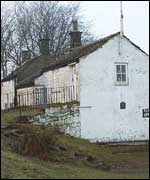 | | It is a tradition - for some - to bathe in the White Wells spa on New Year's Day. |
Despite these early visitors, Ilkley is predominantly Victorian in character. Although it is no longer possible to visit Wells House (formerly part of Bradford and Ilkley Community College and now being converted into apartments) you can still see the building from afar. This grand watering establishment, which opened in 1856, was designed by Cuthbert Broderick, Yorkshire¹s most celebrated architect. But hydropathy in Ilkley had much more modest beginnings. The first watering hole was White Wells on the edge of Ilkley Moor. In the early eighteenth century a house and a bath were built and a roof was added later. 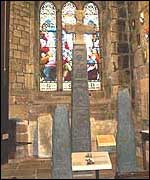 | | Inside All Saints Church |
Anyone interested in finding out more about Ilkley's "healing" waters should follow the Victorian Town Trail leaflet available from the Tourist Information Office. Saint Margaret's Church, designed by Norman Shaw and consecrated in 1879, is also worth a visit and is included in the trail. The older parish church of All Saints stands in a commanding position above the River Wharfe.The present building is largely medieval although, as is often the case, it was rebuilt in Victorian times. The first church on the site was built by the Saxons, no doubt using stone from the abandoned fort. Inside the church are three Saxon crosses decorated with carvings of dragons and other strange beasts. It is thought that such a major group of crosses may suggest that Ilkey was an important place in Saxon times. 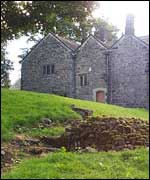 | | Ilkley's Manor House |
The church boasts a 13th century doorway, a 16th century tower, 17th pews and some fine stained-glass which gives the building a warm feeling. There is also a life-sized effigy of Sir Adam Middleton, a local landowner who died around 1320. Just a stone's throw from the church is the Manor House, now Ilkley's museum and art gallery. The origin of this building, also known as the 'castle' is lost in time, but its west wing is thought to date from the fourteenth century. In the 1950s the building narrowly escaped demolition when it was deemed unfit for occupation. Happily it has been restored and now provides an ideal setting for the display of artefacts relating to the history of the town.The art gallery upstairs plays host to an ever-changing programme of exhibitions. Stroll down the road to the River Wharfe and the New Bridge. From here you can walk along the river in either direction and get the impression you are far from anywhere. The path through Riverside Gardens leads to the Old Bridge, passing a very good adventure playground (for small children.) The bridge was built in 1675 for packhorses and marks on its side show the flood levels reached by the river at various times. Previous bridges were washed away!

| 








 Music listings