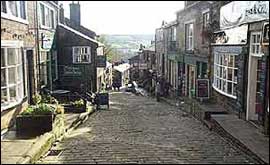
Haworth is situated three miles from Keighley and eight miles from Bradford on a hillside above the valleys cut by the River Worth and Bridgehouse Beck. You can even arrive in style on one of the steam trains of the Keighley and Worth Valley Railway. The upper and lower parts of the village are linked by the steep and cobbled Main Street with all its nostalgic appeal, made even more famous when it was used in a well-known advert , along with a boy, his bike and the largo from the New World Symphony. 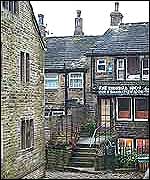 | | A quaint back alley in Haworth |
Small alleyways run off at angles off the street, leading to cottages which were once the homes of handloom weavers. Bronte biscuits, Bronte fleeces, Bronte flagstones... As Tricia Tillotson, manager of Haworth's excellent Tourist Information Centre comments: "No matter what, you can't get away from the Brontes in Haworth." There are still a few working mills in the Haworth district but it is tourism, not textiles, which is now the main local industry. Postcards and guidebooks are even produced in Japanese. 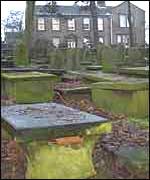 | | Haworth Parsonage from the churchyard. |
People come from all over the world to visit the Bronte Parsonage Museum - this, after all, is where all the poems and novels were written. Even today the moors, reached by a path through the churchyard, start just beyond the Parsonage. A stone marks the site of the gate which the Brontes would have used to reach the church and through which "they were carried to their final resting place." They are buried in a family vault inside the church which was rebuilt in 1879.There is a Bronte Memorial Chapel in the church and a commemorative plaque to the family.  | | New since the Brontes' day |
Thirty-thousand people are believed to have been interred in Haworth churchyard. Today this may be a romantic place but, in the Bronte's time, methods of burial here contributed to a death rate which was estimated to be over 40% higher than in neighbouring villages. The village water supply passed through the graveyard . The high mortality figure was partly due to the custom of covering graves with flat stones which slowed down the rate of decomposition. After a time the bodies would be taken out of their graves and slung into a common pit. 
|