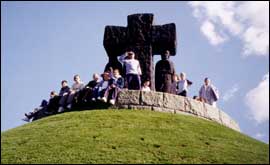
|  | The Eiffel Tower in Paris, Euro Disney, Mont-Saint-Michel...all names that trip off the tongue when when you think of the tourist map of France. But for this particular bunch of school pupils from Queensbury in Bradford, the Normandy beaches were also on the agenda in 2004.
Their languages teacher, Martine Clegg (who is French herself), said that as well as being a cool holiday in a different country, they also were going to get to see something of the reality of what it was like in 1944 when thousands of young men, some barely out of their teens, came ashore to start the liberation of Europe.
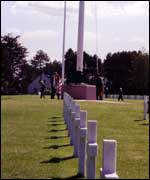 | | Martine Clegg: "I think that's quite a shock to them, when they see the crosses as far as the eye can see." |
Martine said: "It's difficult to get the point across. It's difficult to imagine the hell it must have been. Some of the film footage we see in the museum at Arromanches in Normandy brings it home. I think being there and seeing the blocks still left there brings it home. That, plus the visits to the cemeteries. I think that's quite a shock to them, when they see the crosses as far as the eye can see."
And what about the kids themselves? What were they expecting to see on these beaches which were once swarming with troops?
Bradley said he was expecting to see "trenches and unexploded bombs. Things like that."
And Olivia was expecting to come across some really tragic things: "There might be gravestones and crosses for the people who died during the battle...It'll be quite sad. There'll probably be millions of graves where people died...It must have been quite scary to be on those beaches. I wouldn't like it. I would've been terrified!"
Some of the pupils visiting the beaches from Queensbury School said they already felt they knew the area they'd be visiting because they'd seen Saving Private Ryan, or even played the D-Day 'Medal of Honor' computer game.
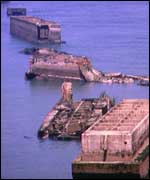 | | The 'Mulberry' Harbours: These can be seen in Normandy even now and were part of the D-Day invasion |
Jack described the film: "It's about the D-Day landings on Omaha beach where the Americans landed. They all got blown up because the tanks that were supposed to arrive all sank in the Channel. On all the other beaches they arrived and saved all the injured. They cleared all the barbed wire and stuff so they could get through over the beachheads into Normandy to liberate Europe from the Germans."
As far as computer games are concerned, Subhaan said though some people might be worried that they just glamourise what happened on June 6th 1944, he wasn not convinced: "It's just for fun, nothing serious. It might be a bit serious for some people, but the basic point of the game is to enjoy it...In some ways it can help you to remember. Some people might think that's important."
Queensbury School teacher Martine Clegg said she just hoped the visit to Normandy in 2004 would bring it home to the children that just because it seems a long time ago doesn't mean it shouldn't be important to them too: "It's my belief that our future is in their hands, so it's vital that they see the kind of madness that Hitler's dictatorship led to. If they don't see that, then there's little we can do to stop it happening again...These children are living very comfortable lives, and they need to see how fragile that is."
But one pupil, Bradley, said he thinks he might yet have to answer the call, just like they did in 1944: "What's happening at the moment between Britain and America and Iraq, I think they might ask young people to go into the army so they're ready when they're older...I wouldn't want to do that!"
|