The British left France with the evacuation of Dunkirk in May-June 1940 and the country fell under the occupation of the Germans. With the entry of the USA into the war in late 1941 it was only a matter of time before the Allies began planning the invasion of Europe. After years of preparation, these plans came together on 6th June 1944 - D-Day.The coast of Normandy was selected for the invasion and a massive US, British and Canadian army was gathered along the south coast of England. Elaborate schemes were undertaken to deceive the Germans into believing the Allies would land in the Calais region.
Postponed from June 4th because of bad weather, events began shortly before midnight when people along the south west coast saw planes flying towards France. 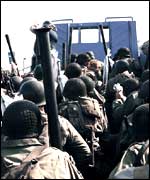 | | A BBC reconstruction of the D-Day landings, 60 years on |
Just after midnight three British gliders landed alongside the Orne canal to capture a crucial bridge in order to protect one flank of the beachheads. (Pegasus Bridge) At the same time American airborne troops were inland in front of the US beaches in order to disrupt German communications and attempts to attack the invasion forces. Bombing raids began on targets near the beachheads in the early hours of the morning. By 0300 the Germans have detected the invasion fleet and are prepared for attack but confused by the activities of paratroops at their rear. At 0530 the navy began shelling the beaches. At 0630 the Americans started to come ashore at Omaha (where they encounter fierce opposition) and Utah beaches. One hour later British and Canadians land at Gold and Sword beaches further east. At 0745 troops land at Juno beach.  | | Arromanches, where some of the landings took place, as it is today |
By mid-morning the British and Canadians, and the US at Utah, were starting to move off the beaches. Just after midday marine commandos reach the airborne troops at the Orne bridges. US forces finally get off Omaha beach having suffered over 3000 casualties - the day's largest single losses.
By the end of the day over 160,000 troops had been landed - including glider borne reinforcements that night. The Germans had failed to drive the invasion back into the sea. It had been, as the German commander Erwin Rommel, had predicted, the "longest day."
|