| 13 November 2014 |

| |
| BBC Homepage | | |
| |||
| Contact Us | | |
Nature FeaturesYou are in: Bradford and West Yorkshire > Nature > Nature Features > Fairburn's owls revealed! Fairburn's owls revealed!Fairburn Ings just outside Castleford is justly famous for its water birds but now it's attracting some very different - and rather illusive - feathered visitors as we've been finding out... 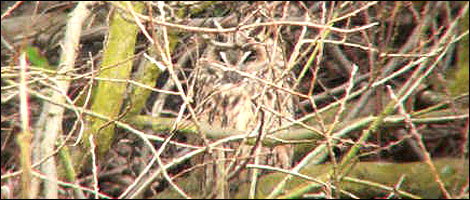 Fairburn's Owl PIC: (C) Chris Gomersall It's the last day of January and we are taking a stroll around the RSPB's Fairburn Ings Reserve in the company of Visitor Centre Manager, Laura Bentley. We've come along because we've heard that Long-eared owls have taken up residence. 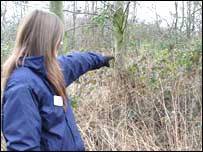 Laura shows where the owl was spotted The Long-eared owl is usually a nocturnal and secretive bird but visitors have been flocking to Fairburn because it's been possible to spot it during the day. Laura says: "We had one Short-eared owl down at the Pickup hide - someone saw it flying away about two months ago now but we've had the Long-eared owls here for about a month. They came at the start of January and we think it was the same family who were here last year. We had a pair breed on the reserve last year and they fledged three young successfully so we think, because there's five of them, it's the same family that have come back. They are down at the Lin Dike hide. "They are roosting so they are asleep all the time you are watching them and they come out hunting at night. Long-eared owls are the most nocturnal of all the owls. It's very rare to see them during the day...They are probably going to be there for at least another month. The three young of the family are probably going to go off and find their own territory at the start of the breeding season." 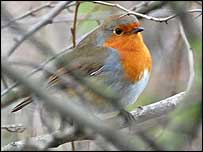 A robin hiding from us at Fairburn Ings! While the owls can usually only be spotted through binoculars by those who know where to look, Laura tells us that both RSPB staff and visitors had been taken by surprise just a week before our visit when a Long-eared owl was spotted very near to the Visitor Centre: "What we suspect happened is that it had stayed out all night. It had been out hunting and it was a bit of a late night stop out and didn't quite get back to where the other owls were." Laura points up into the trees to show us where the owl was spotted: "It was asleep sometimes but when it heard someone go past it would turn around and look. Someone was actually sat in the visitor centre having a cup of coffee and they just looked out and saw this thing in the trees and said, 'What's that?' We got the telescope and the binoculars on it and it was a Long-eared owl sat maybe 20 feet away from the Visitors Centre. It was amazing." A Little owl has taken up permanent residence at Fairburn Ings. We follow Laura to The Meadow to see if we can catch a glimpse of the only member of the owl family to come out during the day: "He just sits in the open all day usually. We should name him really beause he's here quite often. He was here last year as well." But we are unlucky. Laura says: "He hasn't been seen this week so perhaps he's gone on holiday." 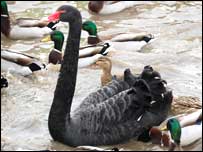 Black Swan @ Fairburn Ings And the Little owl is not the only Fairburn regular who doesn't seem to want to meet us. There's a chance we might catch sight of a kingfisher near the sluice gate: "Often you see a kingfisher swooping down here...It's got a wire across and the kingfisher sits on there and feeds." Posts have also been put up in the water next to the Pickup Hide just to give the kingfisher somewhere to perch but he's not here today. However, right in front of us, we can see a Moorhen and some Mallard. In the distance we can see a tree which gives us just a hint that Spring could soon be in the air. Laura says: "You might be able to see the little black dots in the tree. They are the heron and cormorant nests. The herons are probably going to have chicks in a week's time." And if you are wondering why cormorants are nesting in trees and not on sea cliffs, Laura points out that these are Continental cormorants rather than the Atlantic ones usually found at the coast. Laura says the reserve is quite quiet at the moment but there's still plenty to look out for at this time of the year - shovellers, teal, wigeon and Little Egrets are just a few of the water birds she mentions. There's been some excitement at the Visitor Centre today because a Smew has been spotted - the first this year. 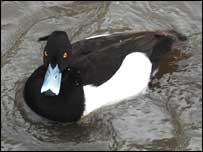 A Tufted Duck stares back at us! And there's plenty to be seen just next to the Centre where the bird feeders are looking quite crowded: "Winter is the most important time for feeding the birds so that's why you see a lot around here but the breeding season is probably in April and May. At the moment we've got plenty feeding - we've got blue tits, there's a few tree sparrows and a coal tit. You can usually see a lot of goldfinches on there, the ones with the orange above the head." We spot a robin and a bull finch - they both have reddish breasts but the bull finch is bigger than a robin and has a black head. We take some bird food to the edge of the largest of the Ings (lakes formed by mining subsidence) where we come across a pair of magnificent black swans. There are also several mute swans and ducks and they are all very interested in what we've brought - so much so that a coot runs over a swan's back to make sure it gets its share. There's also a tufted duck swimming around. Laura says: "Aren't they beautiful with their blue beaks?" This is the first time she's seen one in this part of the reserve.  Laura @ Fairburn Ings With its open water, grassland and woodland, Fairburn is one of the most diverse of the RSPB's reserves. Discovery trails, boardwalk trails, bird feeding stations and a pond dipping platform are just some of the things that make the reserve a great place for families to find out more about all kinds of wildlife and yet Fairburn is near to where people live and work. One of the reserve's three main trails - the Riverside path - follows the River Aire. Laura says: "You can almost feel you are in Paradise here but you can hear it, can't you? You can hear the buzzing of the town." And you don't have to be a wise owl to know that Fairburn Ings isn't just for twitchers! ** IN PICTURES: Take a winter walk around Fairburn Ings with our virtual tour. Meet tufted ducks, black swans and more by clicking on the link below! Fairburn Ings opening times:Main car park and Lin Dike car park are open at all times. Visitor centre opening hours: Monday-Sunday 9 am-4 pm. The centre is only closed on Christmas Day and Boxing Day. last updated: 18/02/2009 at 11:27 SEE ALSOYou are in: Bradford and West Yorkshire > Nature > Nature Features > Fairburn's owls revealed!    |
| | About the BBC | Help | Terms of Use | Privacy & Cookies Policy |