 | 13 November 2014 |

| |
| BBC Homepage | | |
| |||
| Contact Us | | |
Lost CityYou are in: Bradford and West Yorkshire > History > Lost City > Bradford: A 'Lost City'? Bradford: A 'Lost City'?Fifty years ago in 1958, famous Bradford author and broadcaster JB Priestley revisited his home city after four decades away. Followed by a BBC TV film crew, he went back to his old haunts and came to some conclusions which still have echoes today... 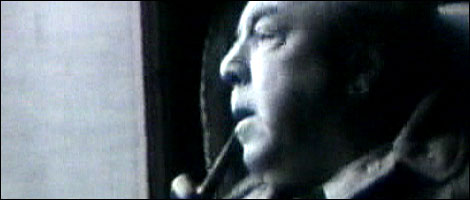 JB Priestley arrives in Bradford As the steam train slowly draws into Bradford Forster Square station, it seems to be the sort of gloomy day anyone who's ever lived in West Yorkshire will know all too well. The gloom is emphasised, of course, by the fact all this is viewed in grainy black and white courtesy of the film camera closely following these events. A group of what we assume are journalists - clutching huge old-fashioned cameras, notebooks and pens at the ready - clamour around the carriage door as a familiar-looking man in a heavy raincoat and hat steps out, laden with baggage. It is, of course, our 'hero' - Bradford's very own JB Priestley. Renowned for such masterpieces as An Inspector Calls, The Good Companions and Lost Empires, he's one of the city's most famous sons. The lad has, as they say, done good. So why is he back in Bradford after 40 years, ask the gathered gentlemen and ladies of the press?: "I've lost touch with it," he answers. "You might say that, to me, it's a lost city and perhaps I've come here to find it." So begins Priestley's return visit to Bradford in 1958 - a city which he admits he hardly recognises from his childhood years. Help playing audio/video 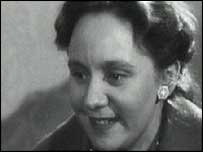 Mavis: Priestley's on-screen companion Accompanied by local journalist Mavis Dean, Priestley's return is certainly tinged with melancholy from the start. We soon see him sitting in his room at the Midland Hotel, 'phoning up his old pals...and getting nowhere fast. "Mr Mothergill is dead," he utters to Mavis at one point as he replaces the receiver after yet another fruitless call. He sadly reminds Mavis that many of his generation were cut down on the First World War battlefields of Europe: "Half the young men who were boys when I was a boy in this town were killed in one morning in 1916." And with that mournful thought, it's time to get out there into the Bradford of 1958... Heading out into the suburbs with Mavis at his side, Priestley first visits No. 5 Saltburn Place - his childhood home. "Up there" he explains, "in the attic of number five, I first began writing. I turned it into a bed-sitting room, bought some orange boxes, stained them and used them as bookcases and there I wrote every night...Really, I didn't write very much about Bradford. I can remember a poem I wrote about Atlantis which was about as far away as I could get from Bradford in my imagination. I didn't realise then that these West Riding industrial towns with their bleached stone can have a beauty of their own..."  Up market: "Pleasant memories" Following scenes of smoke-blackened terraces and belching chimneys, we see the odd couple have arrived back in Bradford city centre - at Swan Arcade, to be precise. The Arcade was once home to the wool office where Priestley first worked - but, he says, things are different since his day: "It's changed completely. All these shops full of feminine frippery weren't there 40 years ago. Everything was sombre, dignified and masculine. There were tailors and wine and spirit merchants, not all this stuff. Now, of course, it's all this feminine frippery because they make money out of that." What, we have to ask, would JB make of Bradford city centre today? He also reminds us, though, that he's certainly not looking through rose-tinted spectacles - his job certainly wasn't his life: "We used to sit on high stools like the clerks in Dickens. I used to handle a thing called 'The Big Book' - or pretend to - and then in the desk below were all the library books I had. It's a tribute to my personality that they had me working there at all. I must have been one of the worst wool clerks that ever existed. I had to go out a good deal on various odd jobs and I must have lingered and loitered longer than any wool clerk...But the one thing that was good about it was that when you were out, when at half-past-one on a Saturday afternoon you closed that office door, you had a wonderful sense of freedom. It's something I've never had since..." During Lost City, there is one location that Priestley claims hasn't altered all - 'Bradford Market'. We never find out which of the city's markets it actually is, but it's safe to say that whichever one it is it's unlikely he would recognise it at all today. Surrounded by lively crowds and bustling stalls selling everything from pie and peas to books, crockery and underwear, he says: "Oh yes, I've got very pleasant memories of Bradford Market. I think it's one of the best parts of Bradford. It's completely unchanged as far as I remember." Priestley actually seems properly at home in this little bit of Bradford, perhaps the only time we see this reaction during Lost City. The explanation is simple - it's one of the places that fed his literary appetite: "I used to buy books on this stall and I tell you that on occasional visits to Bradford I've still bought them at this second-hand bookshop. You get the real feeling of Yorkshire here - full of vitality."  Pie and peas at the market in Bradford! As the good people of Bradford chomp on their pie and peas - shown in plenty of gory detail - our hero and his companion are transported to the bandstand at Lister Park. He describes a scene which from a 21st century perspective seems like a very long time ago: "We used to go to Lister Park every Wednesday and Saturday throughout the summer and listen to the military band concerts. They had the very best bands and people took a great interest in these bands. It was rather a nice scene, there, towards dusk, with the illuminated bandstand, the red uniforms, the brass instruments gleaming, smoke rising from thousands of pipes and cigarettes...Then all round the people who were sitting, there was a great processional parade of young men and girls, the girls arm-in-arm giggling, the young men looking at them and the girls pretending not to look back at the young men. Ah, that's a long time ago. I don't suppose they do that anymore." And he's probably right..! Entertainment of a different kind is the next item on Priestley's agenda as he and Mavis visit St George's Hall to find out how a new generation get their kicks - and he finds himself rather surprised: "I'd never have guessed this is the latest style in dancing! I thought they were all still juggling about, rocking 'n' rolling. This is back to the 1920s. It looks rather like porridge cooking. I suppose it's just sex prejudice but I must say the girls look so much nicer than the boys." 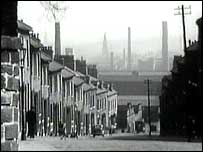 A typical shot of Bradford in Lost City Nearing journey's end now and Priestley and Mavis find themselves in a place where JB once again feels a little more at home - the theatre. Unfortunately, this theatre - again unnamed - is on its way out. Once upon a time, he says, Bradford was throbbing with activity, creative and otherwise, but he fears that's no longer the case. He has his own ideas why: "It was the coming of the motor car that made such a difference to Bradford. When I was young, all the rich manufacturers, wool merchants, lived in or near the city. Then, when the motor cars came, they moved out to Harrogate, Ilkley and Grassington. It made a great difference to the social life of the city and finally, I think, to its entertainment. I'm told, I don't know if it's true, that in a few years there will probably be no live professional entertainment in Bradford at all. Yet, when I was young there were two theatres and two music halls." As he and Mavis investigate this deserted theatre - presumably with the help of the front door key as JB doesn't strike one as a chap who'd break and enter! - his fears seem to be coming true in 1958: "This is the end of something. It's a deserted cemetery, a decayed graveyard...They had an orchestra of 16 here, and a very good little orchestra it was too. They could play serious music. Then there's the stage where, I'm told, Charlie Chaplin made his first appearance on the stage...I used to sit up there in the balcony for fourpence. It wasn't the cheapest place - behind that was the twopence...But what talent you got for your fourpence! Little Tich, George Robey, Harry Tate, Vesta Tilley, Mavis Scott, acts from other countries, WC Fields, Grock - the greatest clown there ever was. Wonderful talent." Fifty years on, these great talents may have been all-but forgotten but Bradford still has two theatres, and though the music halls may be gone live music can still be heard in the city. Maybe Priestley was worrying unduly? It'll cost a bit more than fourpence to enjoy the entertainment these days, though! 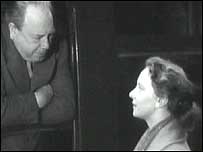 JB and Mavis say goodbye And with that, Priestley's journey around Bradford with Mavis at his side is almost over. Back at Forster Square Station with the reporters clustering around him once again, he admits that he hasn't found what he was looking for in his old home city but still feels a connection with the place: "Perhaps it was some essential link between Bradford and me. I've always said I owe a lot to the Bradford I knew before the First War...The War came which brought the brass but took a lot of the young men out of the city forever. Then Bradford became just another English industrial city: not good enough for the people in it. The people have kept their character, their warmth, their friendliness...It [Bradford] is not as good as it once promised to be. It's not bad but it's not good enough for the real Bradfordians." It's fifty years since JB Priestley uttered these words as he left Forster Square for home, and it obviously poses the question: what would he make of Bradford today? Clearly, much has changed, not least the disappearance of many of the places he visits during his film. But would Priestley still come to the same conclusions about his 'Lost City' if he visited it today - that Bradford is 'not good enough' for its inhabitants? Of course, we'll never know... Not everyone was happy with the way JB Priestley portrayed Bradford in Lost City. Find out more about reactions to the film by clicking on the link below...Want to find out more about JB Priestley's Lost City? Why not click on the link below to watch the film itself and discover more about what Bradford was like way back in 1958? Will you agree or disagree with JB's views on the city?Help playing audio/video last updated: 01/10/2008 at 16:33 SEE ALSOYou are in: Bradford and West Yorkshire > History > Lost City > Bradford: A 'Lost City'?    |
| | About the BBC | Help | Terms of Use | Privacy & Cookies Policy |
