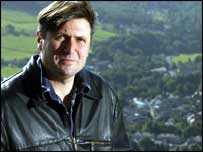
We went along to the rehearsals in Leeds to see if we could find an answer to our question. We had a look round for author Simon Armitage but found he had gone on his holidays but he had left us with some thoughts about his new play... Simon does not say that Jerusalem is Marsden but argues that is is a familiar place name in this part of Yorkshire: "Once or twice I've been rambling around the moors and have come across places like 'Jerusalem Farm' or 'Jerusalem Heights.' Like Jerusalem itself, the town in my play is the epicentre of conflict, where the old and the new are constantly at loggerheads. Here are ancient Yorkshire folk who can trace their ancestors back to bears and stones. Trying to leave is like trying to escape a gravitational black hole. In my play, two men battle it out for the hearts and minds of Jerusalem's townspeople, one defending his patch with almost religious zeal, the other an in-comer, a stranger, but with a familiar face." The "in-comer", is played by George Layton, who, while perhaps best known as Bombardier Solomons in the TV series It Ain't Half Hot Mum, has been a familiar face in TV, film and theatre for many years. We decided that as George was Bradford-born and had taken his first theatrical steps here in West Yorkshire, he might be the man to help us. 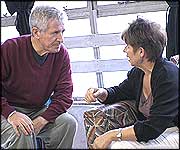 | | George Leyton and Brigit Forsyth |
It turns out George has never been to Marsden but he was able to tells us quite a lot about the play (advertised as a dark, musical comedy) and the idiosyncratic community it depicts: "It's set in a northern town. Jerusalem has a religious feel but it's not at all. It's a northern name. Funnily enough I remembered in Bradford there's a place called Little Egypt...Until this production I'd never heard of Marsden. I'm a Bradford lad. Huddersfield's miles away. To me it's just a northern town, I'm not basing it on any real place. I can imagine places I knew as a kid - maybe Shipley or Saltaire, or even smaller than that - but I think you'd have to talk to the author. If it's based on his real life village, some of the people might be sueing him!" Perhaps because the play has been written by one of the country's best-known poets. George says he has been very struck by its lyricism: "It reminded me a little bit of a northern Under Milk Wood - Dylan Thomas meets the League of Gentlemen - but it has its own voice...It's a very whimsical piece and to my shame I hadn't heard of Simon Armitage and his poetry is lovely. When I was reading it I thought I was reading stage directions for the beginning and I thought these were very lyrical stage directions because it didn't say narrator." George talks about the character he plays, Spoon, who has such a pivotal role in what happens: "This man returns after 20-odd years causing much disruption to the village because he did have a love affair there. We never know his first name.Hhe's an ex-policeman and he rescued a fireman, John Edward Castle, on Bonfire Night many years before. I don't want to spoil too much of the story but Castle was crippled as a result of the accident and in the hospital Spoon met Mrs Carson and something blossomed over a few weeks but eventually he just skulked away. Twenty years later he's back and that's the thrust of the story and the local townsfolk's reaction to him. It's about unrequited love really." However, the play's six actors are each required to play an array of very different characters: "We play other parts as well. I'm really enjoying every second of it and it is very interesting, very much an ensemble piece. I just think if the audience don't like the play or don't like the acting they are going to see something theatrically different. I've never been in anything in my life like this and I've been in the business a long time. The way the director John Tiffany works is fascinating. "The staging is like 'theatre in the long' rather than theatre in the round. You are working in a corridor with the audience on either side of you so it's a treat. You just play it absolutely for real and the way the scenery works, but I don't want to spoil it." 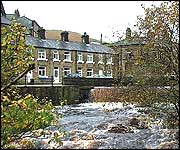 | | Marsden or Jerusalem? |
While it remains to be seen whether Simon Armitage's Jerusalem can be found in West Yorkshire, George Layton believes that growing up in Bradford does relate to the play: "My parents were refugees and I consider myself very lucky that they gravitated to Bradford. I did like growing up in Bradford and the Bradford I remember is a bit like Leeds is today. It was a very vibrant city but, a bit like Jerusalem in a way, it had a very village-y feel because all the roads led down into the city centre and my mother who was a Viennese lady became pretty well known in the town. She worked in fashion and knew people as a manager of shops and she was a fundraiser. She was very charismatic and as a result going to town with her, you never got more than 20 yards without stopping. I remember hanging on to her skirts as a little boy while she talked to the next person. She loved people and people loved her. I keep on meeting people who say: 'I knew your mother.' Sadly she's no longer with us. "I've got wonderful memories of growing up in Bradford. I've written a couple of books based on growing up in the 1950s. I don't name Bradford but they are semi-autobiographical and it's very much the Bradford I remember...There's another book coming out next year." He also thinks that growing up in Bradford also helped him become an actor: "I started in primary school in a potted version of Midsummer Night's Dream playing Puck and that was it. From the age of seven it was my vision to be an actor and I didn't veer from it. I still get the same excitement but I don't have the same confidence I may tell you." Drama was not on offer at George's secondary school but Bradford provided other opportunities for would-be actors: "I used to work at the Bradford Civic Playhouse, as it was then, with some wonderful teachers and I just lived for that. I got some good parts there. I also worked at Harry Hanson's repertory company (The Prince's Theatre) and that was twice-nightly. The year I left Bradford I did The King And I at the Alhambra Theatre and then I went on to drama school. " George's first roles in TV were in soap operas - he played a footballer in the series United in 1965, followed by a part in the Likely Lads. [Brigit Forsyth, who played Thelma in the same series, also stars in Jerusalem]. He has also written regularly for TV over the years, including Don't Wait Up, starring Nigel Havers and Tony Britton, which ran for six series. At the time he was starring in Doctor In The House, George was even writing some of the episodes. Today he says he tends to be a bit more "low profile" about the writing, preferring to act. George says: "There's something about Bradford. I don't know what it is. It's a sort of kinship. I do feel it's God's own country and it saddens me when I see it slightly behind Leeds at the moment but hopefully that will change, and it saddens me that Bradford City went out of the Premiership, too." Perhaps, after all, Jerusalem can be found here inWest Yorkshire but you will need to get along to the play to see what author Simon Armitage has in mind. Jerusalem is at the West Yorkshire Playhouse between November 12th and December 3rd. [Photo of Simon Armitage (c) Richard Moran] |