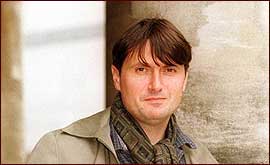
To describe Marsden-born Simon Armitage as a West Yorkshire poet is selling him short. He is one of the country's best-known poets and his work is known to hundreds of thousands of children because it has been on the GCSE exam syllabus for several years. Now in his early forties, Simon has made the transition from Manchester probation officer to poetry and the novel, writing extensively for film, radio and TV along the way. Despite his success he still lives here in West Yorkshire. We started by asking him about his new novel - the story of Abbie Fenton who, at the age of 40, is desperate to have a family. Adopted as a child, she craves a relationship with her real parents as much as she fears meeting them. 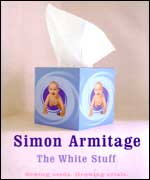 | | Simon Armitage's latest novel The White Stuff |
THE WHITE STUFF IS SET AT A TIME WHEN INSTITUTIONS LIKE THE CHURCH ARE NOT AS IMPORTANT AS THEY ONCE WHERE. HOW DOES THIS IDEA AFFECT YOUR NEW NOVEL? Now people try and establish their identity through lineage and genes and I started with a character called Abby and she's got neither a past or a future. She's adopted and she does not know who her birth parents were and she's trying to have a child so I start from a very neutral empty place and then try and work backwards and forwards from there. WHY NOT PURSUE THE SAME IDEA THROUGH POETRY? In poems I tend to deal with moments or snapshots or just issues as they come up whereas sometimes an idea comes along and it's quite obviously too big for a poem. It needs characterisation, it needs dramatisation. There's a long twisted narrative running through it and I don't think people want to read those kind of poems. I don't think they've got the stomach for them so I guess the novel is the natural place to go with an idea as long-winded as that. DO YOU GET A BIGGER AUDIENCE FOR YOUR NOVELS? I think the publishers imagine more people are going to read a novel than a book of poems and I suppose generally that's true. As a poet you are operating in a relatively small field and when you go into a big bookshop you realise that your novel counts for nothing. You can hardly find it. You can walk around and there are just so many novels, it's a huge territory. IS THERE ANYTHING ABOUT YOUR POETRY THAT MAKES IT ACCESSIBLE TO PEOPLE WHO COME ACROSS IT AT SCHOOL? I don't write my poetry with that particular audience in mind. I think you'll have to ask that question of the examination board. I'm not obscure. Obscurity is an affliction and I think of poetry as a communication device, not an elitist form of philosophy so it might be something to do with that. ALTHOUGH YOU EXPLORE THE BIGGER IDEAS DO YOU FEEL YOU MAKE USE OF BIGGER THEMES? That's the trick that I am trying to pull. I am trying not to sacrifice any intellectual integrity in the poems but I'm trying to write them in a way in which people can engage with them and read them. 
|