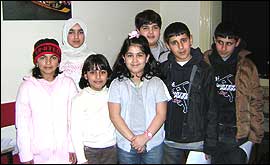
When we arrive Trude is talking about the circumstances in which she left Vienna when she was only eight years of age. She answers questions from Caro who has come to West Yorkshire from Kurdistan.
Adam Strickson, who is leading the meeting, explains what is happening: "We are at KRAFT (Kirklees Refugees and Friends Together) and we are also involving people from the Holocaust Survivors Friendship Association because for a number of years Kirklees has been remembering Holocaust Memorial Day on January 27th. This year we've brought two groups together - young people from Kurdistan and Albania and also older people. Some are 'Kindertransport' who came on the train as eight or nine-year-olds from Hitler's Germany. As well as those are camp survivors and 'second generation' whose parents or grandparents suffered as part of the Holocaust or the pogroms.
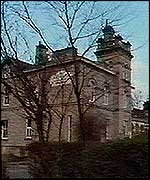 |
| This Bradford building served as a hostel for children brought to West Yorkshire by the Kindertransport. |
"We've been talking and playing games and making some writing from our words about our experiences, particularly with the theme of second lives, of starting life again in England and trying to cross the generations. A lot of the people in the room today came as children to England and had to learn English, to learn a new language and be part of being here."
Kashan and Caro read an extract from I Came From/I Came To, some of the words they will present at Kirklees' Civic Act of Commemoration for Holocaust Memorial Day at Huddersfield Town Hall. They hand us a written copy of the readings they have prepared for the evening - "I came from...I came from my childhood. Often, I try to get back into that room."
Trude tells her story: "I originally came from Vienna in Austria and I came when I was eight on the Kindertransport which was an organisation that got sponsorships from families in England for the children whose fathers and parents were taken away, and who would foster or look after these children.
"England wasn't at war then and it was only going to be a temporary thing at the time, but unfortunately it lasted a long time and I was fostered. I stayed with this family until I got married and at the beginning obviously it was a very, very unhappy time - very traumatic and I remember I couldn't stop crying. I cried for a whole week. I couldn't speak a word of English and they couldn't speak a word of German and I remember saying, 'I want a Taschentuch and nobody knew what a Taschentuch was. A Taschentuch is a handkerchief and, with crying, the more I needed a Taschentuch - and in those days there were no paper handkerchiefs and the toilet paper was hard and I remember using the bottom of my skirt.
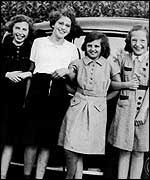 |
| German refugee girls in a hostel in 1942 (from the Continental Britons exhibition at Dewsbury Town Hall) |
"It was very traumatic but children are very resilient and eventually you accepted the fact that you wouldn't see your parents again. It's very hard talking about it. You get very emotional and for years not only myself but the others who came over as children, we couldn't talk about it. It's only recently that we've managed to talk about it because people haven't experienced it, little ones not seeing their parents anymore. It was a very traumatic time. But we managed, we overcame it."
Despite being very upset Trude believes it is important to talk about her experiences to the young people in the room: "Yes, I know they are also going through a very traumatic time leaving their friends and everything they knew. And the language, that is very hard as well."
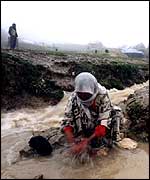 |
| Life in a Kurdistan refugee camp |
Pam Bye, director and founder of KRAFT, explains why her organisation is involved: "Our children are very important to us and people's backgrounds and lives are very important so that's why community history is important. We try to help our children keep alive their past and remember where they came from, and so we're very proud to work with Adam and this is the third Holocaust Memorial Day we've taken part in."
Bah'ra has been in Huddersfield for three years. She says: "I came from Kurdistan in Halaja. My Dad was here three years before I came and I lived without a Dad in Kurdistan and it was really hard and people were calling, 'You're Dad has left you. He doesn't care about you anymore.' He got a British document and we came after three years and then it was really hard leaving my family and friends, leaving them and coming here. All the time I blamed my Dad for coming here, for bringing us here, but we got used to England. It was really nice and people were welcoming but we thought that we'd never learn English because we were just thinking about Kurdistan and what people are doing there and what people are doing here now. But we've got used to living in England and now it's all right. "
| I thought everything is laid out in a gold but everything in England was black and drab. Back home, our houses were painted outside so the dark Yorkshire stone was a shock. I thought it's like a prison here, a prison in the fog, so wet and I couldn't speak a word of English. Once we started going to work in the mill, our workmates were really friendly. It was a very good feeling. We were very happy to be here. It was...It was...the kindness of strangers. |
| From I Came From/I Came To |
She now feels West Yorkshire is her home: "It's really good here and if I could go back to Kurdistan I don't think I would want to stay there, I would want to stay here. I think I'd forget the things that happened in Kurdistan but there's lots of people who would never forget their families and friends because of the tragedy that went on in Halaja."
Bah'ra says she can relate to the experiences of the older people in the room: "They left their country 60 years ago and, compared to mine, it's really, really different but in another way it's quite the same. They've left their family, never seen them again. Now I'm with my parents, my sisters. My family are alive, I could go back anyday I want but it's not the same for them. What happened to them, you can never turn the clock back. It's permanent."
The keynote speaker at this year's Kirklees Holocaust Memorial Commemoration is John Chillag, a Hungarian Jew who in 1944 at the age of 17 was rounded up for slave labour before being taken to Auschwitz and Buchenwald concentration camps. John wasn't at the meeting we went along to but Linda starts to tell us her story: "I lost my grandparents in the Holocaust at Auschwitz. I'll let my husband continue."
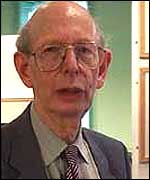 |
| Camp survivor John Chillag will give the keynote speech at Huddersfield Town Hall on Holocaust Memorial Day. |
"I'm Robin, Linda's husband and my late father-in-law fortunately got out of Germany just before the Holocaust took place, with two brothers - one went to Australia, two to England. Unfortunately his parents, my wife's grandparents, didn't get out and they perished in Auschwitz. My late father-in-law, who I was very close to, left us with quite a lot of archive material, books, records, artefacts and photographs so that we were able to carry on and tell the story of what happened and we, along with a lot of other people, like to speak in schools and institutions about these racist activities where people have no respect for other people. We try to preach tolerance and respect for other people's beliefs, religions, whatever...So long as people are law-abiding and have respect for each other. That's our message."
But sixty years after the names of the Nazi concentration camps - Auschwitz, Dachau, Belsen, Buchanwald among others - became synonymous with genocide, does this message still need retelling? Linda knows that it does: "We've spoken in a few schools and it is unbelievable that people do not know anything at all about the Holocaust. It has got to be spoken about to get the message across that this should never happen again."
Robin adds: "It is still happening. It's still happening in the world today so it makes you wonder, have we learned the message? People will say we should move on, forget what happened 60 or 70 years ago but if we do that there will be no-one to tell the story of what did happen so our message is that we have got to keep doing that. Maybe people will eventually learn and have respect. Thank you."
The Kirklees Act of Commemoration for Holocaust Memorial Day takes place at Huddersfield Town Hall on Wednesday 26th January at 7.15pm
Continental Britons, an exhibition which tells the remarkable story of Jewish refugees who fled from Nazi persecution in German-speaking countries, runs at Dewsbury Museum from January 15th to June 2nd. |