
I am drawn in general to films that show the complications of relationships, and I wanted to make something that expressed the importance of love in our lives. The fact that it is such a dominant factor in all of our lives.
Everyone loves, wants to love, or dreams of love, but may not be in a place or position to realize that love. I believe who we love, why we love them, and indeed how we love them is the really big issue for all of us.
It stems from my sense that everyone’s personal life, love life, however perfect it may seem, has complications, whether they are admitted, or recognized.
I’ve always been a huge fan of the film Brief Encounter. Its mood, its atmosphere, its romanticism, but also the moral complications, and even though it was a very different era, the same moral dilemmas exist today, if not more so. These films are my modern day Brief Encounters.
I wanted the series to provoke feelings in all of us, we recognise these dilemmas that are shown, and ask ourselves “what would we do?”, in these situations. I think Love and attraction are very difficult themes to get right in film. If it’s not working it’s because audiences can see though the fake, through any insincerity of feeling.
The chemistry and feelings between the characters is something that has to palpably work and to be seen on screen to work for the film to be successful.
This is why love story’s are hard and therefore a great challenge as a film maker. You may have every element right, the story and character, the sub plot, and the music, but if the on screen magic between the lovers is not there, then it’s simply a very unsatisfactory end result.
However I have always felt that my approach to film-making is well suited to being able to conjure up that on screen magic. To showing and expressing love in a filmic way, a way that is truthful and unique.
I like to work in a way that puts the actors in a place where they have to call upon their own emotions and personal feelings within the scene. This brings a particular reality and authenticity to the work.Because we are all working in the moment, constructing the shape and detail of the scene just before we shoot, no one really knows what the outcome of the scene is truthfully going to be before it is played out.
An actor can be presented with a line or an action from the other actor that they aren’t expecting. This means that they tend to “live” the scene is a more real and surprising way. They are fully embroiled in the “now ness” of it. This is why first takes are so intriguing and possess a rawness that we then refine as the subsequent takes go on.
We shoot the scenes very quickly and instinctively. There isn’t time to think or analyse or process. The actors have to react quickly, like it is in real life, albeit with the knowledge of the scenario being played out. The actors therefore call upon I believe, more personal feelings.
There are never that many takes, because the scene tends to lose that freshness that I so love as the takes go on. The scene becomes predictable for the actors, more known, more acted and therefore more conventional and less interesting.
Often the scenes have no rigidly designated beginning or end. We can keep going until things run aground. This gives an emotional freedom that can only serve to help the truth of the scene and the voracity of the characters own feelings.
The process of working this way can prove very testing, and no actor that hasn’t done it before, really knows what it’s going to be like until they do it.
Part of getting a series like this together, is talking to the actors at length and being open about what it is you want to achieve. Gaining their trust. I think they all ultimately came to it with complete faith and generosity for that vision, as well as a lot of nervousness, as they had to have a willingness to take risks.
I like to create work that is not necessarily based on personal experience, although there is a lot of personal feeling in them, but on an innate curiosity for that subject matter. The sort of thing that you play out in your head and wonder what the outcome would be of a certain occurrence in someone’s life. With this series it has been a way of exploring the what ifs of life.
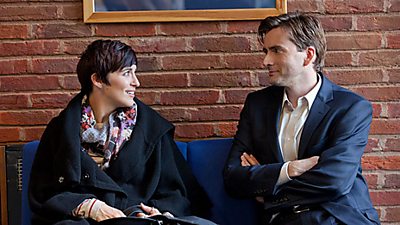
They are in many ways a discovery for me. Certainly they are the kinds of films that i would want to go and see and maybe haven’t been able to.
By setting it in a small seaside town, the series shows the crossover that exists in so many people’s lives.
Everyone seemingly is involved in this cycle of love, temptation and transgression.
The decision to set it in Margate came a bit later, during a visit to the town that I’d grown up in. A place that is full of all kinds of emotions for me, both good and bad as all home towns are in a way.
Mine particularly so however because as a child growing up there I believed it to be the centre of the world. As a thriving seaside resort back then it seemed to be glamorous and vibrant and colorful and amazing.Of course that image of the place changed as I grew up and as the town deteriorated with the demise of the holiday business. I had sort of forgotten about it and what it was.
On a visit I made in early 2011 however I saw it in a very different light. I was able to divorce myself from the past and all the memories that came with that, and saw it as a magical place of fantasy, a place with a real natural beauty.
There is a tangible reason why the artist Turner lived and painted in the town. The sunsets and the light have a stunning quality about them.
It’s a place where the beach and the sea are so dominant, that there is somehow a greater possibility about everything. There are no limitations. The realities of life can be put on hold easier in Margate, there is a real romance about the place.
Given that the place was so emotionally charged for me already I just knew that the series had to be set there.
The whole experience of filming there was understandably very personal, and very precious in so many ways, and I believe all that has imbued itself in each of the films.
I hope the romance and the truth, and the belief that I have of into the series will come through in a unique way.
Dominic Savage is the writer and director of brand new 5-part improvisational drama, True Love - showing all this week on BBC One. Watch episodes 1 and 2 back on BBC iPlayer.
