
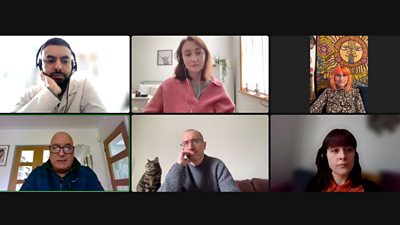
We ran an online event with previous Alfred Bradley Bursary Award winners Alex Clarke (2018/2019), Paul Jones (2021/2022), Emilie Robson (Special Commendation 2021/2022) and BBC Radio Drama North Producer, Gary Brown to discuss the bursary, the development process and what writers should think about when submitting their scripts.
The event was packed with useful advice for anyone interested in writing Audio Drama. Read edited highlights below.
Paul, Emilie and Alex - can you tell us a little bit about your writing careers and how much writing you'd actually done before you applied for the Alfred Bradley Bursary Award (ABBA)?
Paul Jones: I was writing fiction mainly. I'd kind of always written, but I didn't start to take it seriously until my forties, and then I always liked writing dialogue in particular. I had a couple of plays on, nothing major, you know, but I'd been stabbing away for a few years.
Alex Clarke: I had sort of come to writing sideways. I'd never really seen myself as a writer or that there was a career to be had. I was mainly either on the dole, cleaning or a support worker. I was moving around all these different working class jobs and writing was something that I was doing mainly for my own mental and wellbeing so, I’d kind of come to it through a mental health route.
It was something that I used to figure out my own problems and things that happened to me in the past, and it was very much a cathartic practice for me. It was never really something that I saw could even become a career. So I was probably writing for about 10 years for my own self and within different support groups that I was a member of.
Then I wrote a little piece about a crime that happened to me in my teens. I wrote this moment into a play and then sent it to the wonderful DYSPLA down in London. The team there work with dyslexic writers and autistic writers, and they thought there was something in it. So from there, I wrote little pieces of fringe theatre and then I decided I wanted to write television because my first love is television. I'm quite a visual person. I then entered the New Writing North screenwriting scheme and won it and went into development with Channel 4 with a piece that I’d written about childhood, autism and domestic violence.
As soon as that went into development, I was awarded the Alfred Bradley. At this point I’d been throwing a lot of things into the darkness with my writing and then within one year, 2 years, a lot of things kind of collided and came together for me.
Emilie Robson: Not an awful lot had been going on for me. I'd written a couple of plays with friends, and we put them on like a free fringe, but nothing professionally produced, nothing commissioned, and then I'd written a couple of solo things that I've gotten like shortlisted or long listed for prizes, but it was just always a bridesmaid situation.
In 2020 - what a great year that was! I threw everything at the wall with very little else to do and actually, just everything sort of started coming together, and ABBA was probably one of the first things that came through where I thought, ‘oh, my God!’ Like I was close to giving up. My script was long listed, shortlisted and then in the final 5. So I was basically a complete beginner and then it all started coming together.
Paul and Alex, what impact did winning the Alfred Bradley Bursary Award have on your writing career?
Alex: It changed everything, and I think it changed everything because it changed how I was viewing myself and my work, and that definitely came through the development process and working with Nadia Molinari (Audio Drama Producer) there in the team. Starting to see myself as potentially a professional writer, and that there was something important that I had to lend to the world of writing.
That's definitely something that I think is really unique to the process of writing for Radio. I've not found that process anywhere else. I got a BAFTA writing mentorship through it. I think the stamp of BBC and having a piece of work that been professionally made by the BBC was a beautiful calling card. It opened so many doors. The BAFTA writing mentorship were able to hear my writing and hear what I was able to do. From there, I got a BFI writing commission and I got an ITV mentorship, too. Then I also went into development with the BBC and Dancing Ledge with a new TV series that I’m developing and Dancing Ledge contacted me because they had seen that I'd won the Alfred Bradley so, yeah, it changed everything.
Paul Jones: I mean it's the pat on the back that you need, you know. I suppose like any writer it's difficult to call yourself a writer, isn't it? Most of the time you're squirreling away alone and for it to be recognised it gives you that little confidence boost you need. Makes it easier to get a meeting or perhaps get a second play if not commissioned, looked at.

Emilie, you received a special commendation with your ABBA submission - what happened next for you?
Emilie: I sometimes forget I didn't win! Because, I feel like – bar the money and the prestige - there was very little difference between my experience afterwards. It was a few months later, while I was in the middle of developing Pica for the BBC Writersroom’s Drama Room scheme that I got the message to say like we'd like to develop this for Radio 4 and I still got a full commission out of it.
That will still always be a highlight getting to do that when you kind of think ‘oh, second place, lovely. Thank you very much’. The process was just so much fun, even under COVID guidelines and restrictions. Then also because of the Alfred Bradley and the BBC having departments all across the UK, the Northern department were aware of who I was, and Alice Ramsey (Assistant Commissioner for Drama Commissioning and BBC Writersroom North) must have mentioned my name in like 10,000 rooms by now, and it's only from skimming the top of the Alfred Bradley that she even knows who I am to put me forward for these other opportunities. Still, I had a meeting last week where they said, ‘Alice Ramsey recommended you for this’.
So even when the commission's done, it still continues to sort of trickle and there's not really a limit to the impact it can have for you.
Gary, can you tell us a little bit about your role as an audio drama producer and how you work with writers?
Gary Brown: Audio is a writer's medium. Basically, when I get my budget, the biggest cost is the writer. So we can't do it without the writer. The words are everything. So we're here as Producers to facilitate the writer and ABBA is brilliant for bringing on new writers that maybe we wouldn't have been aware of. I mean, obviously, we've got our tendrils out trying to find writers, but ABBA is a great resource for us, and we’ve picked up lots of writers over the years. Everybody's probably seen that Lee Hall (Billy Elliot, War Horse), started with ABBA. A few years ago, we had Furquan Akhtar (The Bay, Wolfe) who's now a well-established TV writer.
My job is - I often work with established writers - but I also work with new writers and I guess the interesting thing is that it takes a year from idea to actual transmission. So we spend a long time with writers and that's the main joy of the job, because I basically take an idea that a writer’s come to me with and develop it over many drafts, and then get the joy of going into a studio with the actors, editing it and delivering it. So I go through all the processes. It's a really, really lovely job, but the writer is central.
I mentored Emilie last time for the Alfred Bradley, but she made my job really easy, because I got the script, and I thought, ‘Wow, there's not a lot I can do . I'm very happy with this.’ Sometimes you have to work quite intensively with the writer, but with Emilie I didn't have to work particularly hard, because I thought the script was excellent. Often, as with Emilie, it isn't just the winner of ABBA that gets produced, often the runners up do as well.
What should the writers be thinking about when writing an audio play, Gary? Is there anything that they should avoid?
Gary: Well, the most important thing is to listen to radio plays. You'd be surprised when you get some submissions, you think, ‘Gosh! Have you actually listened to a radio play recently?’ because they have changed from the old fashioned type.
The biggest mistake that writers new to radio make is that they think it's like a stage play and it isn't. I'm looking for filmic scripts and things that move along, that are very visual, and I don’t like too many plays with just people talking in a room. I like to think of big landscapes and big ideas. For me, it's a sort of hybrid between the film and the novel, because sometimes, if you want to, you can get inside the minds of your characters.
What I would say is, be bold. Go for really bold ideas. We're looking for original stuff. We're looking for, obviously your voice, but be bold. Go for a big idea.
Paul, Emilie and Alex - writers that come through ABBA are new to writing for Audio. What did you learn about writing for the Medium? And were there any surprises for any of you?
Emilie: I very much agree with Gary that actually there's so much in common with the novel and that internal world, that you won't get to see done successfully, probably in Film and TV, and that it looks really trite in Theatre. You actually have such artistic license within audio to get into that internal world. Also, what initially feel like limitations where you're like, ‘Oh, I can't show a facial expression, or I can't tell them what the boat looks like’, there's so much fun to be had in thinking, ‘Well, how do you do that then?’ Embrace the limitations, I would say, because actually there's so much fun to be had within that remit of sound.
Then there's absolutely no limitation to where it can go, because if you need to be in space - brilliant. You're just going to achieve it with a soundscape.
Paul: I treated it filmically, but once that was down, just being really mindful of all of the audio opportunities. Just little things like a bird's wings, or you know, a car in the distance. You’re then able to sort of see them into the story. It's probably helpful just to close your eyes and just to kind of go through it and discover audio possibilities that you wouldn't if you were just walking around.
It's really concentrated. I found that I really had to knuckle down in a different way, you know, and be very specific.
Alex: I think that what I learned was about that really lovely relationship between the listener and my words. It's almost like whispering into the imagination of the listener. It just became like this really lovely, intimate thing where you're not speaking to lots of people, you speak to this one specific person. That might be, I don't know, someone boxing things up somewhere, at work or on the bus to work or lying down in bed, just having a chill. Once I got my head around that relationship everything just became so much more easy and enjoyable for me than thinking that I had to speak to everybody. I was just speaking to this one specific listener.
It is so much like writing a novel, because when you're reading a novel, the images are coming to you, they’re specific to you and I just think that's like a special kind of magic that radio has too.
For the ABBA submission window we’re not only accepting scripts for Audio, but we’re also accepting TV, Film and Stage scripts as well and, if successful, those scripts will be taken forward for development.
With that in mind, Gary, what elements of those other mediums transfer well to audio, and which ones are perhaps better suited than others?
Gary: I think you can adapt most things to Audio. What I would say is, look at the structure. Look at fast storytelling. When I see a new script, I always look at how many scenes there are. If there's more than sort of 30 for a 45 minute play for example, I think, ‘Oh, good! This is going to be fast paced’.
Structure is everything with rising tension all the time. Every scene needs to lead up to the next one. So you want to go, ‘What happens next?’
Don't worry about set up in scenes. My advice to all writers is get in late and get out early. If you get people walking through doors at the beginning of the scene, it’s just unnecessary set up. Get to the meat of the scene. The great thing for TV writing and for radio writing is the 2 words at the end, which is ‘CUT TO’ because then you’ve got to the meat and you’re then off to the next scene.
Those first 10 pages that you are sending to us, those have got to be brilliant, the best that you can do, because basically if you don't hook us, the readers, in those first 10 pages, we’re going to move on. It's the same principles for any great storytelling.
Alex, can you just tell us a little bit about that process of developing your submitted script? Were there any significant changes when you got to the point of developing it for Radio 4?
Alex: There was a lot of changes, I mean the name changed (from 'Poundshop Vanilla Princess' to 'Waking Beauty'). That was one of the big ones. I think, like what Gary was saying - there was a story, and there was a seed, and there was potential because there was really good dialogue in what I'd sent in originally but the structure and the pace, and how we were going to tell this story was not really there. So I was working with Nadia Molinari (Audio Drama Producer), being mentored and getting the different drafts ready for the rest of the Alfred Bradley competition and throughout we were asking what is the best way of telling this story? Because you can tell one story a 1,000 different ways. But what's the best way to grab people's attention and keep their attention right through this 45 minutes because, the thing about radio as well as television is, you can turn over, find something else, flick through. We've got a plethora of stories out there.
It's not like theatre, because if you've paid £30 for a ticket, you’re going to stay till the end. It's the same with cinema as well. You know people are captive. So, unless it’s really bad, they're not going to get up and leave, but with radio they will. They will just go, ‘Oh, this isn't for me!’ They can do that so quickly.
So we went through many, many changes to try and get that pacing right and the vehicle for the story right. It's like pruning a rose brush. You start cutting things back so other things can grow and come to the front and that process is lovely and really nourishing.
As Paul was saying before, a lot of times it's you writing in a room on your own, so to be able to engage with somebody else who is curious and inquisitive about your work just helps you grow. So it was so valuable that period with Nadia.
And Paul, how was that process for you?
Paul: Yeah, it was terrific, actually, I was with - and I'm working now with Jessica Mitic in developing a second Audio Drama. It's just that kind of back and forth, and you know I'm always happy to take notes. I mean, I might not agree with them, and I might dismiss them. But for the most part it's a conversation, you know? I'm sure everybody sends their work to a friend to say, ‘Look, have a look at this, and tell me what you think. Is this terrible or not?’ But you need somebody to bounce work off. And so, being in that relationship with somebody who is invested in it, and not frightened of telling you that's something’s no good, or that needs work, I found that tremendously beneficial, and I'm continuing to do so.

Emilie, Gary touched upon how brilliant you were to work with in the ABBA development process when you were paired up together. How did that work for you for you both?
Emilie: Well, I think Gary’s doing himself a disservice saying that he didn't do anything for a start! What I'd written was designed to have aesthetic possibilities, but it was very much the emphasis was on the dialogue, and it was on a sort of aural soundscape, if you like, so we didn't have lots of recalibrating to do, but there was plenty to be trimmed. There was plenty that needed to be clarified.
Like Paul said, getting to hear anyone who's took the time to read your script, and who wants to back it, I think, is just invaluable. You've got to learn to love the notes.
What else is unique about Audio Drama?
Gary: For a start, and not a lot of people know this, but you've got a huge audience. There's nearly a million people who listen to the Radio 4 afternoon play, and when you say this, to maybe a younger audience, they go, ‘What?!’ And then after that, there's the life on BBC Sounds so you could probably add another 200,000 - 300,000 on that. You are talking to a quite a large audience.
We’ve mentioned before that it is an intimate medium. You work collaboratively with the audience to conjure up images, and we try to do what's called, ‘lean forward radio’ where you, instead of it being sort of background, you so stop what you do, and you lean forward, and you listen to it. When somebody says, ‘I was driving to the shops and I’d arrived and there was still 10 minutes of your play to finish, and I stayed, and I listened’. You think ‘Result: that's fantastic!’ because you've grabbed them. I think - Alex made that point - you've really got to grab them, because there are so many other things that can go on.
Audio is a great medium and it's very important and the Alfred Bradley feeds into it all with new writers and that keeps it going.
Submissions for the Alfred Bradley Bursary Award 2023 close at 12 noon on Tuesday 11th April 2023.
Read 'Patterdale' by Paul Jones in our Script Library
Read 'Waking Beauty' by Alex Clarke in our Script Library
Read 'Pica' by Emilie Robson in our Script Library
The Dos and Don'ts of Audio Drama - plus help, advice and top tips
You can read more about Alfred Bradley's life and work in this blog post by his son, Jez Bradley
Latest blog posts
More blog postsSearch by Tag:
- Tagged with BlogBlog
- Tagged with Alfred Bradley Bursary AwardAlfred Bradley Bursary Award
- Tagged with OpportunitiesOpportunities
- Tagged with Radio 4Radio 4
- Tagged with WritingWriting
- Tagged with TipsTips
- Tagged with 20232023
