
Simon Nelson is settling into his role as the BBC Writersroom’s new Development Producer.
Well, hello to all regular (and irregular) readers of the BBC Writersroom blog. As some of you will have read in her last blog entry, Abigail Gonda has left us for a time to take her maternity leave. Abigail has been a bold and indefatigable champion of New Writing and will be much missed by her friends and colleagues here at the BBC. I, for one, will miss her enormously and I know that I have very big boots to fill! I want to thank Abigail for all her support during our handover period and I am sure you will all join me in wishing the very best to her and her new baby son.
So who am I? Well I have worked in theatre and television for over 20 years, in both drama development and production – my most recent job being as a producer for BBC Children’s Drama based at the BBC’s MediaCityUK base in Salford Quays. And – as luck would have it – my last job at BBC Children’s Drama was also my first job at the BBC Writersroom: helping to deliver a jam-packed 2-day course on Writing for Children.
Late in 2014, CBBC Drama announced its intention to run an initiative for new and early writers. Through a network of theatres and writing groups we asked for sample scripts (radio, TV, Film or Theatre) from any writer who had less than 120 minutes broadcast TV experience. More than 400 people sent their work, which was read and assessed by the CBBC Drama development team; from these samples, 40 potential candidates were selected for interview; and of these interviewees, 25 writers were invited to come and spend some time with CBBC in Salford.
The course looked at the more general areas of television writing, covering familiar subjects like structure and character; but it also focused in on the more specialised skills that are required when writing for children. At the same time, the delegates got the chance to exchange ideas and find out about the practical process of taking a children’s drama or comedy from first pitch right through to production. And, in addition, the writers got to meet and question an array of Salford-based experts from TV Drama, Radio Drama, Comedy and CBeebies, as well as from CBBC itself. The writers got the rare opportunity to speak directly to people like CBBC’s channel controller, Cheryl Taylor, and the newly appointed Director of BBC Children’s, Alice Webb.
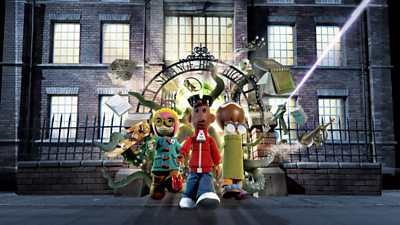
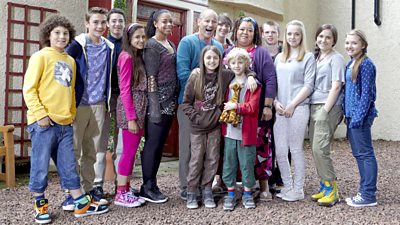
However, for me, the highlight of the course was hearing from our guest writers. The course delegates got to work with two of CBBC’s key writers – Elly Brewer who spoke passionately about her work as lead writer on The Dumping Ground; and Mark Oswin who gave a fantastically entertaining presentation on writing comedy, with reference to his work on All At Sea, Strange Hill High, The 4 O’Clock Club and – very excitingly – the remake of Dangermouse.
Although vastly different in their approaches to the scripting process, they were both adamant on two things:
1. You MUST watch what the BBC is producing for today’s children – NOT what you remember from the past.
2. You MUST know your audience and how they are today – NOT how you remember them from your own childhood;
Indeed, when you visit CBBC, something that quickly becomes clear is how passionate the department is about its relationship with its audience. Several of the course delegates noted how often the CBBC staff mentioned their audience and the frequency with which they met and interacted with them. And just to reinforce how importantly CBBC regards its audience, the writers were just a little bit shocked when they discovered that as part of their course they would actually have to work with some of their young audience – yes, they had to meet a class full of Year 7s who left them in no doubt that if they wanted to write for this demanding bunch they had better dust off their best programme ideas and get thinking about how to entertain this challenging audience who can happily watch 3 different screens at once whilst simultaneously tweeting about something they’ve seen on the web!
The writers went off exhausted but – we hope – inspired, enthused and armed with the right tools to create and pitch some fabulous ideas for this very challenging audience.
The CBBC Drama development team has produced an invaluable set of Top Tips on Writing for CBBC for the BBC Writersroom
BBC Writersroom Toolkit - Writing for Children
Watch an interview on our site with 4 Children's writers including Elly Brewer
