
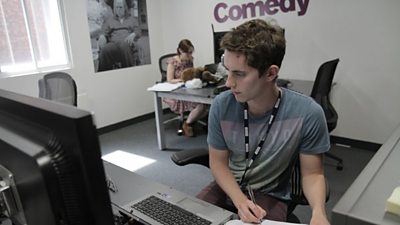
There is a wall at the BBC listing all the names of people who’ve previously been awarded the Radio Comedy Writers Bursary. The names on there are pretty impressive. Probably. I only ever look at my own. But can you blame me? If you’ve ever enjoyed defacing property as much as I do, seeing your name on a wall is a real rush. It doesn’t even matter that the wall’s opposite a toilet – it’s romantic - like your graffiti’s growing up, moving from scribbles in there to a posh stencil on the wall facing it. The most exciting part of the wall, however, is that these people (Stewart Lee, Douglas Adams et al) weren’t household names before the bursary. Over the year they all made contacts and nurtured their talent to achieve everything they’ve since gone on to. And that’s what I’m doing now. Hopefully.
But how did I get here? And what makes me more than just some guy on a spin-ny chair who occasionally steals mugs?
Money’s great. But it would be ridiculous if money was your motivation to become a writer. If you want money, find some ambergris, sell it and live in a bubble mansion. In utero, I realised my real desire in life is to perpetually seek approval. Writing comedy is the perfect domain for this. Thus, in 2009, I turned down a finite period of paid employment to write a sitcom I thought up travelling to said work. I didn’t know what I was doing, but I thought I shouldn’t delay any further and just start. The sitcom of course went on to be the highly successful Dad’s Army, and I never had to work again. This isn’t true. It was about benefits – which I know as little about as I do ambergris (google it) – and three people read it. One was an old girlfriend I gave the script to as an anniversary present. The relationship’s subsequent collapse is a useful metaphor for the success of that particular project. However, my journey towards the spin-ny chair of destiny (read: paid writing) had begun.
I then went to university in York (the University of York no less). I knew I wanted to pursue writing as a career, but I also wanted a degree I could rely on. I’m a realist. Writing comedy is a hard gig to get, and I didn’t think a scriptwriting qualification would suit me. For many I’m sure it’s absolutely perfect. However, I was sufficiently enthralled by my subject (Politics, Philosophy and Economics) and knew I could hone my writing skills at university anyway.
In the first year I did largely nothing. I hosted a radio show, watched Mean Girls seven times and missed a vital penalty in the EconSoc six-a-side semis.
That Summer I decided to write a radio play - The More Beautiful Game. Was the world ready for a play about table football? ‘Yes!’ cried back all seventeen people who tune into University Radio York non-accidentally. It even won a bronze Student Radio Award. This gave me hope. New opportunities arose. I got to write a kid’s DAB radio series - I was too naïve to realise no child has listened to the radio since Just William died. But, more importantly, I was practicing writing and producing comedy across different formats. I learnt invaluable lessons about the process which are far more difficult to pick up outside of all the facilities available. If you’re at university now, go and play with a boom mic. Just do it. Thank me in five years’ time when you’re Martin Scorsese.
I left university an older person, as is the norm, and decided to try the writing game whilst working part-time. I also chose to send some comedy to NewsJack. Everyone should do this, as it’s a wonderful and quite unique opportunity, even if you don’t like satire or volume in general. In the first episode of series seven I had a one-liner featured. The next episode a one-liner and a sketch. Then an email. The producer – ‘keep sending stuff in. You’re funny’. ‘FINALLY’ I thought, and said to myself repeatedly in a mirror. I carried on, with said producer kindly listening to/reading my work. He agreed I wasn’t entirely hopeless, and that I sang a mean ‘I Dreamed a Dream’ on YouTube. Soon I was called in to write on a few episodes of NewsJack. There are videos which explain this in more detail, but it involves a team of civilian writers hanging out in a BBC bunker all day writing nonsense. It’s great. And you realise very quickly what works by having the immediate feedback of more experienced writers around you. ‘James, don’t waste your time writing about an enchanted ATM. That’s bad’. And they were right. Amongst all this schmoozing I found out about the Radio Comedy Writer’s Bursary. I applied. I charmed. I, remarkably, got the job.
Every year the bursary opens for two budding writers who sit in the office, soaking up the aura and occasional spillage. We contribute material weekly to the flagship topical shows The News Quizand The Now Show, but theoretically we could work on any radio comedy programme, if producers so wish, including creating one of our own. It also allows me to pick up tips from previous writers and producers which, in a year’s time, will hopefully make me some kind of comedy-writing deity. At the very least I hope to be able to write my name with a biro.
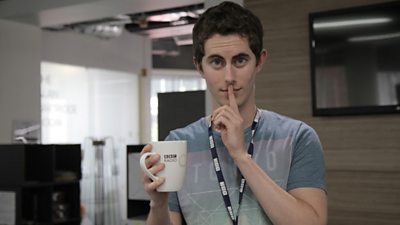
If anyone’s made it this far - keep sending stuff in. This could EASILY be you next year. Nay, it will be you next year. Each and every one of you. I only started working on NewsJack four months before I was offered the bursary. So there are opportunities out there. As my great character Corporal Jones said ‘they don’t like it up ‘em!’ Except they do – by which I mean producers love good jokes. Write good jokes. Watch Dad’s Army. Steal a mug.
James Bugg is a recipient of the Radio Comedy Writers Bursary and a contract writer for BBC Comedy. Follow James on Twitter: @jbugg89
Find out more about opportunities to write for Newsjack and watch the video guide to getting involved with the show.
Read our tips on Writing Radio Comedy and explore opportunities for comedy writer on our Opportunities page.
