
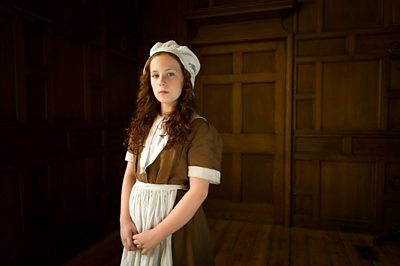
It was quite some time ago that CBBC approached me to see if I was interested in adapting Hetty Feather… Such a long while ago that I can’t actually remember the year. It could have been 2010, it could have been 2011… But suffice to say, that it was long enough ago for the exact timing to have now become a blur in the memory. Anyhow, they sent me the book – and I read it and I cried. And I knew there and then it was a project I didn’t just want to write; I had to write.
I’d adapted Dustbin Baby, also by Jacqueline Wilson, back in 2009. It was a 90-minute family feature for CBBC and BBC One, produced by Kindle Entertainment. It had heart. It also had Juliet Stevenson, Dakota Blue-Richards and David Haig in the starring roles. And the same thematic drive as Hetty Feather: one girl’s on-going search for her birth mother. The endings to the two stories, for the character of April in Dustbin Baby, and the character of Hetty, are very different – but they share a parallel need to complete their identity. It was this that the channel were obviously responding to. But as the process went on I realised there were other elements of the projects that were similar too; elements that I only realised once Hetty was completed.
Hetty Feather was initially commissioned as another 90-minute event piece, with the potential to be cut into 3 x 30-minute episodes – focussing solely on the first novel in Jacqueline Wilson’s series of three books on our indomitable heroine. I wrote the initial treatment - and CBBC loved it. They loved it so much they began to wonder if Hetty could work for them in the longer term. If Hetty’s entire story, the trio of tales, could be brought to our screens. And yes, it was decided they could. So now – my 3 ep project had morphed to a 13-parter, covering the entire encyclopaedia of Hetty Feather that made up Jacqueline’s works.
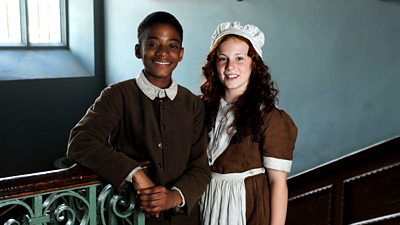
Taking the books and transforming them, initially in treatment form, was a joy. The Hetty novels are chock-full of country idylls, Foundlings girls, circus scenes and general Victoriana. The 3 novels I found broke down nicely into 12 eps – leaving me with a 13th with which I had free-reign for an ending. Obviously, at this stage, I was still at treatment stage. Jacqueline Wilson hadn’t read where I felt her favourite-ever character should end up. But what mattered was that the channel really loved it. And they saw the potential to take Hetty in an altogether different direction from their first intention.
And so the Hetty Feather that you currently see on screen was born. Hetty was to be a returnable precinct show for CBBC. This was exceptionally exciting for me. But it also, to a point, meant starting ‘afresh’.
At some point amongst this process I had also written the first couple of scripts for the adaptation of the first novel – covering Hetty’s early life in the country and her heart-breaking return to the Foundling Hospital. And now I was leaving the books as we know them and breaking them open into a ‘based on’ TV show…
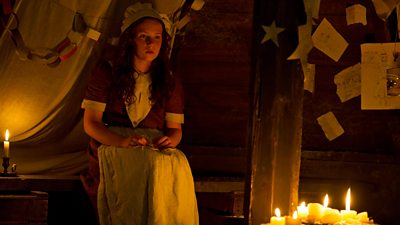
I remember my agent saying to me – ‘it’s been so long! How do you keep going on this?’ The answer was simple – I loved Hetty. The character is pin-sharp, exciting, daring; a modern-girl in a Victorian world. She was a warrior-female. She was a character that I wanted my daughter to watch and be inspired by. She stood up for her friends. She stood up for justice. She stood up against the controlling Matron ‘Stinking’ Bottomly. And she wanted to find out who she really was – and nothing, and no one, would stop her. Nor me…
By this time, I was onto my third set of development execs. Projects had come up and personnel had moved on. Yep, that’s how long it had taken. Now however, Hetty was marching forward apace. The precinct show of Hetty Feather was taking shape.
And this is where the creative choices I’d made during 'Dustbin Baby' came back to serve me well. Hetty Feather had to appeal to both boys and girls. However in the novel, Hetty’s world is very much from her point of view. We don’t see the Boys Wing of the Hospital. Her perception of life is limited. As in 'Dustbin Baby', we had no male protagonist, or wider world for Mrs. Bean, Juliet’s Stevenson’s character. I introduced her male friend in the shape of David Haig to give balance – and to give her someone to talk to.
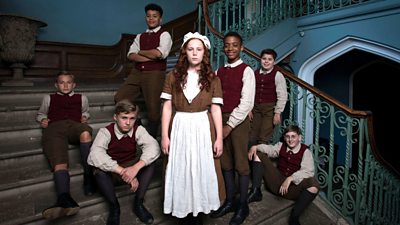
This is just what Hetty needed too. The Boys’ Wing was created. I gave them a gang, a school-master in the shape of Mr. Cranbourne – and the possibility of jinks and japes too. In the Foundling Hospital, the children lived by exceptionally strict rules. And in the show we had to adhere to them too. Boys and Girls live separately. The only way they can meet is in secret. And to do so, they have to sneak under the radar. Finding ways for them to see each other and the daring involved in doing so became very central to our concept.
To get the rules right and the tone correct, I immersed myself. Being set in the Victorian era, I read and researched. I visited the Foundling Museum in London, on the site of the Foundling Hospital where the book is set. But the show had its contemporary restrictions too. We were working with young actors and the licensing laws for children on set must prevail. In the book, we meet Hetty at a very young age. She returns to the Hospital at the age of five. In order for us to meet our exacting shooting schedule however, we knew early on, that having a lead actress, potentially in almost every scene, who is so young would be an impossibility. However, and rightly so, Jacqueline Wilson wanted us to be historically accurate in our timeline of events. Foundlings were brought back from their foster families to the Hospital at around the age of five or six. We needed to stick to this and yet at the same time, focus on the older Hetty too.
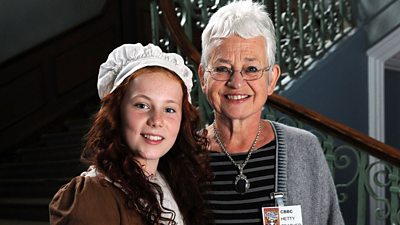
The creative and practical decision was then made to use both – a young Hetty on her return and an older Hetty who then carries the show forward. In the book, there is a timeline gap where Hetty grows up from the little girl in the ‘junior’ dorm of the Hospital to an older Hetty, whose friends are beginning to leave to go into service. This was to be our focus; our ‘lost years’, if you like.
And so the precinct show of Hetty Feather was born. With a gang-show feel, stories abound for our central characters – always driven by Hetty and drawing on inspiration from both the books and the era. It is a delight, I feel, for children to see period drama on TV. To them, a life without electricity and handheld technology, is akin to a fantasy scape. It’s different to the worlds presented to them in other shows and yet the central character is as feisty as any other. And female.
All hail the red-headed one. We love her!
Watch Hetty Feather on CBBC and catch up on BBC iPlayer
Follow Helen Blakeman on Twitter
Find out more about Jacqueline Wilson
Enter our Class Dismissed Sketch Writing Initiative for the chance to get your sketch on CBBC
