
It is a truth universally acknowledged that the collective noun for writers is a “whinge”. The mood at Cardiff’s Chapter Arts Centre, however, during the informal networking session which concluded the formal launch of BBC Writersroom Wales, was optimistic. And not just because of the complimentary wine.
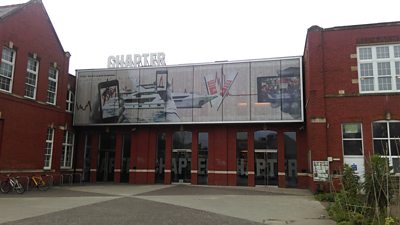
The free tickets for the BBC Welsh Writers’ Festival were all eagerly snapped up, the event attracting writers of all levels of experience: bright-eyed neophytes and seasoned professionals as well as cynical Ed Reardons. During the introductory address, Anne Edyvean, Head of BBC Writersroom, the writer’s open door to the BBC, hailed past and current successes; Rhodri Talfan Davies, Head of BBC Wales, pointed to an upcoming boost in investment; and Rachel Williams, recently appointed Development Producer for BBC Writersroom Wales outlined a planned program of initiatives and partnerships aiming to result in tangible outcomes.
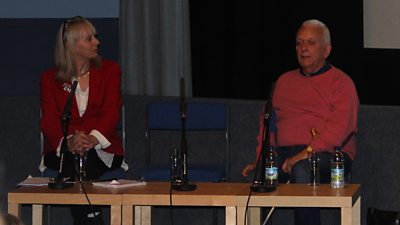
There followed the keynote Q&A with esteemed scriptwriter, Cardiff-born-and-raised Andrew Davies, preceded by selected clips representing his literally-too-long-to-summarise career (“To Serve Them All Their Days”, “Pride And Prejudice”, “House Of Cards” etc). He recalled his first credit, a radio drama inspired by his experience in the teaching profession. This was eventually followed by a BBC TV Wednesday Play (in 1967), and several dry patches. He stressed the importance to his success of relationships with particular producers (his “patrons”), reassured all present by confessing to a fondness for procrastination, discussed his favourite projects (“Vanity Fair”, “Doctor Zhivago”), and his least favourite (“Warrier Queen" about Boudica – his vision did not come across on-screen), and spoke warmly about the work of Sally Wainwright.
Surprisingly, as the creator of the marvellous “A Very Peculiar Practice”, he did not express frustration that his reputation was as an adaptor rather than an author of original work, citing a lack of skill in “making up stories”, and the fact that “f***-all happens to writers”.
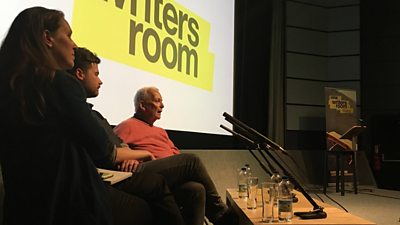
While other attendees split off for a session on popular Welsh-language soap “Pobol y Cwm”, I stayed with Mr Davies, who was joined by script editor Will Johnston to discuss the practicalities of adaptation, with particular reference to 2016’s “War And Peace” and current project “Les Miserables”. Davies’ process involves living with the original text for an extended period, in both physical and audio-book form. His career in education involved the analysis and explanation of classic literature, thus was excellent preparation. His work entails deciding which two or three characters the story is about and shaping the narrative around them, cutting out the surrounding “fat”. When asked which authors he steered clear of adapting, Davies cited the Brontës, and his inability to believe in the worlds they created.
Then came lunch (thoughtfully provided), during which I sat near another script-writing legend, Lucy Gannon, hoping to absorb some talent by osmosis.
Rather than her afternoon Q&A, however, I opted for the highly popular session on children’s TV, featuring CBBC’s Laura Conway and Ros Attille, CBeebies’ Vanessa Amberleigh, and writer Emma Reeves, creator of sci-fi comedy-drama “Eve” (and, like myself, a graduate of the school of “Tracy Beaker”). It was pointed out that this work changes its audience’s lives, and that genre is a useful vehicle for addressing issues which concern them (e.g. the lycanthropy in teen drama “Wolfblood” as a metaphor for puberty). Ideas for long-running series featuring unique characters are always being sought, as well as stories foregrounding boys (“The Worst Witch” currently doing the job for girls); and the 12 to 15 age group is sorely un-catered-for. Valuable skills for writers of children’s TV include a facility with physical comedy, and the ability to work as part of a team.
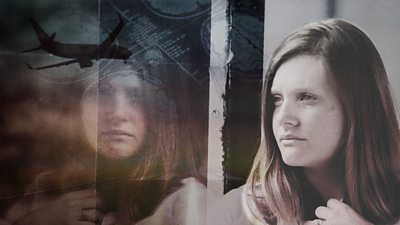
The next session I attended (also standing-room only, and concurrent with the one on “Casualty”), focussed on radio drama, with Cardiff-based producer James Robinson, and writer Matthew Broughton, author of the atmospheric nine-part Radio 4 science-fiction drama “Tracks”, and creepy life-swapping-twins two-parter “Demon Brother”. He spoke about coming to radio following a career with Theatre De Complicité, and much time spent working on unproduced screenplays – in contrast, once commissioned, radio plays generally see the light of day. Writers were advised that radio drama submissions to script windows were more likely to make progress than television ones.
Then came another frustrating clash – “Doctor Who” vs comedy drama. I opted for the latter, with Sian Harries (“Man Down”), who comes from a sketch comedy background, and George Kay (“Stag”, My Mad Fat Diary”), whose previous experience is in drama and factual programming. They agreed that the lack of rules within this hybrid genre was creatively liberating; and pointed out that they were also able to pitch projects to both comedy and drama producers. They also noted that the best jokes which arose during the writing process were inevitably rooted in character.
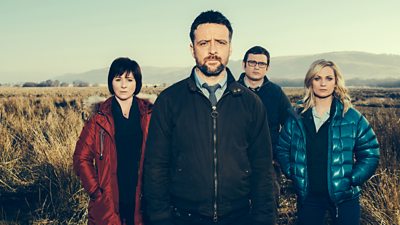
The final, collective session, “What Next For Welsh Drama?”, with director Euros Lyn (“Happy Valley”), BBC development executive Jonny Lewsley, writer Cath Tregenna (“Torchwood”, “The Bench”) and producer Ynyr Williams (“Hinterland”) focussed on the hot-button issue of the representation of Wales, both within and beyond its borders (also to be discussed at an Institute of Welsh Affairs conference a few days later).
The BBC’s need to do better in this area has been publicly acknowledged at the highest levels, and more funding has been promised. Following an earlier comment by Andrew Davies about finally “coming to terms” with his Welshness, it was stressed that cliché-ridden tales should be avoided; his point re Sally Wainwright, about her skill in finding the universal within the specific was reiterated. The inherence of the landscape to the success of West Wales-set detective drama “Hinterland” was remarked upon, and it was suggested that the incidental use of attractive Glasgow locations in the recent psychotic-female-architect drama “The Replacement” could easily be emulated here. The lack of an English-language equivalent to “Pobol y Cwm” (which provides regular work for Welsh-language writers) was bemoaned – not for the first time.
And then it was wine... I mean, networking time. And did I mention the free tote-bags?
A much-needed day of positivity.
