
It’s 11pm, and I’m in a hotel room in Cardiff, surrounded by coffee cups and chocolate wrappers. Two hours earlier I’d taken the perhaps quite rash decision to completely re-write my guest story – which I’m supposed to pitch at 9.30am tomorrow to the Story Team at Casualty, in an attempt to secure my place on the writers' Shadow Scheme. But now, the night before, I haven’t rehearsed my pitch… and in fact, I haven’t even finished writing it.
Before I elaborate on how this occurred, it might be helpful to go back a bit:
First up, it’s worth noting that the Casualty Shadow Scheme has changed. The four-day Residential training, which used to be part of the Shadow Scheme, is now part of the selection process - X Factor style.
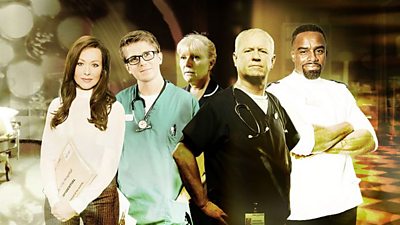
The Interview
Around July, I’d submitted a spec' script, which was not medical in any way, with a CV, and my 500 word guest story (i.e. the patient’s story). I was invited to an interview in October.
A few months before I applied, I started keeping a spotty notebook of medical ideas, articles and experiences. I watched the show every week. I’d think about the characters while I was cooking the kids’ dinner. Obsessed is probably too strong a word, but then again, probably not.
Although I was nervous, I was also looking forward to the interview. It was an opportunity to talk about a show that I love, with the people who actually make it. Any nerves I had dissipated with the appearance of Rachelle Constant – who I’d known from another project – and Oliver Kent, who announced with a wry smile that they weren’t going to ask me anything horrible.
And they didn’t. They asked me some questions about my work and my script. And they asked me about Casualty – which storylines did I like? What did I think worked (and didn’t work) in the last season? Did I have any storyline ideas for their regular characters? After a pretty intense 25 minutes, it was all over.
A week later, I got an email to say I was down to the final eight - and was invited to join the Residential.
The Casualty Residential
Three weeks later, I’m on a train to Cardiff re-reading Casualty scripts, and putting the finishing touches to a guest storyline we’d been asked to prepare for a pitch to the Story Team on Thursday.
We spent four days in a hotel in Cardiff, learning about what goes into writing an episode of Casualty. Obviously there’s no set formula, and different writers approach it in different ways, but there are some ‘need to know’ ingredients, as well as some hard and fast rules.
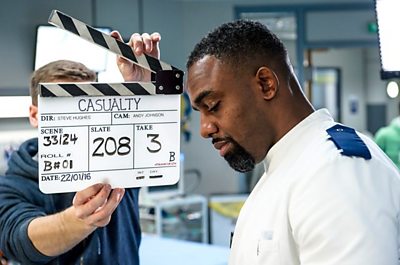
The week was packed with fantastically useful sessions, run by the writers and producers. We had a session with John Yorke on five act structure, during which he ran through his brilliant 10 questions. We had a session with Mark Catley (Writer and Story Consultant) and Kelsey Richards (the Casualty Script Producer) who talked to us about resonance – how we relate our patients’ guest stories to the main characters’ serial stories. We spoke to the medical advisor Pete Salt and the researchers - who gave us an idea of how the medical story is put together, and we also had a session with Wendy Wright (the Line Producer), who spoke about scheduling. Later, we got to have a snoop around the incredible set.
The final pitch
On the final day, we were scheduled to pitch our guest stories to the Story Team.
Which leads me onto how I ended up ditching the guest story I’d painstakingly prepared a week earlier, and pitching one I’d rustled up the night before. It was all down to one of those hard and fast rules we’d learned during the week - namely, that the paramedics, nurses and doctors should not be upstaged by other emergency services.
The guest story I’d prepared was about an extremely heroic fireman.
So at 9pm on Wednesday night, I went back to the serial document they’d given us... It was an episode about Connie, and how she kept pushing everyone away and trying to do everything herself. So I went through my spotty notebook, and found a medical story that revolved around loneliness, and trust. Once I’d made the connection it didn’t take too long to write.
I got up early and practised my pitch, before presenting it to 13 people, including the Story Team and the other Shadow Scheme hopefuls. A highlight of that session was listening to the other writers’ stories. Although we’d all received the same serial document, our guest story pitches were all very different. I don’t think I’d be alone in saying it was supremely nerve-wracking, but the atmosphere in the room was extremely supportive.
In fact, the same goes for the whole of the application process. The Residential was very challenging - it was long days and late nights, with lots of writing assignments. But it was never intimidating.
Four things I took away
Apart from my stash of dark chocolate, I think there were four things that helped me get through the week:
The first was preparation; I tried to go into the Residential with ideas for storylines for every character, ideas for new characters, opinions on everything, all of which really helped when it came to the writing exercises.
Second was enjoyment – I enjoy the show, and I wanted to enjoy the whole experience, whatever the outcome, which meant putting my nerves in a box for the four days of the Residential.
Third, was adaptability; although rewriting my guest story at the eleventh hour felt like a massive risk, in the feedback I received afterwards, I was told one of the reasons I’d got through was that I’d taken in the training, and changed my pitch accordingly.
Last but not least, was sharing the experience with the other writers. Although it was a competitive process, it didn’t really feel like that - and the good humour of the other writers was a huge part of what made it so much fun.
I’ll be getting my teeth into the shadow script next month, so the real work starts now!
As long as BBC Writersroom will have me back, I’ll be doing another article covering the shadow script.
Happy writing everyone!
Visit the Casualty website, watch episodes and find out more about the show
Watch our Writing for Medical Drama event
(The Casualty writers Shadow Scheme and the other shadow schemes for BBC Continuing Drama shows are only open to applications from agented writers)
