
Ext. Forest. Day.
Lily, 9, crashes through the undergrowth, the key to Utopian World of Endless Adventure held tightly in her hand. She reaches the portal and plunges the key into the lock. The door yawns open. She’s bathed in pulsating light. She steps forward. Johnny, 9, touches her shoulder.
JOHNNY
No, Lily. You wait here and look after the rucksacks. I’ll go and have all the fun….
If you’re a girl and a TV viewer the anti-climax of this scenario might be familiar. As a woman who is now writing for TV, I started to wonder how I could help Lily shoulder-butt Johnny out of the way so she’s the one who gets the glowy lights and adventures?
My experience is in writing continuing drama and I try to write guest characters as women whenever possible. But then it occurred to me that writing for children’s TV might be where it’s at when it comes to challenging gender stereotypes. So, armed with a yen to write for kids - and a pen of course - I jumped on my unicorn and headed to the Children’s Media Conference in Sheffield this week to find out.
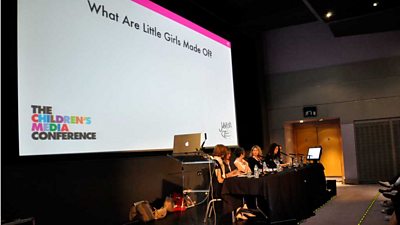
Carried on the wave of conference-FOMO, I headed for a session that asked ‘What are Little Girls Made Of?’. It opened with a clip from the Geena Davis Institute on Gender in Media. ‘See Jane’ has a powerful message. It asks when half the world’s population is female, why are girls outnumbered on screen by a ratio of 3 to 1 on kid’s media and when she is there it’s often as “eye-candy”. The conclusion - ‘if she can see it, she can be it’ - was heartening: simply adding more girl characters is a straightforward way writers, male or female, can help girls break out of their pink prisons. Yea!
But then it was pointed out that with kids’ content, writers are often stymied by the perceived wisdom that boys can’t or shouldn’t empathise with girls or their experiences.
Darn. As my heart was sinking, VP children’s programming at PBS' Linda Simensky shared a revealing anecdote. In a focus group for Cartoon Network, 10 boys were asked if they watched The Powerpuff Girls. One put up his hand. Later they were asked the same question, but this time the boys had their heads down so they couldn’t see each other. Eight out of 10 put up their hands.
CBeebie’s data was shown that also undermines the pink/blue divide. Shows like Peppa Pig, Henry Hugglemonster, Katie Morag and Kate & Mim-Mim appeal equally to boys and girls.
Let Toys Be Toys campaigner Jess Day flipped the debate by highlighting how it is important for boys to see a diverse group of girls on screen and learn that empathising with the experience of girls isn’t a threat to their masculinity. (Good tack. Show how gender balance benefits the boys. Make it about diversity, equality not nasty, gnarly feminism.)
The creator and producer of Henry Hugglemonster, Niamh Sharkey was optimistic that writers and producers can drive a change. She said if we’re all active about having more diverse characters on screen, the imbalance can be changed in a generation.
Resolved to come up with ideas that moved away from the ‘token spunky girl’ or ‘action hero boy’ mould, I headed home. Rosie the Riveter’s slogan ‘We can do it!’ was in my head. Because of course these new ideas have got to be that too. Riveting.
Find out more about the Children's Media Conference
