
It started with the image of a man sitting on a check-out counter, dousing himself in coke. An image which (perhaps worryingly) arrived in my head one night without any explanation or obvious source. I had no idea who he was, or what he was doing there, but as Pinter said ‘our beginnings never know our ends’, and I always find plenty of time to fret about 'the whys' later.
The man soon became Jim, a wannabe Buddhist Sin Eater in a Midlands mini-mart, trying his best to atone. But things aren't ever that easy. So Jim had to be confronted by his polar opposite: a form-ticking, protocol-preaching assistant manager, called Sam, who never apologises for anything and feels physically ill when stock gets damaged. This end-less beginning developed into a short play called Temples, which was performed at the BBC Writersroom 10 showcase at the Birmingham Rep, and it was fun, and silly, and visually interesting, and I pretty much thought that was that. And then, out of the blue, it was commissioned by BBC Radio 3 to be adapted for The Verb. And I was ecstatic and terrified in equal measure, because I'd never written an audio-drama before, and didn't quite know how to approach adapting a very visual play, which started life as an image with no story. Now was the time to fret about 'the whys', and 'the hows'.

A few weeks later, I was sat, staring blankly at a blank word document, when I remembered my first brush with audio-drama: I was five years old, staring blankly at a blank wall in my attic bedroom, which was so high-up and hot, it induced nightly nosebleeds and delirious visions of monsters made out of flannels. I’d barely slept for a year, and my parents were probably near breaking point, when some kindly corner-cutting mother recommended some audiobooks for lulling children into night-terror-free sleep, and they gave it a go... It didn’t work – I still didn’t sleep at all - but that didn’t matter because the stories were melting the blank walls of my hot, high, Pringles-tube of a room, and letting in a secret world of creatures, and treasures and faraway woods. And I remember seeing everything for real, and being completely agog, and not ever thinking about how those images had gotten into my head.
Of course, you can’t solve everything with stories, and the nosebleeds continued, but at least this slightly traumatic memory helped me twenty-two years later, whilst staring blankly at that blank word document. I remembered that my favourite tapes had always been the most visual – or rather, the most provocative of imagery (whether through sound or language). Those ones – the stories I really saw - were full of action, and dynamism, and movement, and used sound as a means to convey a world, with depth and life and scale. Those stories embraced the black-hole between story-teller and listener, and never underestimated the audiences’ ability to fill the gap with their own imaginations. And I stopped worrying about describing how someone might pour coke over their head, and thought instead about their mental state whilst doing so, and where they were in their head at that moment. Using that internal voice meant I could move anywhere without actually leaving the shop, and the world was suddenly open - those blank walls melted away like the ones in my bedroom twenty-two years ago.
I had a lot of fun hinting at worlds, like trying to conveying what sort of shop it is from the buzz of neon, and the sound of the electric bell above the door, or even what sort of temple Jim imagines from the sound of wind-chimes and goat’s bleating in the distance. I found I didn’t have to write a huge sound-scape, but that actually even a couple of distinct noises or phrases were enough to set up a mood or a place or a person for the listener to spar with. I thought of the whole thing as images described through the language of sound, and loved how satisfying it was to convey something without explanation, like the difference between describing your favourite place to someone, and actually taking them there – which, of course, with radio, is very do-able. If I covered as many story beats as I could with sound, and not description, I could reserve language for salty, driven dialogue, and I found that the story gaps which needed filling by spoken exposition were fun to play with once I’d accepted the knowingness of those lines (e.g. finding funny foods for Sam to get irate about, or Jim over-describing the coke as ‘own brand’). It may be the years of nosebleeds and night-terrors talking, and it may be contradictive, or obvious, or boring to say, but imagining the visual was key to me thinking about writing the audible, and went some way in solving something which has long been a bit of a mystery to me. And now I can’t wait to see the next inexplicable, inaudible image, and then spend ages working out a way to help others see it in the dark, through sound.
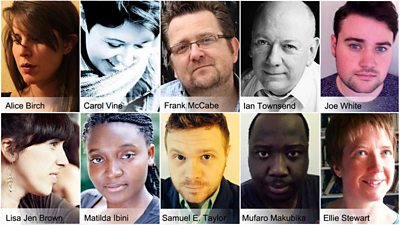
Listen to Temples by Joe White (at 26'16" into the programme, 9 more days to listen)
Find out more about the BBC Writersroom 10, a development scheme in partnership with theatres across the UK
Joe White is 2015 Writer in Residence at Pentabus Theatre
There will be three more short dramas by Writersroom 10 writers broadcast on Radio 3's 'The Verb' over the next few weeks.
