
‘We want it to be an authored piece’. This is one of those bits of TV jargon that becomes more mysterious the more you hear it. All drama is, after all, authored. What it seems to mean, as far as I can tell, is that you will be the sole writer, and that anyone familiar with your work up to now, watching the end product, would be able to identify it as being written by you. But what does that mean?
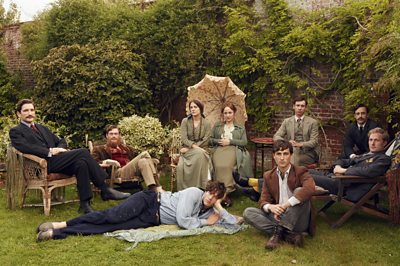
‘Life in Squares’ is a 3-part drama about the Bloomsbury group, centering on painter Vanessa Bell and her sister Virginia Woolf. Given that they were not only real people, but very articulate and prolific real people who have had countless books and articles written about them, they were bound to be strong voices in the room themselves as I started to develop the scripts. In fact, sometimes I wonder if I chose Vanessa as the central character precisely because out of the entire group – whose core included painter Duncan Grant, critic Clive Bell, biographer Lytton Strachey and economist Maynard Keynes – she was the quietest. A watcher, rather than a talker. A maker of images and not words. What that meant in life was that other members of the group – most famously her sister – ‘made her up’ according to their fantasies and obsessions, as Vanessa herself noted. They thought she was a goddess, or a Saint [a nickname she hated] or their mum. But all along she was ploughing her own, extraordinary furrow, trying to make art and raise her family and follow her heart. I suppose what she left for me was enough space to make her up for my own ends. I couldn’t author her, though: Vanessa’s project after the death of her oppressive Victorian father Leslie Stephen in 1905 was precisely to author herself.
This is where ‘Life in Squares’ comes in: after the move to Bloomsbury, a disreputable area in its day [though incredibly respectable in ours]. What follows is the story of a marriage to Clive Bell that is first invaded by Virginia and then becomes amicably open, an impossible love for Duncan [who is gay] that Vanessa is determined to make possible, the birth of their daughter Angelica at the end of World War 1, then, as the Second World War starts, Angelica’s coming of age and her growing closeness to Duncan’s former lover David Garnett … Out of all the many dramas – many the stuff of melodrama – of Bloomsbury, this was the spine I settled on for the piece. The longer form of TV gives you the luxury and the pleasure of playing out a saga, of showing the effects of time in a way that is more novelistic than cinematic. I loved the idea of a third episode that showed the next generation rebelling against the erstwhile Bloomsbury rebels, and the challenge that threw up to their values of tolerance and loyalty: the circle of life, and all that.
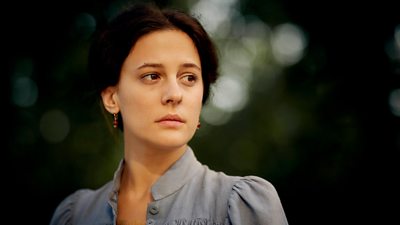
The other side of my writing life is as a novelist, so that deeper structuring felt natural and appealing. I’ve always run prose writing alongside screenwriting and I enjoy the contrasts enormously. In writing novels I relish the complete control and freedom to invent, while writing screenplays brings the pleasure of collaboration and wider audiences. In that sense TV is ‘authored’ by the contributions of the entire production team, and of course in particular by the director. The director of ‘Life in Squares’ is Simon Kaijser, whose first job this is in the UK [he’s Swedish]. Since the scripts were based on a large amount of research – more than anyone could possibly encompass coming to the subject cold, as Simon did – I was quite involved during the shoot, as a handy compendium of Bloomsbury facts as much as anything. Still, ‘Life in Squares’ remains very much a product of his vision, in its delicious colours and beautifully humane framing.
It always felt important to try to get away from the almost proscenium arch feeling of some period drama into a more intimate, lived space, just as the Bloomsbury characters were escaping the strictures of Victorian morality and domestic life. That was something I tried to embody in the scripts, so that although I drew heavily on sources such as diaries and letters and wove in reported speech, I was mindful that the dialogue shouldn’t feel stilted, except when it was meant to be. The touchstone really, was intimacy, because it was as pioneers of intimacy in life and art that Bloomsbury still has an impact. Maybe that was what attracted me to the project in the beginning, drawing on an ancient Virginia Woolf obsession. As a teenager, I was blown away not by Woolf’s novels but by her diaries, which are one of the masterpieces of English diary writing. The feeling of being in contact with a life as it’s lived is astonishing: all the random observations and fleeting emotions and jealousies and despairs and bitchiness and generosities.
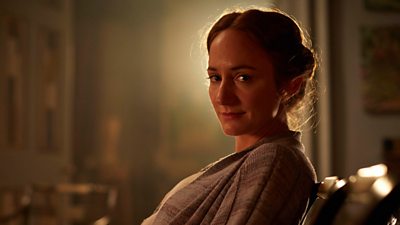
Virginia Woolf was a genius; I’m not. But in this authored piece, hopefully what comes through as the name in my particular stick of rock is what it means to relate to others intimately, as friends, lovers or family members. I think that’s probably what my work collects around, from ‘As If’ to early episodes of ‘Shameless’, to biopics such as ‘Margot’ to the adaptation of ‘Room at the Top’. The surprises of being human.
Watch Life in Squares on BBC Two and BBC iPlayer from Monday 27 July 2015 at 9pm
Find out more about the Filming Locations
Find out more about Amanda Coe's work as novelist and screenwriter
