
Editor's Note: Radio 4's epic World War One drama Home Front returned for Series 2 on Monday December 1st 2014. The drama reflects events happening on the home front exactly 100 years ago to the day.
Back in May I was on holiday in sunny Cyprus and nervously awaiting an email from BBC Writersroom to see if I had been successful in their open Script Room. I can’t tell you how nervous I was, especially as I knew the email was coming. I had no access to the internet and considering all those who had entered my chances of getting through were slim.
My writing experience until then had been small pieces for theatre, which had begun as part of a project from Birmingham Repertory Theatre. I became part of a writers group called Cucumber and we began to stage our little pieces in and around Birmingham. I then submitted a piece for Kali theatre and they offered me workshops to help develop me as a writer. As confidence in my writing grew I began to expand my ambitions. I visited the BBC Writersroom website which encouraged and dared me to come up with a children’s programme based upon my childhood growing up in the 1980’s. I had little expectation when I pressed the submit button but every few months I would get an email saying I had made it to the next stage.
I had barely arrived home from my holiday, expecting a rejection, when I logged into my email account and I saw the words BBC Writersroom and Congratulations in the title. I knew before I had even read it I had made it to the final. I was invited to a BBC Writersroom workshop along with the other winners. At the workshop I met the whole team including Development Producer, Abigail Gonda who had read my script and was very encouraging about it. About two weeks later I had a call from Abigail asking me what areas of work I might be interested in, I mentioned that radio had great appeal for me but I had never written for radio and didn’t know what the process involved. Abigail sent me an email a couple weeks later asking if I would be interested in meeting the Home Front team who were in the midst of production at BBC Birmingham, I immediately accepted the offer.
I went to the studio where I was met by the director Jessica Dromgoole and her team. For a radio production it is a surprisingly small team. There were only four people working behind the scenes, the director, two on sound production and the writer. On the other side of the studio window actors were delivering their lines from a script - the drama was quite literally happening before my very eyes. I was given a script to follow and then watched the action unfold, what struck me immediately was how very ordinary words were before my eyes being turned into drama.
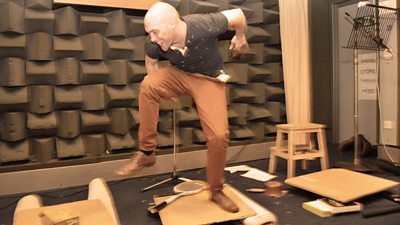
I quickly learnt that radio drama has two very important elements that must be considered: words and sound. Sound surprised me the most. As a writer I am used to seeing, writing and reading words. The technical process of how sound is used in radio is different from a film or TV. In radio sound not only creates an impression of feeling but also creates action. For example a scene in the script used snow in different ways for three very different actions. Firstly there was snow for footsteps going across a path, then there was snow that was used to fall from a tree, finally there was heavier snow falling from the tree, so that you could differentiate between the two drops. The scene involved a character standing precariously on branches on a tree, while another character called for her to come down. To show that her life was in danger, and that the tree was unstable snow was used as an effect to alert the listener to the danger of the situation for the character. There isn’t a sound that cannot create a feeling or mood that pictures can do visually.
Perhaps the most important aspect of radio drama from a writer’s perspective is that the writer is much more involved in the process than they would be for a TV show. Richard Monks is one of the writers on Home Front and has experience of writing both for radio and television. He explained to me that unlike TV, where the writer is probably not seen either by the production crew or the actors, in radio they are present when the actual production and recording take place. This allows them to have an input in the process and be involved in any changes. He explained that the opportunities in radio were just as many as in TV, but that it isn’t something that most writers think about. In some ways being involved in a radio drama greatly enhances a writer’s experience as it helps them understand the greater importance of words in drama.
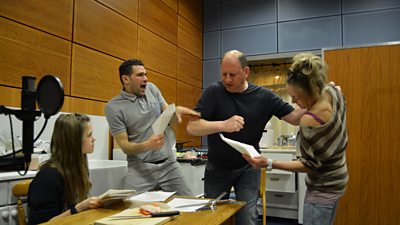
Things took an unexpected turn later in the day when a scene from the episode required extras for a rowdy chorus of disapproval in a Temperance Hall meeting. I was asked by the team if I would be one of those extras. Not sure I will ever be a thespian but somewhere in the background I did manage to mumble a few words of how alcohol was ruining the lives of the people in the city!
A day at Home Front has inspired me to write for radio. Now that I know what is involved, there isn’t any subject that would not be suitable for a radio drama. Whatever TV can do so can radio, the only difference being that it is heard and not seen and in some way that is an advantage for a writer because the listener has to actively participate in the drama, and words are listened to with greater thought and feeling than they would be on a screen. So I say to other writers out there, give radio your consideration, otherwise it’s a great opportunity missed.
Listen to Home Front, find out more and download episodes for free
See more photos from the recording and from locations featured in the programme
