
Rachel Harper is a writer and actor who was previously part of our Welsh Voices writer development group. She explains what it was like to write her first episode of Casualty, which is broadcast this Saturday 28th August at 9.30pm and on BBC iPlayer.
I’m writing this the day I begin the contract for my second episode of Casualty which should tell you two things. One - I must have done something right. And two - I enjoyed it so much I came back for more. (Either that or they were desperate and I was strapped for cash… but I’m going with the former.)
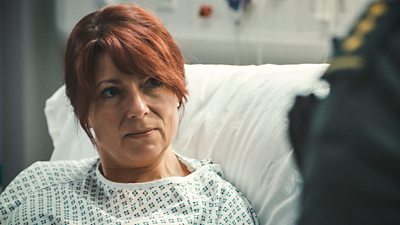
Writing for continuing drama is like leaping aboard a moving train, in the case of Casualty a train that has been on the tracks since 1986. It’s a well oiled machine and for me, understanding how every piece fits into place was the first learning curve. Almost as soon as I had said yes to the contract my diary dates came through - pitch due dates, head of department meetings, treatment deadlines. Were it not all moving so fast I probably would have taken a bit of time to panic but as it stood, I was straight in at the deep end. Panicking time is a luxury in continuing drama - and honestly you’re better off without. So I threw myself in with both feet. I re-watched episodes, read character bios, timed episodes and gave them a full autopsy in order to understand the nature of the beast. Don’t get me wrong I have been an avid Casualty watcher for years, but when you know your words are going to be on that screen soon, you see it all in a different light.
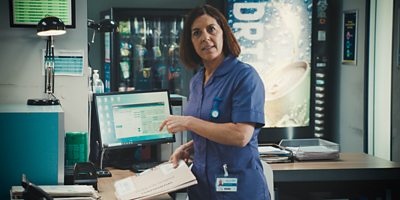
I was suddenly aware of how short a lot of the scenes were, where the long ones tended to appear, how the A, B and C stories would intertwine and play out time-wise. How hooks worked, how episodes grabbed you at the beginning and gave you something to come back for next time.
Then before I knew it, it was time to read my episode serial! I couldn’t have been happier - even though lots of things shifted and changed as we progressed, I was so thrilled with my episode. But I had no idea how to translate the serial document (the storylining document for the threads of your episode) into a treatment. To me, it read like a treatment - so what was there for me to do? “Take ownership of it!” Was the headline note from my wonderful script editor (one of my favourite parts of writing for Casualty was my incredibly supportive script editors, who also doubled as my mentors/therapists/human connection during a global pandemic).
That note was one of the most helpful, I can see that now as I read my current serial. Plot the vital beats, stick to the storyline but take ownership of the detail, the motivations, the inspirations. And then there is the fun of pitching a guest story! Just don’t do what I did and suggest an old feller tripping over a hosepipe - “that might have flown in the early nineties but you are writing Saturday night drama” (a note I frequently received and now have tattooed on my lower back). The trick with guest stories is like any good bit of writing, simple story, complex character and a clear character arc.
The scary thing with a medical drama is the meds - especially if like me, the most you know about emergency medicine was the time you were sat in a festival first aid tent because you drank too much and fell out of your wellies. But that is where the brilliant medical advisors swoop in, and they are brilliant.
The big question which I begin with now is ‘what did this character learn that they wouldn’t have learnt if they hadn’t fallen over a hosepipe…’.
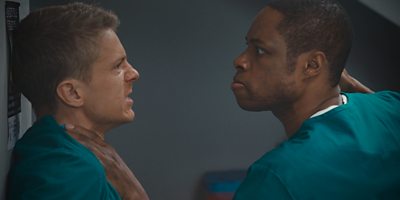
Next up was a pitch meeting with the Heads of Departments - which I assumed was going to be a couple of people but turned out to be an enormous zoom during which I reminded myself I did not win the lottery - I’m meant to be in this room. There I watched everyone discuss the ins and outs, what is possible to do for a guest stunt, where it is possible to film and everything else that has to be taken into account.
Then once we had the green light on that story and the treatments were all done it was onto the scene by scene! Again, this was the first time I had ever written one. I quickly discovered that I bloody love a good bit of colour coding. I would recommend it. Each thread gets its own colour and then you can see how the stories mesh and intertwine - which makes everything clearer. What has too much? What needs more? What cannot go back to back? An added complication is how the lot works. You have a set amount of time on location, and in different areas of the studio but with the help of my script editor, we made sense of it all.
A bit of back and forth on that and we were sailing into the first draft. This was where I did what I will affectionately call the continuing drama cry. “Oh God what am I doing? I have to actually write it and be good and turn this into forty pages!” (she wailed into her sauvignon blanc). But once that was out of my system and also remembering that I had the nicest team around me - it got a lot easier. And OBVIOUSLY the first draft is meant to be terrible. (She tells herself). I’m never one to let perfect get in the way of absolutely readable.
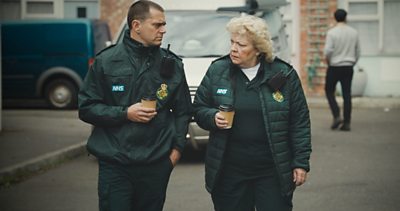
From there on it is all of the fun of rewriting - which I loved. Working on the fly, solving mysteries (Why isn’t this story working? What are these characters' real motivations? Where did all my gin go?) and finding or meeting the characters' voices. It’s great fun. Continuing drama writing takes a particular kind of writer I feel. You can’t be precious, yes that bit of dialogue might have been your Hemingway moment but is it tonally fitting? Does it have a clear thought so that the actor can make sense of what it is you want them to say? Have you nailed that character's voice? (Know your Fairheads from your Beauchamps). Because this isn’t an exercise to stroke an artistic ego, it’s adding a stroke to an already existing painting.
By the time we made it to shooting drafts, the rewrites had all slowed down and we were ready to go and I was lucky enough to get to go to set - although frankly, finding out it wasn’t a real hospital was devastating. Next they’ll be telling me Walford doesn’t actually exist. But getting to see the layout was invaluable, especially going into a second episode. And watching how scenes are turned around by a brilliant team and how the actors roll with your script is a joy. This was where I learnt two particular pieces of advice. Throughout the process I had a terrible habit of getting people stuck talking around beds, which is not that momentum-filled Saturday night drama you want. While chatting about this with one of the team, he told me about a brilliant scene in Game of Thrones, where a man is chatting whilst skinning a deer. It changes the scene completely - he is not just talking, he is skinning a wild animal. So now in any scene I always aim to skin the deer - not literally, although hey if that stunt ends up in the next script then so be it.
And the second piece of great info came from one of the actors who had shifted a few lines. I was worried I hadn’t nailed his voice but he informed me it wasn’t the voice, it was the thought. An actor will love you if you give them a script or a scene that makes sense. Because when it makes sense, the actor can make sense of it. Even if you thought that curve ball line you’d put in was pure genius, is it serving the actor and the scene, or do you just like it? A switch flicked in my head, and now I apply these two rules to everything I write.
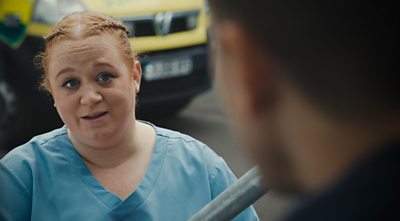
Once my episode was all done and dusted I was lucky enough to be invited to a storylining conference. Which was super exciting (and not just because of the free stationery and fact that I hadn’t been in a room with that many people since January of 2020). Watching the team create storylines was such a learning curve too, of course I did my best to contribute but above all I wanted to be there to learn. Watching someone who really knows what they are doing, plot the trajectory of a character and how every piece of their story will fit together, is again, invaluable experience. When you’re in a room with very smart people, the smartest thing you can do is absorb it all.
And now here I am! Back again! My pitches were sent off today, my HOD meeting to discuss them is tomorrow and I couldn’t be happier to be leaping back on that train - because continuing drama is where all of my favourite writers began, and after the mentoring, experience and fun I had the first time round, I can really see why…
Celebrating Casualty at 35 - Discover 10 Memorable Episodes and download and read the scripts
