
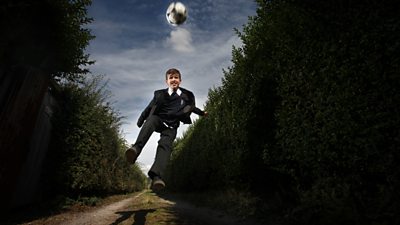
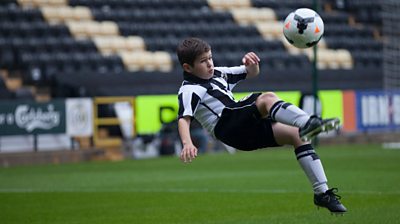
Jamie Johnson (available on BBC iPlayer) is the new CBBC drama about an ordinary boy with extraordinary skills… Unlike a mass of other protagonists right now, Jamie can’t fly or punch through steel. But when it comes to football, he’s good. Very good. He’s got a bunch of 'real world' problems - like his parents splitting up - but when the whistle blows, off he goes…
The show is well worth checking out – it’s the kind of strong storytelling that means it’s not just kids that will be drawn into it. Just watch the opening scene of ep 1 and we guarantee you’ll be saying wow…
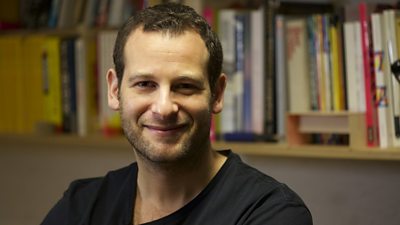
We caught up with the creator of Jamie Johnson, Dan Freedman, an author who’s passionate about stories that youngsters can relate to and enjoy; stories fashioned with realistic plots and characters who are authentic. He’s candid and insightful about the writing process, achieving success, and much more besides…
BBC Writersroom: One of the first things that struck me after watching Jamie Johnson was that you don’t hold back from the unpleasant side of life in it… The characters face recognizable problems and the kids in it are no angels… How important was that aspect to you?
Dan Freedman: I don’t think story works without it. And I don't think I could be interested in writing it without that element.
It was one of the progressions in terms of my development as a writer, as well. I initially thought because I was writing for a younger audience, I had to do what you're suggesting which is to have the kids being angelic and therefore role models for other kids... But that’s a bit boring and it’s unrealistic. The minute I was able to cast that off I discovered what I was interested in writing which is a balance. In Jamie’s case that’s his talent but also his flaws.
And so now, where I’m at is, okay, it’s about a kid growing up and a lot of kids read it, but I don’t try to write specifically for kids... I just try to write a story that I find engaging about a boy with amazing abilities who also has amazing difficulties. You have to treat your characters truthfully… It just gets a bit boring if you’re reading about characters of any age going through life without all the complexities and obstacles that we all recognise.
BBC WR: How did you go from a ‘wannabe’ writer to a successful writer?
DF: It is quite hilarious to be honest! I never thought I was that brilliant writing fiction or stories when I was at school, but I loved football and I can certainly express the way football works on and off the pitch. And so I managed to get a job as the editor-in-chief at the FA. Over the course of a number of years I interviewed people like [Cristiano] Ronaldo and [Lionel] Messi. So I knew exactly what I was doing writing about football.
I then became aware, to put it bluntly, that there wasn’t a Harry Potter equivalent for football. My mind doesn’t really go towards wizards and fantasy and I think a lot of kids are probably the same. Now this is the hilarious bit: I thought I’d just do a story about a kid who wants to be footballer instead of a wizard. I’ll tell them [publishers] I know Beckham, I’ve interviewed Ronaldo and I’ll be the next JK Rowling and they’ll make a TV series out of it and it’ll be a huge hit! I spent a year working on it, sent off the manuscript and then proceeded to be rejected by every single publisher in the UK for the next three years!
They just were not interested for a variety of reasons. I couldn't believe it. It got to the point where they were beginning to say, we're not going to look at anything unless you get an agent. And then I just started getting rejected by agents instead of publishers!
You know, I believe it came down to the fact that a lot of people thought that if kids like football they’ll be out playing it and not inside reading about it. That’s a load of rubbish! It was also about the fact that I’d never written fiction, so I needed to go on a journey, taking in things like I just mentioned about never talking down to kids or trying to paint a sanitized picture of growing up and secondary schools.

BBC WR: Any tips for getting through those times?
DF: Everybody is going to get rejected and in fact, that's a good thing. You see, I should mention the other thing that I did - and I recommend that everybody does this – every time I got rejected I asked them why. So every time I failed I tried to fail a little bit better. I am stubborn. I really wanted to prove them wrong. And to answer your original question, Gavin, it was three or four years between me thinking I was going to be the next big thing to actually getting a book deal!
BBC WR: Could you tell me about the process of going from being a published author to having a TV series made from your books?
DF: Well, the first book, The Kick Off, came out in 2007. I did a book each year after that, charting a year in Jamie’s life. From about 2010 I started getting emails from kids asking when’s there going to be a film, or can we have a TV series? I thought that was a good sign!
I had always visualised the story like that myself. I thought it would translate very well. But, of course, you could argue that getting a broadcaster on board is more difficult than getting a publisher on board. And it'd taken me three years just to get a publisher…
So, then there were lots of discussions with lots of different broadcasters and ultimately over a two or three year period of conversations with the BBC and CBBC, they decided they wanted to do this miniseries... There were three motivating factors. One. The readers. The kids. I call them ‘my bosses’… A lot of them started writing to the BBC saying we really want a TV show!
Secondly, there’s a production company called Short Form Film Co. who had absolutely the same vision as I did about the stories and about how they could be translated... And they saw the good that we could possibly do by showing what you mentioned: showing what kids have to go through in a truthful manner…
And thirdly, it was the BBC… who had the vision to see what we believed in and saw that hopefully the kids would enjoy it.
BBC WR: What’s been your involvement with the TV show?
DF: In terms of my involvement with the show… What I need to do now is let them [the programme makers] get on with it! There are some fabulous TV writers who worked on the first miniseries and are currently working on a second series. I have to recognise, if I’m looking over their shoulder, looking and analysing and questioning everything they're doing, it's not going to work. They have to be given the room to write and have the ownership to treat it as their own story…
I’m there if they need me and, of course, if it’s something I feel very strongly about, I’ll say it. But I have to filter those moments to the ones where what I am saying is helpful and constructive so we're making the best TV show possible…
[When you’re] writing a novel… it’s just you. That’s a good thing and a bad thing. It’s just you and the pen or keyboard and the whole world is your realm. Whereas TV is so much more collaborative. So many more people work on it and that's something that I have to embrace now!
You’ll be able to read the second half of our interview with Dan Freedman on Friday! Meanwhile, there’s plenty of good stuff about Jamie Johnson and the series at Dan’s website.
Plus you can watch Jamie Johnson on BBC iPlayer now!
