BBC BLOGS - Writersroom Blog

Archives for March 2011

Miranda: 'The New Me' script

Fiona Mahon|12:18 UK time, Thursday, 31 March 2011

Blog comments are currently unavailable. Find out more.

We've just added the script for Episode 1, Series 2 of the award-winning comedy, Miranda, to our online script archive.

Miranda - 'The New Me' by Miranda Hart.

You can watch a clip from the episode below:

In order to see this content you need to have both Javascript enabled and Flash installed. Visit BBC Webwise for full instructions. If you're reading via RSS, you'll need to visit the blog to access this content.


Read an earlier interview we did with Miranda Hart, and a blog post from Richard Hurst, a co-writer on the series.

And it's goodbye from me

Micheal Jacob|10:26 UK time, Wednesday, 30 March 2011

Blog comments are currently unavailable. Find out more.


It's now 20 years since I became professionally involved in comedy, so that milestone, combined with leaving the BBC, has prompted me to embark on a nostalgic journey in my final blog.

If there is a secret of comedy, I have yet to find it. Indeed, to use a rather overworked quote from William Goldman in his book Adventures in the Screen Trade: "The single most important fact, perhaps, of the entire movie industry, is that 'nobody knows anything'. Not one person in the entire motion picture field knows for a certainty what's going to work. Every time out it's a guess and, if you're lucky, an educated one."

For 'movie industry' read 'television industry', and Goldman's wisdom of 1983 still holds true.

By far the most enjoyable aspect of my work has been and is working with writers. This is partly because I've done a fair bit of writing myself over the years - from songs to journalism to some odd books and most recently a screenplay that's hanging about waiting for a read-through at the Soho Theatre in July - and partly because my first involvement in comedy was with a couple of old friends and former band mates. They had written some hit shows, and were looking for a script reader at a time when my first foray into TV had ended with me signing on and looking for work. They were called Laurence Marks and Maurice Gran, and they had recently set up a company, Alomo, on the back of the success of Birds of a Feather.

Looking back, the Alomo model has been very influential in how I think things should work, because the company was led and driven by writers who were also executive producers of their shows, and run by a man, Allan McKeown, who believed that investing in creative talent and letting them get on with it was the way to create successful television.

But at the time, I absolutely knew nothing, so Alomo was my foundation course. Being a script reader is an odd occupation. There's a classic way of doing notes in which you briefly summarise the script, describe it in some detail, offer an opinion on what works and what doesn't, and end with a recommendation.

While reading is a recognised way into the industry, I learned very quickly that the classic way of doing things is a complete waste of time. From my work with Alomo onwards, I must have read - taking competitions and College of Comedy applications into account - maybe 10,000 aspiring scripts or part scripts. And the depressing fact is that no more than 100 were any good. The tragedy of comedy is that many people think they can write it and hardly anyone can.

A lot of writers feel that sitcom consists of people telling jokes, invariably in the same voice, with no differentiation between the characters. A lot of writers approach sitcom by beginning with someone waking up, invariably when the alarm clock hasn't gone off, and they're late for something important like the first day in a new job. They go through a day in which this happens and then that happens, all with hilarious consequences, and the script ends with them going to bed. So there's no structure, no surprise - it's just an extended anecdote.

Equally, there's a belief that if a show has a novel setting then it's bound to be commissioned because that setting hasn't been seen before, not realising that if it hasn't been seen, there's a strong chance that the setting doesn't work.

Through reading unsolicited scripts, I came to realise that the most important thing to look for wasn't a show that could be made, but writers who could be fostered, who had the ability to create involving characters and the ability to be funny. Technical stuff like structure and building jokes can be taught - being funny can't.

My second lesson - once I'd been asked to join the company and script edit Birds of a Feather - was that the whole process is a negotiation, and that writers and actors are in a constant state of tension. Writers believe that what they have written will work, if the actors perform it properly. Actors believe that they can't perform properly if they don't feel comfortable with the words or the motivations and consistency of character which lie behind the words. Both writers and actors feel that whatever the show may be, it's theirs.

There's an old saying that in a first series actors are pleased to be working. In a second series they'll announce - my character wouldn't say that; and in a third series they'll claim - I wouldn't say that. Writers create the characters and stories, but on screen it's the actors who are judged.

Script editing is an odd discipline. It used to be just the writer and a producer/director. Then producers and directors separated their roles. Then script editors arrived en masse. Alan Plater once told me that he thought the proliferation of the script editor coincided with the introduction of computers. You're doubtless too young to remember stencils, but basically one would roll a stencil into a typewriter, and the impression of the keys would make holes on a waxed paper, which was then attached to a duplicating machine and printed. So a 60-page script would require someone to type 60 separate stencils which would be printed individually.

As you can imagine, rewrites were a complete pain, and were thus quite minimal because each stencil had to be retyped. So essentially early drafts were shot. Now, with copying and pasting on a computer, there's no limit to the amount of script changes, and because people can change things, they do right through the process.

I'm not arguing for a return to the typewriter, and if script editors hadn't come into being I wouldn't have had my career, but it's an example of how technology has driven the possibility of fiddling about.

Equally, moving from film to tape to digital tape to tapeless recording, has allowed for a lot more fiddling at the editing stage. When I started to work in television, programmes were recorded on one-inch tape, and you'd prepare your edit on paper or on VHS tape. If there were notes from someone once the edit had been completed, then another tape was needed, meaning that the picture quality would be one generation worse. So edits had to be extremely precise. I remember the awe I felt when an editor brought in a laptop with an Avid program, and sat at the next desk putting a show together digitally.

So edits can become an exercise in people saying could we try this, could we try that, can we go back to what it was, and so on. I found a colleague who produced a pilot recently slumped over his desk, having just completed the eleventh edit in the light of notes from higher up.

I guess the lesson from technology is that rather than speeding things up it can often slow things down by allowing people to have notes, and notes and then some notes. So while they - and of course I - really know nothing, there's considerable scope for playing around with ignorance.

In my view, and this is a philosophy I carried over into producing and executive producing and will take out into the world with me, the job of someone who works with a writer is to help that writer express what they want to express in the most effective way. I see it as like being in a studio with a sculptor, standing back and saying - 'that arm's looking bit wonky'. In other words, it's offering perspective and asking questions like - how would it be, if? Or talking about character consistency or repetition of story or pace, or it feels like it needs a joke there.

A script is the writer's creation, and that notes should be more in the area of suggestion than direction. Though, of course, sometimes one has to be a bit bossy in terms of language or libel or stuff that might lead to an adverse Ofcom ruling or a telling-off from the BBC Trust.

Working on shows has taught me that good scripts evolve, and that reading something on the page is never as good as hearing it read aloud, even if the readers might be people in the office rather than proper actors. Some things read as if they're funny on the page and aren't funny when you hear them. And, in fact, vice versa. I've seen writers suddenly quiver when a line that seems neutral gets a big laugh. So hearing, rewriting and tweaking is essential, and the lesson there is that humility is a useful quality.

I produced a first (and sadly last) series by a new writer, who was offered a great deal of help from people with a great deal of experience, and chose not to act on it. In the writer's view, the scripts were fine, and it was thwe actors who weren't doing it properly. So while it's true that nobody knows for a certainty what's going to work, I would argue that listening to people who have been there and done it successfully helps to make a guess an educated one.

While writers need to listen to notes, and consider them, they also need to be strong enough to resist a suggestion that feels wrong. It's the writer's script, not an executive's. A New Yorker cartoon of a few years back showed a man on the phone in a Hollywood office saying: "We've just got the script from the focus group. Fabulous!"

I began by quoting William Goldman to the effect that nobody knows anything and the most anyone can do is take an educated guess. I've touched on my own education, and how I feel I've come to earn the right to guess. But, really, like everyone else - like the increased layers of people with a say - I don't really know what's going to work and what isn't. Only the audience decides that.

So thanks to everyone who has read this intermittent blog over the years. I'm not planning to disappear, and I hope to see you elsewhere soon.


32 Brinkburn Street

Karen LawsKaren Laws|11:06 UK time, Tuesday, 29 March 2011

Blog comments are currently unavailable. Find out more.

I pitched the idea for 32 Brinkburn Street in November 2009 as part of a brainstorming session in Newcastle held by the Writersroom. We met Phil Collinson, Hilary Martin and Simon Judd who were interested in daytime drama ideas. I'd just been co-writer in residence for Radio 3's Free Thinking Festival and the theme was the family, so that was very much in the back of my mind, plus I had other family things going on at the time. I wanted to do something where the audience knew more about the family's history than the family did itself. This meant doing something historical but I knew the costs involved might make that a non-starter.

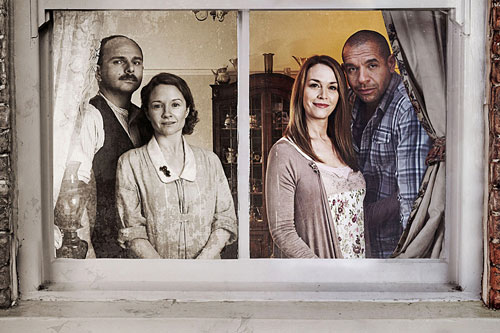
Image from drama series, 32 Brinkburn Street.

Initially I pitched the idea of three generations living in one house over a century but quickly cut it down to two timeframes. Our pitches then went to Liam Keelan, Controller of Daytime in December 2009, but a couple of months later I got an email to say although he'd been really keen on the idea it wasn't going to go any further due to lack of slots and finance.

I was trying to work out how to turn Brinkburn Street into a play when I got a call in March 2010 to say that the idea might have some life after all; a series of programmes were being planned around the census and there was a chance of a tie-in. It was one of those times when luck really plays a part and suddenly there was a chance to move forward. Between April and June we started mapping out a potential series and I started work on the first episode. We chose 1931, not only because it was within living memory but also because in many ways it's our parallel decade historically.

In order to see this content you need to have both Javascript enabled and Flash installed. Visit BBC Webwise for full instructions. If you're reading via RSS, you'll need to visit the blog to access this content.

The first draft went through a lot of changes, partly because we kept discovering things about the characters and partly because the shape of the series was changing as well. A draft of episode one went with the final outline for the series to Liam in August 2010. The show was greenlit in September; by then Alice Nutter had joined us to write two episodes. All five scripts were finally locked off by the 25th October to give the director, Dan Wilson, the chance to shoot the contemporary stuff first and then go on to the period material. We always knew our deadline for transmission had to be census week so time was always going to be an issue. I was thrilled when we got such a strong cast, absolutely delighted. Shooting was finished on 17th December, one year after the initial pitch in Newcastle.

It's wonderful seeing it on the screen; I'm still getting over the surprise of having it commissioned never mind seeing it finished. The past fifteen months have been intense, no doubt about it; sometimes it was fantastic and other times you'd be tearing your hair out, but then, that's what families are all about.

Watch 32 Brinkburn Street at 2.15pm on BBC One from 28th March - 1st April.

Read the script for Episode 1 of 32 Brinkburn Street in the BBC writersroom script archive.

Andrea Hughes, set designer for 32 Brinkburn Street, has written a blog post about her work designing the set for the series on the BBC TV blog.

TV Drama - The Writers' Festival 2011

Fiona Mahon|16:12 UK time, Monday, 28 March 2011

Blog comments are currently unavailable. Find out more.

We wanted to let you know that BBC writersroom's TV Drama: The Writers' Festival will be held this year on 6th and 7th July at Leeds College of Music. We'll be announcing full details of the schedule and guest speakers shortly on the website and blog, and tickets will soon be available to writers with a television broadcast credit or commission.

Last year's festival agenda was created by Tony Marchant, Jack Thorne, Alice Nutter, Toby Whithouse, and Stephen Butchard, with seminars headed up by the country's best writing, producing and commissioning talent including Kay Mellor, Ben Stephenson, John Yorke, , Adam Curtis, Polly Hill, Peter Bowker, Sally Wainwright, Paula Milne, Philippa Lowthorpe, Tony Jordan, William Ivory, Ben Richards, and Peter Flannery.

Stay tuned to the blog for more info.................


Writersroom 10: The winners

Fiona Mahon|14:54 UK time, Wednesday, 16 March 2011

Blog comments are currently unavailable. Find out more.

We launched the Writersroom 10 scheme in December last year as a new partnership programme for writers and theatres - marking the importance of theatre as the first home for many brilliant writers in the UK, and investing in writers and new theatre writing at an early stage.

We are very pleased to announce that the 10 winning writers and their partner theatres are:

West Yorkshire Playhouse - Dawn King

Salisbury Playhouse - Kate Mitchell

Live Theatre - Paul Charlton

Bristol Old Vic - Penny Gunter

Library Theatre - Rebecca Prestwich

Lyric Theatre, Belfast - Seamus Collins

Tamasha - Amman Brar

Old Vic - Kenneth Emson

Bush Theatre - Rachel De-Lahay

Broadway, Barking - Jon O'Neill

The 10 writers will be part of a year-long development scheme and they will each receive a seed-commission of £1000, while the theatres and BBC writersroom will run a partnership programme of events.

Judges Lee Hall and Rebecca Lenkiewicz said:


"We were very impressed by the imagination, range and quality of the work submitted. It was difficult to hone down the most outstanding from such a wealth of diverse plays. The final ten leapt out through their strength originality and boldness. The dialogue was particularly impressive and the ideas for their new commissions were striking and ambitious".

The winning writers will be updating us on their progress throughout the scheme on the writersroom blog.

Hattie

Post categories:

Fiona Mahon|11:49 UK time, Monday, 14 March 2011

Blog comments are currently unavailable. Find out more.

Another new addition to our script archive - this time it's the script for Hattie, BBC Four's recent drama about larger-than-life Carry On actress, Hattie Jacques.

Hattie by Stephen Russell

Watch the trailer below:

In order to see this content you need to have both Javascript enabled and Flash installed. Visit BBC Webwise for full instructions. If you're reading via RSS, you'll need to visit the blog to access this content.

Sherlock

Post categories:

Fiona Mahon|10:35 UK time, Monday, 7 March 2011

Blog comments are currently unavailable. Find out more.

We've just added a script from Sherlock to our writersroom script archive.

Sherlock - The Blind Banker by Steve Thompson.

Watch the trailer for the Sherlock series below:

In order to see this content you need to have both Javascript enabled and Flash installed. Visit BBC Webwise for full instructions. If you're reading via RSS, you'll need to visit the blog to access this content.

An Imam and a Rabbi: The well of personal history

Post categories:

Shakeel Ahmed|11:30 UK time, Friday, 4 March 2011

Blog comments are currently unavailable. Find out more.

Ideas can come from anywhere. A song. A conversation. A dream. Something overheard. David Gray once remarked, when discussing the song 'Please Forgive Me', that inspiration came and he was lucky enough to intercept it. I'd only partly agree with that.

Image from an Imam and a Rabbi

In the Arabic language the word 'khaliq' means 'Creator' when it is used in reference to God. However, when it is used in reference to human beings the word means 'liar'. Within the language there is an acceptance that the capacity for creation (that is, to bring something into being from a state of nothingness) lies solely with God. Human beings can only fashion, form and configure using what we already have. This is an important point to keep in mind when considering where a writer can get his or her ideas from. Every single one of us has a wealth of life experience behind us - broken promises, dashed hopes, happiness attained, sadness earned, loneliness, joy, rage, love, regret etcetera. By reflecting deeply on our own personal achievements and shortcomings (especially the shortcomings!) we can increase our chances of accessing the material necessary to write engaging, meaningful stories. To write about life we must first live.

Though An Imam and a Rabbi could be described as a supernatural comedy, in my mind the story was always about the quest for sincerity, and the point was always to get the protagonists from a position where they are doing what they are doing because it is what they've always done, to a point where they are doing it solely because they know it is the right thing to do. Once the overriding theme was in place, it was simply a matter of drawing from the well of personal history (hey, that's the title of this blog piece!) to fill in the blanks.

On a Less Useful Note...

It would be ridiculous to assume that a budding scriptwriter who has only had a couple of script commissions has much of value to pass on in the guise of advice. Irrespective, I'm going to assume, in the spirit of unity, that you ('the Reader') are exactly like me ('the Fluke') and will offer advice accordingly. If you have any hope of surviving as a scriptwriter you will need the following:

a) A pen

b) Something to write on using the aforementioned pen (paper works best)

c) A laptop

d) A lap (preferably own)

e) Delusions of grandeur married to lashings of passionate self-loathing

f) A network of understanding family members who know to expect nothing productive from you

for an extended period of time

g) A call centre job

Once all these variables are in place quit the call centre job and follow the timetable below as stringently as possible if you wish to obtain a BBC Radio commission:

Dawn - Get up to pray. Go back to sleep as soon as possible once devotional worship is complete.

10.00am - Start the day (i.e. wake up and lie in bed contemplating the finite nature of existence until the fear of death lights a fire beneath you).

10.30am - Get up.

11.00am - Following general bathroom (un)pleasantries prepare yourself mentally in anticipation of the hard day's work ahead.

11.05am - Contemplate having a nap. Decide against it. Treat yourself if you reach your intended

target for the day.

11.10am - Surf the net. Convince yourself that this is vital research.

12.00pm - Start typing. Empty your head of every incoherent though.

12.20pm - Attempt to make sense of the interminable chaos that now soils your laptop screen. This is called 'scriptwriting'.

13.00pm-14.00pm - Eat and pray. Not at the same time.

16.00pm - Wake up from nap. Try to remember when you actually fell asleep. Realise that you never did actually give yourself a target for the day. Lament the fact that you embody the very worst possible stereotypes associated with 'the writer'. Pray and ask for forgiveness.

16.10pm - Start to rectify the fact that you've done less than nothing.

17.00pm - Having found yourself in a groove, only take breaks for prayer (and maybe food). It is also recommended to stretch legs occasionally to minimise risks of developing a blood clot.

Midnight - You are now hungry (and lonely). Re-read that day's efforts and thoroughly despise

everything you have written.

01.00am - Realise that any success you have within this industry is either a complete fluke or Divine providence. Continue anyway. Be grateful to anyone who has ever given you even the slightest modicum of encouragement and continue your efforts in the knowledge that nobody ever achieved anything of worth without exerting themselves.

Shakeel Ahmed is the writer of An Imam and a Rabbi, which was broadcast on Radio 4 as part of 'Market' - an umbrella series of six plays about people who work in and around its stalls.

Listen back to An Imam and a Rabbi on iPlayer.

Read the script for An Imam and a Rabbi in the BBC writersroom script archive.

Shakeel responded to a writersroom open call for Muslim writers to work on a forthcoming BBC comedy show, he also took part in BBC writersroom's 2008 EastEnders Voices scheme to bring diverse writers to the attention of the show, and has been the recipient of a bursary to work with BBC Comedy in Manchester.

Laughing Stock - the latest

Paul Ashton|12:08 UK time, Wednesday, 2 March 2011

Blog comments are currently unavailable. Find out more.

So our final tally of entries is an astonishingly grand total of 1808 - a lot more than we usually get in script competitions, augmented no doubt by much tweet activity.

The readers are ploughing bravely into the scripts as i type and are already uncovering what they think may be contenders for the workshop. Halfway through the initial sift and we've had all kinds of characters, ideas, worlds and setups, from transvestites to trappist monks, pathology labs to magical doors, storage units to surreal newsrooms. Recurring themes include student sitcoms, hapless men, mockumentaries and the recession.

Watch this space...