BBC BLOGS - Writersroom Blog

Archives for February 2011

Free tickets: West is West screening and Q&A at The Tricycle

Fiona Mahon|14:56 UK time, Monday, 28 February 2011

Blog comments are currently unavailable. Find out more.

The Tricycle is offering a limited number of FREE tickets for a screening and Q&A of West is West tomorrow at 8pm.

To book your tickets - call the Box Office on 020 7328 1000 and quote: 'BBC Writers Room West is West Special Offer'. Tickets must be booked in advance of the screening and there are only a limited number of free tickets available.

Further details are below:

West is West (15) + Q&A with Lead Actress Linda Bassett, Director Andy de Emmony and Executive Producer Jane Wright

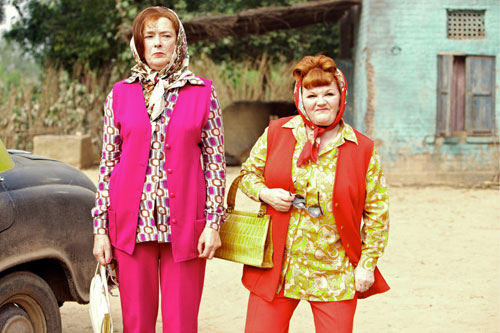
Image from the film, West is West.

Tuesday 1 March at 8.15pm

Tricycle Cinema

The fantastic Linda Bassett - most recently seen Simon Amstell's Grandma's House known for work including Calendar Girls, Lark Rise to Candleford, The Hours and The Reader - is visiting the Tricycle for a special screening of West is West the sequel to BAFTA winning East is East, one of the UK's most successful films. The lead actress who returns to our screens as Mrs Ella Khan (twelve years after the first film!) will be joined by director Andy de Emmony whose previous work includes Father Ted, Red Dwarf and Spitting Image and Executive Producer Jane Wright recently Managing Director at BBC Films.

Visit The Tricycle website for more information.

Watch the trailer for West is West on the BBC Films website.

2011 Oscar Nominated Scripts

Fiona Mahon|10:52 UK time, Monday, 28 February 2011

Blog comments are currently unavailable. Find out more.

This year's Oscar-nominated scripts including The King's Speech, Inception, True Grit and The Fighter, are available to read over on the Raindance website.

Enjoy!

Writers Academy 25

Post categories:

Ceri Meyrick|10:17 UK time, Friday, 25 February 2011

Blog comments are currently unavailable. Find out more.

Oscar nominations and other news

It's Oscar weekend, and Writers Academy graduate Tom Bidwell has been nominated for his short film Wish 143, made through the Writersroom's scheme BBC Drama Shorts.

Tom's inspiring story as a writer is told in this Guardian article:

https://www.guardian.co.uk/film/2011/feb/24/oscar-nomination-tom-bidwell-short-film

And, if you haven't seen it when it was posted here before, here's his film:

Tom teamed up with Casualty director Ian Barnes to make his film, and in addition, former EastEnders director, Tom Hooper is up for awards for hot favourite best film The King's Speech. All in all a good week for Continuing Drama.

" A huge percentage of our continuing drama graduates have gone on to play major roles as directors, writers, producers, script editors and commissioning editors, across not only the British television industry but the American one as well.", says John Yorke, Controller, Drama Production and New Talent.

We even made a film about it...

In addition this week Continuing Drama has announed the appointment of an External Writers Ombudsman to look after the interests of writers working for the department. Tony Garnett, the hugely experienced and respected independent television producer has agreed to take on the role.

The purpose of an ombudsman will be to offer writers the opportunity to benefit from Garnett's wealth of expertise as a script editor, screen writer, director and producer when they feel they need third party guidance beyond the BBC or Writers Guild.

The new role is set to support BBC Continuing Drama's on-going drive to attract and develop the highest quality talent and place writers right at the heart of the drama production process. The new role has been set up with the blessing of the Writers Guild who work to protect the interests of all writers working in the industry.

And finally, Writers Academy applications will be open this year from 11th April. For details of the online application process keep you eye on this site.


Silent Witness: Bloodlines

Post categories:

Jim Keeble & Dudi AppletonJim Keeble & Dudi Appleton|11:42 UK time, Tuesday, 22 February 2011

Blog comments are currently unavailable. Find out more.

Silent Witness is a rare thing on British television, a two hour show. Two hours is the length of a film, and we've tried to approach each SW script we've written as just that - a movie. To carry an audience through a two-hour story you need a strong concept at its heart, and a good pay-off. If the audience has stuck with you for 120 minutes you better not leave them less-than-thrilled at the end.

Yet this was Silent Witness' 14th series. How to keep it fresh and stirring? For a while we'd been talking about making a 'Euro-thriller' in the vein of the recent Jason Bourne movies, or contemporary French films like Tell No One. So when series producer Richard Burrell said there was interest in setting an episode in Hungary, where he worked on BBC's Robin Hood, we shook him warmly by the hand.

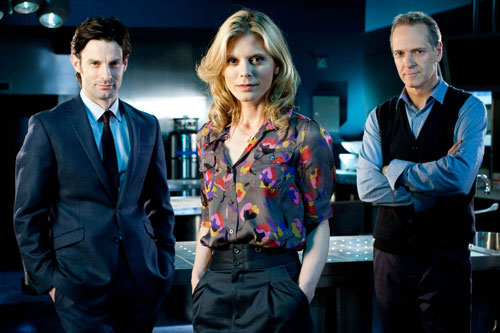
Cast of Silent Witness.

From the outset, we liked the idea of Harry Cunningham, the show's pin-up boy, and a character wholly confident and competent in his English world, suddenly alone in a country where he knows no one, doesn't understand the language, and people want to kill him. We wanted to take the character to the limit of his endurance, pushing him darker than the audience was used to, and perhaps comfortable with. It would be a classic 'man-on-the-run' thriller. And like our previous campus shooting episode, far from your typical Silent Witness.

But we needed a concept, something at the heart of the story to give it intrigue, veracity and excitement. We needed a hook.

We're two writers who write together. It works like this. We sit in a room and write every action line, every dialogue line, every scene. Together. Having known each other for more than two decades, there's a familiarity that breeds much respect and minimal contempt. We have a simple rule. If there are two rival ideas at stalemate, we have to come up with a third idea that's better. It works. Most of the time.

Over copious coffee a clear and simple hook emerged.

Who better to fake their own death than a pathologist?

The Silent Witness pathologists spend all their working lives (and it seems much of their leisure time) deciphering how someone died. What if they needed to disappear long enough to solve a crime? Surely they'd be able to fabricate evidence that would suggest they were dead.

So Harry would 'die'. And for part of the film all the other characters would believe he was dead. For this to work, we felt, we needed not only the people in the film to think our leading man was dead, but those watching the film too.

In short, we wanted to kill off a lead character in one of the BBC's most popular dramas. And then bring him back to life again.

To their credit, the series producers and executives agreed (with some trepidation). Now we had to pull it off, to convince people Harry had been killed and then show, convincingly, how he faked his death. Both sides of the mirror had to be rigidly believable.

Next up, we needed a reason for Harry to go to such lengths. So we gave him a Hungarian girlfriend who is murdered while he's upstairs in her flat, making Harry the prime suspect in her killing. On the run, trying to discover who killed her, he is himself almost killed. Then he learns his girlfriend was pregnant. Each development in the film takes Harry further from his comfort zone, and closer to the truth.

And so, at the end of the first hour, Harry is 'killed'. We see an assassin pointing a gun at him. Gunshots ring out as, from a taxi, Leo sees a hooded man shooting Harry in the head. Leo rushes to the burning body, its face shot to pieces, a Ukrainian gang killing. Only Harry's passport survives the inferno...

But would the audience actually buy that Harry was dead?

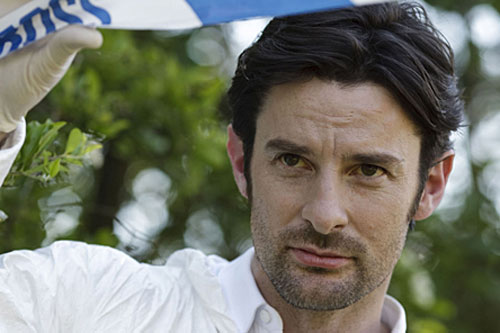
Silent Witness character, Harry Cunningham (Tom Ward).

On transmission day, instant online reactions told us most viewers believed wholeheartedly that we'd just killed Harry. Yet our relief quickly became fear. The fans were mad as hell. How dare we kill off hunky Harry? One female Tweeter (most comments were from women, strangely) declared: "Silent Witness, you're dead to me!" The next day a Daily Mail headline screeched: 'Silent Witness fans left reeling...'

The next night, Part Two brought jitters. Would they forgive us when Harry resurfaced alive? Not long into this second hour, Harry reappears and explains what happened. The 'killer' was clipped by a passing truck, hit his head on the concrete and died. A shocked Harry switched identities, shooting the dead man's face and burning the body, mimicking the gangland execution.

There was euphoria from (female) viewers. Harry was alive. And people seemed to accept the premise that Harry had faked his own death. We were not going to be lynched. At the end of the film, viewers seemed genuinely excited that they'd been put through the mill.

Sometimes, it seems, you don't give the audience what they want and they like you for it.

Jim Keeble and Dudi Appleton are the writers of Silent Witness: Bloodlines - Parts 1 and 2.

Read the script for Silent Witness: Bloodlines in the BBC writersroom script archive.



Last day for Laughing Stock

Fiona Mahon|14:21 UK time, Monday, 21 February 2011

Blog comments are currently unavailable. Find out more.

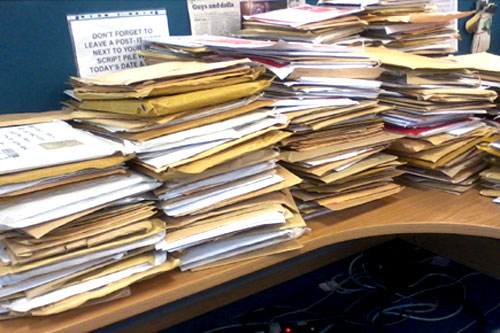
The entries for our Laughing Stock comedy competition have been coming in thick and fast. We've had over 15 sack loads of mail today alone, and are expecting even more to come. Here's what our office looks like right now!

Scripts piling up in the BBC writersroom office.


We can only accept entries until 5.30pm today (if you're in London - you can hand deliver your script up to this time). Good luck to everyone who has entered.

The Big Question

Lisa HoldsworthLisa Holdsworth|12:29 UK time, Wednesday, 16 February 2011

Blog comments are currently unavailable. Find out more.

It's a question that has become a joke amongst writers. You assume that the person asking you the question is devoid of any creativity. Certainly no self-respecting writer or wannabe writer would catch themselves asking the question in question. Still, maybe it's a question that bears some analysis. So, get down from your high horse and ask yourself...

Where do you get your ideas from?

The answer, in case you are wondering, should be "everywhere". The job of a writer is to be a sponge; soaking up information, fab facts and characters wherever they may go. You should be exposing yourself (metaphorically not physically) to everything that the world has to offer.

Now, I realise that sounds tiring. We are writers after all; we took the job so that we wouldn't have to leave the house. Or wear shoes every day. I'm not suggesting you go all Bruce Parry and strap on your rucksack. However, make sure you are not closing yourself off to those crazy moments of sparking inspiration when an overheard conversation or a one-paragraph story in the Metro sets you off on one of those brilliant flights of fancy. You know what I mean. When you have to jump up and turn on the bedside lamp and grab a pen? When your pencil won't move quickly enough across your page? Yeah, that glorious thing.

But there are also the dead times. The head-on-desk days when your muse has deserted you and you feel like you are pushing the same dusty, boring characters around the page. That's when you need to go out and meet some new ones.

Take a ride on the top deck of a bus and make sure you leave your MP3 player at home. Earwig, eavesdrop and generally be a nosey parker. Do some people watching and not just at your regular overpriced coffee shop. Go to the dodgiest looking pub in town. Go to your local market. Spend a day in the crown courts or at a council meeting.

Obviously, be sensitive and have some respect. I don't want to hear about anyone sitting in on an AA meeting or hanging about at an STD clinic looking for ideas for a Doctors episode. Being a writer excuses a lot, but it doesn't excuse you being a douchebag.

And also, don't go out in a desperate frenzied search for an idea, pencil and pad in hand. Looking for new ideas is a bit like looking for a snog at the school disco. If you're too desperate, you'll repel ideas. Or you'll end up slow dancing to Careless Whisper with the boy with terminal acne and paint-stripper breath. Or was that just me?

Be the sponge. Just accept that you're going to soak in the inspiration only for it to surface when it's needed.

It's also worth taking a long hard look at your viewing, reading and listening habits. Do you only watch films of a certain type? It doesn't matter if you're a hard core Jennifer Aniston romcom fan or you only watch black and white French films. Try to open yourself up to new stories and new ways of telling those stories. Watch the classics, but don't get too hung up on the fanboy arguments about whether Star Wars is a better film than Citizen Kane. It doesn't matter! Watch 'em both and see how they tell stories.

It's totally Citizen Kane by the way. Moving on...

The same goes for the telly box. Don't dismiss certain genre because you think they are too populist. You should be watching soaps, medical dramas and cop shows to see why they are so enduring. Don't be a box set snob. Also, don't just watch the national news. There some great small, human stories on local news. Just because they don't make the front page, it doesn't mean they don't have impact or jeopardy.

Of course, we have a great source of quirky stories and incredible, inspirational factual programming broadcasting 24/7, free to air in the UK. It's Radio 4. Now, don't get me wrong I can't listen to it when I'm writing or driving (it's all about the Glee soundtrack in my car). But recently I retuned the radio in my kitchen to Radio 4 and I've heard amazing stories and great research material. I only dip in and out, but it's all going into my brain bank for a rainy day.

Remember, there is an unlimited supply of ideas out there. It's just that only some people are open to them. We call them writers.

Lisa Holdsworth is a TV writer who has written episodes of Fat Friends, Emmerdale, New Tricks, Robin Hood and Waterloo Road. Read her blog - Deadlines and Diamonds.

Men Behaving Badly

Post categories:

Fiona Mahon|11:03 UK time, Monday, 14 February 2011

Blog comments are currently unavailable. Find out more.

Image from Episode 1, Series 6 of Men Behaving Badly.

With only one week left till the deadline for Laughing Stock, we thought you could do with some inspiration. We've just added a script from classic BBC comedy series, Men Behaving Badly - written by Laughing Stock judge, Simon Nye - to our script archive.

Men Behaving Badly - Series 6, Episode 1 'Stag Night' by Simon Nye.

Find out more about the Laughing Stock comedy competition.

The Interface - A Reader's Perspective

Post categories:

Writersroom ReaderWritersroom Reader|10:54 UK time, Tuesday, 8 February 2011

Blog comments are currently unavailable. Find out more.

Somewhere out there in a distant universe is the land where TV drama gets made. For most writers, even highly experienced ones, successful in the field, it's a mirage on the horizon. Does it really exist? How the hell do you get there?

All of us readers are people who work in one guise or another within the world known as the 'industry'. With this comes as an awareness of how hard it is to break through to that promised land. The sinking feeling that you get when you read a covering note saying something along the lines of, "I think Judi Dench/ Valerie Singleton/ Joan Rivers would be great in the part of Mrs X" is tangible. What this attitude implies is that we are destined to be the bearer of bad timings. Not only is Judi Dench not available, but neither are Val Singleton, Joan Rivers or even Joan Collins.

One of the hardest things to deal with as a reader is the knowledge that writers are going to be disappointed with the feedback we give. They're going to be disappointed because they're approaching us with false expectations. The land of TV Drama Production does exist, but it's distant, remote, and most of the time there aren't even any signposts. As I say, even the most experienced of writers will struggle to arrive there and see the green light. For the inexperienced writer it's even harder. That's where we come in. We are a port of call. We are the interface.

There are certain basics which if they're lacking in a script make a reader groan. An understanding of character, structure and story. A grasp of dialogue; the understanding, frequently lacking, that every story, no matter how avant-garde, has a beginning, a middle and an end. The sense of a world which is inhabited by the characters of the piece, a world which might exist in the real world, beyond the confines of the author's head. An understanding of genre and medium. All these things are essential, and frequently lacking, and it will be the ones which fail to come to terms with these basics which are unlikely to make it through the first ten-page sift.

But when you enter the full-read stage, there's something else that we're looking for. The chances of unearthing the next Pinter or Potter are unlikely. But we're looking for potential TV writers. TV is a team game, and TV writing has own particular requirements. These include the ability to respond to notes; an awareness that even the submitted draft, whilst at the time seemingly the very best the writer can deliver, still has scope for improvement. And also, finally, sheer perseverance.

On every sift day, when the readers come in to do the initial ten page read, there's a script meeting, where we feed back on the scripts we took away the last time which we feel have real potential. The writersroom is, in my experience, unique in encouraging this forum, where most organisations have a highly impersonal relationship with their readers. This opportunity for the reader to talk about why they liked the script in question is one of the most satisfying aspects of the job. Over the years of reading, certain names of aspiring writers become familiar. Satisfying as it is to talk about someone whose script you've just read and liked, it's even more satisfying when another reader champions the script of someone who you read six months or a year ago, call them Mrs T, and gave notes to. At which point you think - Great, Mrs T is sticking at it and maybe the notes I gave them helped and maybe they didn't, but something seems to be functioning, both for Mrs T and the system.

At which point Mrs T's work will go on to be read by people who are slightly closer to the distant universe where exists the land where TV Drama gets made. They've still got a long long way to go, but they're on the road. As a reader, you've done all you can.

We are not the wizards or gurus of the promised land. We're just the interface. But we aim to interface as well as we possibly can.

Find out how to submit your script to BBC writersroom.

Writersroom Q&A: Tony Marchant on Garrow's Law

Fiona Mahon|11:45 UK time, Monday, 7 February 2011

Blog comments are currently unavailable. Find out more.

We recently held a very special BBC writersroom Q&A session with writer, Tony Marchant. Focusing on BBC One drama, Garrow's Law, Tony spoke to Kate Rowland and an invited audience of writers about the process of researching and writing the series - how he approaches writing his treatments, and how he turned the original court transcripts into primetime drama.

You can watch clips from the Q&A session below:

BBC writersroom: Tony Marchant Q&A - Part 1

In order to see this content you need to have both Javascript enabled and Flash installed. Visit BBC Webwise for full instructions. If you're reading via RSS, you'll need to visit the blog to access this content.


BBC writersroom: Tony Marchant Q&A - Part 2

In order to see this content you need to have both Javascript enabled and Flash installed. Visit BBC Webwise for full instructions. If you're reading via RSS, you'll need to visit the blog to access this content.

The script for Garrow's Law, Series 2: Episode 1 has just been added to our script archive. Watch the trailer for Series 2 below:

In order to see this content you need to have both Javascript enabled and Flash installed. Visit BBC Webwise for full instructions. If you're reading via RSS, you'll need to visit the blog to access this content.

Future Talent Award

Jo Combes|10:13 UK time, Friday, 4 February 2011

Blog comments are currently unavailable. Find out more.

We are delighted to announce that the finalists for the FUTURE TALENT AWARD are:

Bill Grundy for his screenplay set in the Cumbria fells in the wake of the foot and mouth crisis

Daniel Moulson for his comedy about a day in the life of three students with romantic crises

Katie Ruffley for her family drama about a brother and sister coming of age in the 1960s.

We also shortlisted Alix Eve, Callum Mitchell, Kate Warburton and Refat Yasmeen for their great scripts.

The winner will be announced at the Future Talent Ceremony on March 2nd.

We'd like to thank each of the over 160 writers who entered their scripts - the standard was incredibly high this year and the quality overall was brilliant.