BBC BLOGS - Writersroom Blog

Archives for November 2010

Primary colours in grey Newcastle

Micheal Jacob|15:33 UK time, Monday, 29 November 2010

Blog comments are currently unavailable. Find out more.

Bright colours, repetition, a strong sense of right and wrong and a title sequence which tells the audience what the show is about are all important elements when it comes to making television for an audience of four- to six-year-olds.

Those are some of the things I learned when the College and CBeebies Production collaborated on a writing workshop in Newcastle earlier in the month.

The workshop combined in-depth exploration of three successful shows with the seven writers devising, developing and refining individual ideas for a live-action comedy series, which they presented at the end of the week to Kay Benbow, the Controller of CBeebies.

The main lesson I took away, though, is how difficult it is to make successful television for this particular audience, and how rewarding it must be to get it right. Unlike CBBC - where comedy is essentially a scaled-down, broad-brush, sillier version of adult shows allowing writers to unleash their inner child - CBeebies demands a recognition of the developmental stage of the audience.

It's an audience that needs clear signposts, logic, uncomplicated story-telling and a pace that allows for understanding. So writing isn't about talking down. Rather, it should meet the audience where the audience is.

Michael Towner, who produces the Justin Fletcher sketch show Gigglebiz, and who ran a session at the workshop, described two screenings of the pilot. The first was for three- and four-year-olds. They watched in silence, then at the end erupted, repeating lines and acting out the sketches. The five- and six-year-olds laughed and interacted with the show as it was being screened. Both enjoyed it, but approached it in ways which reflected their age.

ZingZillas is a hybrid show involving music, comedy and narrative, with the educational goal of introducing children to different forms of music and different instruments through human guests in each episode - the ZingZillas themselves are monkeys who live on an island which also features the megalithic Moaning Stones.

According to the series producer, Tony Reed, in initial development each episode featured an interwoven A story and B story, a plan which was jettisoned in favour of a single plot with clear signposts. The climax of each week's episode is 'The Big Zing', when the monkey band plays with the human guest, and there is an element of jeopardy each week - will the plot allow the ZingZillas to sort it out in time for their big number? Fortunately, it does.

The third show to be examined in depth was Grandpa in My Pocket, in essence a sitcom, in which James Bolam as a mischievous grandfather has a shrinking cap which allows him to wreak havoc, seen only by his grandson, Jason Mason.

Its co-creator and co-producer Mellie Buse, says the key to the show's success is that at its heart it has a true, touching and recognisable relationship, albeit one with an unusual twist. If a show has reality at its heart, then it's possible to build 'bonkersness' around it, Mellie said, something as true of Father Ted as it is of Grandpa.

Our three case studies, as well as the wisdom of colleagues from the children's area - Barry Quinn and Katie Simmons - provided a great deal of advice for writers wanting to explore the pre-school area, but while the advice appears perfectly straightforward, the reality of getting things right for the audience seems rather less so.

So adding to the first paragraph, I also learned that catch-phrases are good if they come from character; that familiarity is important; that reading something you've written to a child in the target audience can be very illuminating; that there is always another audience to take into account - that of parents and adults; that there can be antagonists, as long as they receive a comic come-uppance; that shows should be educational in a broad sense; that characters should regularly remind the audience what the story is about; that the world should be a world that children would like to live in; that a show should have a theme; and that structure is as important in writing for children as it is in writing for adults.

Of course, a number of these are rules that span any age-group, but some aren't, and it was a week where I learned a lot and the world was full of primary colours.

Saturday sees the end of the All Mixed-Up sitcom competition, with a showcase which I'll write about next week.

Atching Tan: Travellers on Radio 4

Post categories:

Dan AllumDan Allum|15:37 UK time, Monday, 22 November 2010

Blog comments are currently unavailable. Find out more.

I'm a writer, and the director of the Romany Theatre Company (RTC). I'm a Gypsy Traveller. I've been writing plays for theatre, radio and short films for about twelve years now. I founded RTC eight years ago - RTC runs Arts and Education projects with both Travellers and non Travellers.

Being a Gypsy I had very little formal schooling and taught myself to read and write in my mid teens. I went to drama school in London in my mid twenties. Since then, and outside RTC, I've become a commissioned writer for theatre, worked at the Royal Court and been involved in a number of projects with the BBC including being part of SPARKS for Writersroom and creating the local radio series, Atching Tan (stopping place in Romani). The play for Radio 4 is a spin off and prequel to this series.

The main characters in the play are two Gypsy Travellers, Lovvie and Nelius. Both are played by real Travellers as are all the Travellers parts in the play. Lovvie is an 18-year-old Traveller girl who is caught in a dilemma - she feels there is more to life then living on a site but is not sure whether she should take the easy road and do what all her friends and family are doing and stay with the community she loves, or take a risk and step out into a new exciting and unknown world?

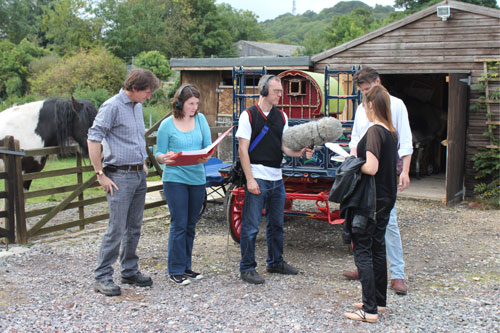
Behind the scenes on Radio 4 Afternoon Play, Atching Tan.

From left to right: Dan Allum (writer), Damian Le Bas (Neilus) , Alisdair McGregor (Sound Recordist) and Candis Nergaard (Lovvie)

As a Traveller it was fascinating for me to write this script because in many ways I faced the same dilemma when I was young. And although I did take a risk and step out of my community to work in the arts, I've always managed to keep close links with my community both personally and professionally.

The Atching Tan play has a history of its own and grew from a pilot episode of a radio drama series that was broadcast in late 2007. The pilot was so successful that BBC East commissioned a 36 part series, with support from the Arts Council and Heritage Lottery Fund, and the series is still running across Eastern England.

BBC's Writersroom have been enormously supportive and without their funding and expert guidance, this project would never have been so successful.

Even though I've been working in radio for three years I haven't had anything on Radio 4 till now. So it's a new and exciting experience for me. One of the things I was surprised about at an early stage was that though it's the proposal that gets commissioned there is much room for flexibility within the proposal to create and play around with characters. I recall after the first draft (I think I wrote four in all) I dropped two characters and changed the name of the play. And that was just the beginning!

I've learned so much through writing for radio - the discipline of working to tight deadlines, coming up with storylines, working with professional actors alongside actors who haven't even seen a script before let alone done any acting.

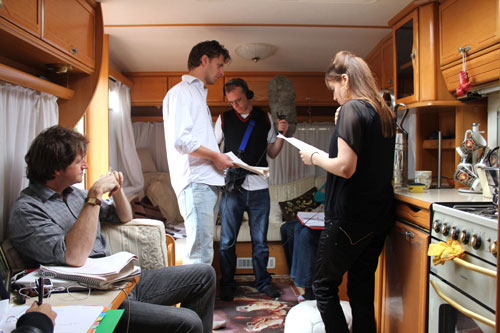
Behind the scenes on Radio 4 Afternoon Play, Atching Tan.

It's been great to explore my culture through drama in such an exciting and authentic way. I've often heard or seen Travellers portrayed either on radio, TV or film in such a clichéd way. It's either over romanticised or just showing the bad side. I guess it shouldn't be surprising as so few people know anything about the Gypsy community as it's so secretive and tight knit. BBC drama have been very sensitive and respectful to the Traveller community throughout and have always kept authenticity at the centre of the work.

Even so I never thought in a million years I'd hear Traveller voices speaking the Romani language on Radio 4! It was amazing writing the script, having the characters use the words Travellers would actually say in day-to-day conversation.

The BBC commissioner took a big chance with this play and it would be a great if this inspired other BBC commissioners right across the networks to have the courage and vision to take risks with new voices tackling controversial subjects.

But for now my primary hope is that the Radio 4 audience enjoy the afternoon play for what it's meant to be - entertaining drama.

- - - - - - - - - - - - - - - - - - - - - - - - - - - - - - - - - - - - - - - - - - - - -

Read the script for Atching Tan.

The Atching Tan afternoon play will be broadcast on Radio 4, at 2.15pm, November 23rd, 2010.

BBC TV Blog: Miranda: The making of a sitcom

Fiona Mahon|12:55 UK time, Monday, 22 November 2010

Blog comments are currently unavailable. Find out more.

Writer, creator and star of Miranda, Miranda Hart, has written this blog post for the BBC TV blog where she talks about how she creates and writes her sitcom.

It's an entertaining read which gives a real insight into the writing process for a TV sitcom - from initial storylining, to drafting and pre-production.

Watch a clip from the new series of Miranda below, and read our top tops on writing TV sitcom:


In order to see this content you need to have both Javascript enabled and Flash installed. Visit BBC Webwise for full instructions. If you're reading via RSS, you'll need to visit the blog to access this content.


Accused

Fiona Mahon|15:31 UK time, Monday, 15 November 2010

Blog comments are currently unavailable. Find out more.

Accused - Jimmy McGovern's sextet of dramas on crime and punishment, starts tonight on BBC One at 9pm.

Watch an introduction to the series below:

In order to see this content you need to have both Javascript enabled and Flash installed. Visit BBC Webwise for full instructions. If you're reading via RSS, you'll need to visit the blog to access this content.


Keep an eye on our blog in the next few weeks as we'll be featuring blog posts from the writers of Accused. In the meantime, here's an earlier interview we did with Jimmy McGovern.

Ivan and the Dogs

Fiona Mahon|15:45 UK time, Wednesday, 10 November 2010

Blog comments are currently unavailable. Find out more.

Based on a true story, Hattie Naylor's Ivan and the Dogs follows Ivan, a four-year-old boy who runs away from home in 1990's recession-ravaged Moscow, finding protection and kinship with a pack of street dogs.

Ivan and the Dogs artwork.

Currently enjoying a successful theatre run, Ivan was originally a radio play broadcast in BBC Radio 4's Afternoon Play slot, winning the The Tinniswood Award for radio drama in 2009.

We're very pleased to have been able to add the script for the original radio play to our script archive:

Ivan and the Dogs by Hattie Naylor

Enjoy!

BBC Drama Shorts

Fiona Mahon|11:01 UK time, Tuesday, 9 November 2010

Blog comments are currently unavailable. Find out more.

In 2009, BBC writersroom worked in partnership with BBC Film Network and Lighthouse Arts to produce four new cinema shorts from emerging writing and directing talent, which premiered at the Encounters Short Film Festival.

You can watch three of the four films below:

Wish 143 by Ian Barnes

In order to see this content you need to have both Javascript enabled and Flash installed. Visit BBC Webwise for full instructions. If you're reading via RSS, you'll need to visit the blog to access this content.

Tells the story of a young man desperate to come of age before time runs out.

Munro by Michael Keillor

In order to see this content you need to have both Javascript enabled and Flash installed. Visit BBC Webwise for full instructions. If you're reading via RSS, you'll need to visit the blog to access this content.

Enduring a poorly planned camping trip deep in the Scottish Highlands, Father and Son, Bill and Robbie face up to the secrets they've kept from each other..

Conversation Piece by Joe Tunmer

In order to see this content you need to have both Javascript enabled and Flash installed. Visit BBC Webwise for full instructions. If you're reading via RSS, you'll need to visit the blog to access this content.

A unique musical-of-sorts in which a domestic argument is lip-synched to the sounds of a jazz cornet.

Drama on 3: Vultures - BBC Radio 3's Free Thinking Festival

Fiona Mahon|12:48 UK time, Thursday, 4 November 2010

Blog comments are currently unavailable. Find out more.

Free thinking festival logo.

As part of this year's Radio 3 Free Thinking festival, there will a live recording of Vultures - a new Roy Williams play, at the BALTIC Centre for Contemporary Art, Gateshead.

Vultures will be broadcast in Radio 3's Drama on 3 on Sunday 7 November at 8.30pm, and you can book NOW for free tickets to attend the live recording.

For more information, and to book your tickets, visit the Sage website.

For a full schedule of events, download the Free Thinking festival PDF as a brochure.


In the Red

Jo Combes|10:14 UK time, Thursday, 4 November 2010

Blog comments are currently unavailable. Find out more.

We had a great time judging the IN THE RED competition. We received a huge range of entries, some were entertaining, some were hard-hitting, and all were topical. Recurrent characters across the spectrum: George Osborne as a child, more surprisingly Wayne Rooney, and of course, many of the pieces were populated by bankers and politicians. While many pieces were very funny, the most successful scripts emotionally engaged with the idea of cuts and their human cost, and we felt that the winning writers had found a way into the subject via an offbeat route or surprising metaphor, building compelling stand-alone narratives.

We're delighted to announce the four winning plays below - Gabriel's introduced each for us:

Haven by Jill O'Halloran

"This is a great look at one of the most disturbing aspects of the cuts. Very bleak but very powerful."

The Council by Naomi Todd

"This is very funny and it really gets you thinking about the idea of the distribution of power."

The Surgeon's Knife by Stephen Searle

"This is a very well-structured piece. And considering how short it is the characterisation is great."

The Wall by Dan Murphy

"The story structure is really good. The main characters' struggle is really interesting, as is the premise."

And we also want to give honourable mentions to TONY CLARE, STEPHEN IRWIN and RACHEL MACAULAY for their pieces which all came very high on our shortlist.

The Sarah Jane Adventures

Post categories:

Fiona Mahon|15:25 UK time, Monday, 1 November 2010

Blog comments are currently unavailable. Find out more.

We've just added two brand new scripts from the current series of Doctor Who CBBC spin-off, The Sarah Jane Adventures - both written by Phil Ford, to our script archive:

The Vault of Secrets, Part 1

The Vault of Secrets, Part 2

Read an introduction below from Phil, where he talks about how he approaches writing for the series.

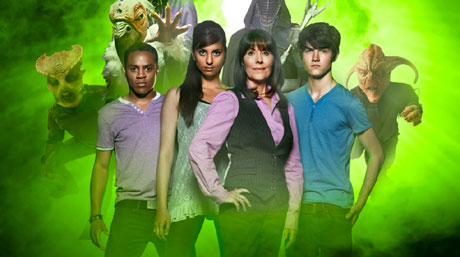
The cast of The Sarah Jane Adventures.

Phil Ford

For anybody who hasn't watched it, The Sarah Jane Adventures is the CBBC spin-off from Doctor Who - I'm guessing that you've probably seen that, and indeed the only reason you've never tuned in to SJA is because it's on before your home time - or you think it's just for kids.

Well here's a hint on how to write for kids - DON'T.

I've worked on every series of Sarah Jane (I've also done Doctor who and I've done Torchwood) and I've written scary stuff for all of them, emotional stuff, and stuff that's there to make you think.

Because that's the secret of writing for children - respect them; they're a smart bunch. And tell stories that entertain you, the adult. Stories that you would want to watch, something that would satisfy you, and feed your imagination. Don't give them candyfloss - it might look bright and colourful, and it might taste good, but an hour later you're either hungry again or nursing a stomach ache.

So I never write for this show thinking of it as a kids' show, just as a medium to tell a great, thrilling story.

Okay, let's be sensible; there are things that you wouldn't do in a show that goes out around teatime, but that's just common sense. That doesn't mean you can't tell your story in a grown-up way. It doesn't mean you can't be challenging in your themes or nature of your story.

Our show might deal with aliens - even some that fart and explode in messy goo - but we've also talked about serious subjects like dementia, marital break-ups, and (no pun intended) teenage alienation.

On the other hand, The Sarah Jane Adventures is also fun - it's a rollercoaster ride of thrills and fun and drama that's about family and the wonder of the universe, and the wonder of life itself. And The Vault of Secrets is very much a romp that doesn't take itself too seriously.

It sees the return of two extra-terrestrials that I've written for in the past - Mister Dread and his Men in Black who first appeared in my animated Doctor Who story, Dreamland, and Androvax the Veil who has a nasty habit of slipping inside other peoples' bodies as he sets about destroying their planet.

Androvax first appeared in the previous season's Prisoner of the Judoon story which was itself connected with Dreamland (the wonderful thing about working in the Whoniverse is the opportunity to cross-reference shows like this). But the only reason to ever bring a creature back is in order to learn more about them (don't forget aliens are characters and worthy of development just as much as any human protagonist) - and in The Vault of Secrets we get to see another side of Androvax, and get a better grip on Mister Dread and his purpose on Earth.

For all its running about and shapeshifting hi-jinx, however, there is also a real moral dilemma at the heart of this story, and that's why I love it.

BBC writersroom on Twitter

Fiona Mahon|12:30 UK time, Monday, 1 November 2010

Blog comments are currently unavailable. Find out more.

BBC writersroom typewriter.

Just a quick one to let you know that we are now on Twitter!


Follow @bbcwritersroom to stay up to date with the latest new writing opportunities, and to get a glimpse into the daily goings-on with the BBC writersroom team.