New radio drama
Oldipo Agboluaje, who came on our Sparks radio scheme and was on of our Royal Court 50 writers too, has a new play on this weekend on Radio 3.

Oldipo Agboluaje, who came on our Sparks radio scheme and was on of our Royal Court 50 writers too, has a new play on this weekend on Radio 3.
Our Rapid Response: In the Red competition has now closed.
We've had over 100 entries - the winning scripts will be published on our website next week.
Good luck to all who entered!

An overall winner for the seventh Windsor Fringe Marriott Award for New Drama Writing has now been announced.
The winner is:
"Click" by Jan Perry.
The runners-up are:
"Man of Straw" by Norman Cowell
"We That Are Left" by Peter Harrison
Of the final ten shortlisted plays, six - including runner-up "Man of Straw" by Norman Cowell - came via the BBC writersroom opportunity page.
Another new script has been added to our script archive:
EastEnders: E20 - Series 2, Episode 1 by Emer Kenny.
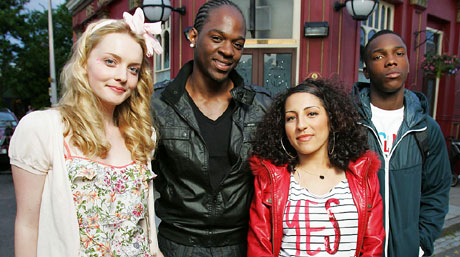
Read an introduction below from EastEnders: E20 producer Deborah Sathe, where she talks about finding and developing new talent for the writing team, and the challenges involved in showcasing Albert Square through the eyes of four teenage characters.
Deborah Sathe
As producer on EastEnders: E20 I am across all aspects of production including recruiting, training and commissioning the writers. I work with a script producer every summer on the E20 summer school where we, together with a bunch of writers aged 16-22, create the characters and stories for each series of E20, whilst teaching the young team how to write for Online and Television.
To get onto the E20 writing team a writer has to write a monologue for a character they would like to see on television, which they send in to E20, then if we like what they have written, the writer is asked to create a scene introducing their character to an established EastEnders character confessing love. Then they come for an interview and after that we select the most promising writers. We look for people that have a good ear for dialogue, story ideas, and who will learn quickly. And you don't have to be a fan of EastEnders to get on!
E20 is a different animal to EastEnders. The joy for the audience is watching these four new Londoners invade Albert Square and seeing what they think of Walford. Our young characters have to survive without their parents or adults, normally young people in EastEnders are seen as part of a family, the E20 kids are always on their own which gives the creative team loads of fun storylines. The style of the show is very different, it's filmed with hand held cameras to give the story more pace, there are jump cuts (where we play around with the shots in the edit), and there is music all over the series. We work with a composer to create a soundtrack for each series.
As Series 2 finishes online (though you can still watch it for the next five years!), I am proud of the characters we created. It's brilliant to see something that was only an idea on a flip chart come to life. Watching the characters march about the Square bumping into institutional EastEnders characters like Billy Mitchell, Masood and Zainab really thrills me. We are currently storylining Series 3 with a new bunch of writers. I could tell you exactly what is going to happen ...but that would spoil it for you! For those who haven't already - go online and watch Series 1 and 2 on the E20 website.
Last time we did a Rapid Response was 'Five Days In May' when we asked you to submit pieces in response to the general election. Now that the Rapid Response is back with 'In The Red' we thought we'd gather some feedback from our team of readers that might help you with your submissions...
Here are our top tips for Rapid Response Writing;
1) Less can be more...
Don't feel like you have to pack loads and loads of story into 10 pages, sometimes you can show us just a moment in time in the world of your characters and it's enough to capture our imagination.
2) The big twist / happily ever after...
You don't need a big reveal/reversal/twist at the end or a nice/neat/happy ending but do be aware of what you want the reader to feel at the end (shock/tears/triumph etc) and give yourself room to do that.
3) Know where you're going...
When we did our last Rapid Response some of the comments from our readers were "it was a really great idea, lovely characters and/or dialogue but just didn't know where it was going".
With rapid response this might be because you only had time to do one draft so perhaps ask yourself have I got the structure of my story right, have I got the right beginning, middle and end?
4) Every character counts...
No matter how many characters you have in your script try to develop them all as much as your main character.
Think about what journey they go on and how they impact on the narrative.
In short scripts we don't have much time to get to know them (or you) so think about how you can best convey who your characters are.
5) Show don't tell...
A lot of the scripts we received were 2 or 3 characters or a family sat in a room simply talking about what was happening in the news.
We want to see what your imagination can come up with: we don't want a re-cap of the events, we want to see the impact of the events.
'Actions can speak louder than words' is especially true in short scripts, it's more economical for you and it's more interesting for us. Ask yourself what your characters do as well as say. We like to see characters that make their own decisions - not just reflect on other people's.
6) Repetition...
We are all creatures of habit - but don't rely on the same dramatic devices (unless of course you are using the repetition to make a point) because in a short script the reader is more likely to notice.
7) Be original...
We're looking for original voices, we'd rather you used a rapid response like this to try something completely off the wall and out of your comfort zone than send us something in the style of another writer or something that you think we'd like. Surprise us, you know you want to!
8) Respond to the brief...
We want you to interpret the brief in a new and exciting way but we also want to know that it inspired your script. There might be a desire to re-work something you've already written, there's no rule against that, but ultimately the judges were most excited about the ones that were a relevant but original insight on the events in question!
Happy (rapid) writing everyone.
On the subject of rapid responses (see Fiona's post below), the episode of Doctors that I blogged about writing here is on telly tomorrow. It's called The Flood and is my first proper serial-only episode. If anyone interested in writing for the show fancies watching it (obviously you're watching it all the time anyway, right?) and having a bit of a debrief, I'll be back on here to comment this Friday.
In particular, for those keen to write for the show, it might be most useful to imagine what you'd have done if all you had to go on were the central revelation between the two main characters. Sorry if that sounds vague, but after watching the ep it should hopefully be clear which revelation/characters I mean. So if that's the only bit of story info you knew you had to impart, how might you go about building an episode around it?

Would you like to have your script published to the BBC writersroom website?
We're looking for scripts based on this month's government spending review. What would you put in the 'spending envelope'? Could you come up with a completely different and dramatic approach to the budget deficit?
We're not looking for scripts to make - we're looking for scripts that we can post online.
To enter, send us a 5-10 minute script for film, TV, radio, or online that imaginatively responds to the spending review.
Up to five of the best scripts will be posted on the BBC writersroom website.
Deadline: 10:00am, 27th October 2010
For more details, including where to send your script, read the In the Red opportunities page.
Confused by all the figures? Read an overview of the key points of the Spending Review from BBC News.
Just wanted to let you know about two new posts on the BBC TV Blog which may be of interest.
Mick Ford, writer of Single Father talks about the real life tragedy that inspired the story. It starts 9pm Sunday on BBC One and stars Suranne Jones and David Tennant.
In step with National Poetry Day, Greg Wise (exec producer) talks about how he took the poem The Song Of Lunch and turned it into a drama (starring Emma Thompson and Alan Rickman).
We have just added a new script to our script archive:
The Cut - Series 3, Episode 1 by Al Smith.
Here's Al to give some background on the series and the unique role the audience plays in shaping its storylines.
Al Smith
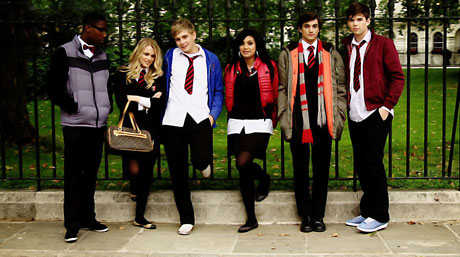
What is "The Cut"? It's a show about a bunch of teenagers doing their best to fall in and out of love with each other in London. It's pretty much my teenage experience: I struggled for years to try to get a girl to look at me, and failed nearly all of the time. I'm still failing.
It is also a kind of hybrid drama - it's born both online, and broadcast on television. Every weekday at 5:10pm, a new five minute episode is uploaded online on The Cut website, and every Saturday, those five weekday-episodes are broadcast as one 25 minute omnibus on BBC2 at noon.
Most of our storylines are suggested by our audience, and we have a very close relationship with them through our blog and through our Facebook page. The gap between scripting, production and broadcast is very short, so we can be more reactive to their suggestions than most telly - we try to make our audience feel as big a part of the show as possible.
My job is to oversee the writing of the show - I have a small team of writers, so I spend a lot of time planning story arcs and script editing, and occasionally I write an episode of my own. Here is the episode I wrote to open Series 3 and here's a link to watch it on iPlayer. We killed one of the stars of the show as the cliff at the end of Series 2, so it's pretty heavy going at first. Still, I hope you enjoy it.
Getting down to a final list of six for the competition has been extremely difficult, and all of us involved in the selection have had to lose at least one favourite. It was that tight. However, we now have the six, and I have written today to the writers who made it through, and the ones who didn't.
So, in alpahbetical order, these are the scripts and writers.
Gypos by Daniel Brierly is about a family of Irish travellers who live under the Westway in London. Daniel is currently doing an MA in screen writing at the National Film and Television School.
Human, Right? by Tom Glover is set in a human rights charity. Tom has several theatre projects in development, including work with the National Theatre Studio.
New Money by Wally Jiagoo is about the fall-out from a work syndicate's lottery win. Wally is on the Royal Court Unheard Voices scheme, and works in film as well as theatre.
The God Committee by Sophie Petzal is about a young woman and the four potential fathers of her unborn baby. Sophie is studying scriptwriting at Bournemouth University, has worked in film and live comedy, and is also a journalist in print and online.
The Marvellous Ascendancy of Jerome J Knight by Nimer Rashed is the tale of a man plucked from obscurity and handed a position of power in a talent agency. Nimer has won awards for his work in film, theatre and non-fiction writing.
Champs by Ben Syder and Jonathan Wright is a slacker com about two flatmates. They both write and act for theatre and television, and have won awards for their work.
Each of the scripts has an individual voice, and each offers a diferent style of comedy, so it will be exciting to meet the writers at a workshop later this month and see how the scripts have progressed from ten pages to full length. We'll be reading each script aloud at the workshop and I hope throwing up thoughts so that the writers can produce new drafts in time for casting and planning the showcase on 4 December.
