Oscar-nominated scripts
This year's Oscar-nominated scripts are all available online.

This year's Oscar-nominated scripts are all available online.
I always find the suicide of a successful artist shocking. Such as Alexander McQueen this past month. Take a profile shot of his life and all seems gleaming: World renowned in his chosen field, rich behold comprehension, famous friends and famous admirers. He achieved everything this society says you need to achieve to be content. But for whatever reason, tragically, it wasn't enough. With the eroding of religion we need a new type of heaven to look forward to. A man made mortal heaven where everything will be okay. Better than okay. Blissful. The new heaven is "Making It" in whatever stream of life you choose to swim; medicine, finance, sport, art, politics. You name the career, there's a divine peak everyone's trying to reach and when you manage to reach this golden summit you are assured that All Will Be Well.
I don't count myself any less of a climber in the Peak Distinct of Attainment. Starting out I would spend hours rambling around the Internet Movie Data Base, searching out writers who I respected and scrutinize the year of their first big break with the year of their birth. If I calculated that they had made it in, say, their early twenties. I'd become agitated and depressed. But if I found out that they'd made it, say, in their late thirties, I'd rejoice; "there's still time," I would think, "I still have an enough years to break on through". This is a ridiculous practise, of course. It helps to develop your skills as a writer in no way whatsoever, while simultaneously injecting severe doubt and insecurity into your head. Comparing careers is like crack cocaine for the struggling writer - the laptop and data base sites become the paraphernalia and the information becomes the freebase. I've been off it for years, but sometimes, late at night, I'll catch myself on doodle.com checking out Anthony Neilson's D.O.B.
As I carried on up the mountain of Making It I found that, like all promises of promised lands, there were pit stops, sub divisions, side roads and above all mirages. Another person's accomplishment was another's disappointment, and one's person's perceived failure was...you get the idea. When I was in York one time for a new playwrights conference I met a fellow scribe who knew me by name - we'd never met before but he had heard about me and was "very excited" to finally be introduced. I was flattered but I was also completely bemused. I did not consider myself successful in any sort of way (not according to my ordnance survey map of Great Achievement) but here was this lad looking at me thinking I was on the divine path to Making It Nirvana. Hmm.
When we finally get to Making It Nirvana we expect certain things to evaporate instantly. Such as loneliness and poverty. These of the two biggie burdens that we demand to be taken off our tired shoulders. Though this doesn't always happen. I know two very successful scribblers that have achieved the peak and still suffer the same old frustrations. A playwright friend of mine and winner of the prestigious George Devine Award was telling me the other day that he still can't afford to give up his day job in a bookstore. Even though he has commissions coming left right and centre and a residency at a top new writing theatre. Another writer I know whose show got 5 star reviews last year and was in the running for national awards, got so lonely at a party once that he ended up in a corner reading the Guardian. And not the fun G2 section either. This playwright had to fend off isolation with just the World Affairs pages. Ugh.
So even if you get to the summit you still have to contend with real life I guess. Real life never goes away. Which pisses me off somewhat as I was lead to believe that real life would be magically got rid of when you manage to reach Making It Nirvana. But then I consider - would I want real life to be disposed of? Would that make me, in some way, I don't know, artistically buggered? Think about the true success stories, the ones who rocket past the Making It plateau and storm into the realm where yes indeed real life can be blasted apart along with any kind of human struggle. These titans in the sky get million dollar deals and Oscars galore and then turn in very bad art very quickly. Their next project, once in the cosmos of success, is often rotten and riddled with clichés.
Is it possible perhaps that to continue to make good art, Making It Nirvana must always be kept out of reach, there to be climbed but never conquered?
Check out the alternative endings to last week's live episode of EastEnders, and reveal the other possible murderers of Archie Mitchell!
In the book The 101 Habits of Highly Successful Screenwriters there is a section on the hours these highly successful scribblers devote to their craft. Each and every one of them tells the editor of their gruelling work schedule. Getting up before dawn and pounding on the laptop, at furious pace, until dusk. Only stopping to do aerobic exercise on the porch of their Malibu beach homes or to play with they're overtly charming and attractive children. My double chin (un-aerobicized) fell to the floor and I was filled with a nameless dread. Jesus Christ, I thought I hardly manage to drag myself to my own dramatic doodles for 60 minutes per day and even then my cursor is magically drawn to the internet explorer icon - 'ah there's an article on filmmaker Kevin Smith being too fat to fit on an airplane, I must read this in minute detail'. Now it turns out these Hollywood stiffs are putting in 12 hour shifts. Blimey Moses.
With sweaty palms I put the book back on the Waterstones shelf (I'm a wannabe screenwriter; I can't afford books on screenwriting). This can't be true I hoped. Well maybe it's true of these uber successful scribes but the common garden writer would never manage that kind of hellish slog... right?
I clicked on my trusty explorer icon and put into Google this desperate question: how many hours a day should you write? The first site to appear was a Yahoo Answers message board . The best answer (chosen by the asker) went as follows: "I write for about 8-9 hours a day. It's very hard work! It depends on how fast I am writing. Sometimes I'll write 20 words a day, and sometimes I'll write over 2000! But usually my goal of the day is to write a chapter of the book I'm writing (My chapters are about 10-20 pages long). Good luck, and have fun writing!" GOOD LUCK AND HAVE FUN WRITING?! I'd commit suicide twice if I had to write 9 hours a day. 9 hours a day. 9 hours a day? Who was this person? Stephen King? Thomas Pynchon? Martin Amis? No, it was: Soon_ To_ Be_ Mommy_4_Weeks_To_Go. That was her Username and that meant - I was presuming - she wasn't a professional ink layer. Just your average soon to be housewife and she was beating me on the commitment scale by 540 minutes to my 60 (not including YouTube breaks).
At this point I was in full despair mode and started on the self-flagellation; I'm a lazy, undisciplined piece of work that does not deserve to kiss the boot of Soon To Be Mommy 4 Weeks To Go or anyone else who's ever lifted a brio. Time to delete all plays and scripts and bring up that ASDA application form again. Before I sent My Documents to Dignitas I decided to watch an interview with David Foster Wallace on charlierose.com. Wallace is - or was (he tragically killed himself in 2008) the kind of writer that makes your soul sing in delight. He's that good. His magnum opus is Infinite Jest, 1079 pages of brilliant near future Meta fiction. My mind started spinning on rinse cycle at the thought of the number of hours he would put into his craft. I took a deep breath and prepared to be awed. But when the subject of writing day to day came up and what he would doing in a year out because of a grant he had just received Wallace said this "If past experience holds true, I will probably write an hour a day and then spend eight hours a day biting my knuckle worrying about not writing". At last, a writer who procrastinates as much as me and doesn't wear out the keys on his computer.
This little piece of info kept me afloat and then I found an interview with screenwriter Dan Roos at the wonderful makingof.com (if you have a weird fetish for viewing on set footage like I do, this sites for you) where he tells of his daily writing schedule and advice for beginning screenwriters - Make an appointment to write for an hour per day. Spend that hour either writing on your current project or in a journal. Sometimes you'll spend 10 minutes writing in the journal and 50 on the project at hand and sometimes you'll spend 10 minutes on the project and 50 minutes on the journal. Doesn't matter because at least you're putting words on the page. Every day. This is liberating for a whole set of reasons; Writing 10 pages of screenplay a day is instantly intimating. Ever looked at ten blank pages? Feels like looking into the abyss. Whereas working for a mere hour doesn't have the same awful ring to it. Also in an hour you can write 10 pages, or 6 or 2. But because you've set the goal as an hour of desk time you feel like you've accomplished something.
By this time my heart rate was back to normal. Then I remembered a foreword written by the playwright David Watson who talked about the importance of "thinking time". I too believe in thinking time. Some of my best ideas, characters, scenes or lines have come out of just walking around having a good think. However if you do this and don't scribble down what you've thought, the gems will flutter out of your head. That's where the hour a day writing appointment comes in handy.
When I had fully calmed down I began to wonder about some of the 12 hour, full working day boasts that I had read in Waterstones. I also began to ponder on the writer's preference for exaggeration. The screenwriters who were being interviewed for the book knew that other scriptwriters - their competitors - were being interviewed as well and perhaps they figured that if they didn't make out like they were sweating 24/7 they would be looked down upon, perhaps even lose work. In other words I thought they may have been telling fibs. Like all writers do. Like I've done. 60 minutes per day? Come off it - More like 20 minutes (including YouTube breaks).
My name is Dominic Mitchell and I am one of the writers on the BBC Northern Voices scheme.
Hart Hanson - creator and showrunner of Bones - gave a talk at Grant MacEwan University in Edmonton, Canada recently.
Fortunately, one of the audience members recorded and transcribed his speech, which you can now find online here.
As a straight transcript, it's a bit of work to get through - but well worth your time, as there's a lot of good advice in there.
Ok, in memory of Johnny Dankworth, here's how a sketch is like a jazz tune.
Say you're listening to Coltrane play 'My Favourite Things'. He'll start out with the basic tune, and then he'll take it and muck about. He'll take that tune all over the shop, he'll noodle, he'll swoop, he'll throw it over to the piano, maybe the drums will get a solo. For most of the track, he'll do all the things that jazz lovers love and jazz haters hate. Then he'll bring it back. The basic tune reasserts itself and... finish.
A sketch is like that.
I've said elsewhere that a sketch is one idea. It can have as many twists and turns, as many opposing viewpoints and (must have) as many jokes as you like, but at heart it is one single idea. The opening of a sketch sells that idea, gets a laugh, sets the tune. From there on you can take it anywhere as long as, like Coltrane's rhythm section, you have the basic idea backing you up. A sketch can, and should, be as surprising as you can make it but every twist is just a variation on the central theme, an improvisation around your tune. Look at how Fry & Laurie play around with the information desk idea here.
The punchline, then, is the tune reasserting itself. It's the payoff - the ideal finish that the start promised. Everything in the sketch is pointed towards this moment. That's why a satisfying punchline gets such a big laugh - it's a Freudian release moment, with everyone getting there effortlessly at the same time.
Of course, you might not like punchlines. A lot of people think they're old fashioned. These are people who have to put stings between their sketches to cover the lack of laughs. A punchline doesn't have to be a badum-tish gag, it shouldn't inspire a wah-wah-wah from the trombonist. It does have to tie up the sketch. A sketch always has to have a last line, obviously, so why not make it funny? Otherwise you might just find your producer cutting out on the last big laugh.
So there you go: Thesis, Antithesis, Conclusion. Oh, wait, no. That's why sketch writing is like A Level History essays. I think my basic point is this: I like jazz.
Well, its just a bit-of-fun theory, thought up over an idle hour on the tube reading Newsjack submissions - and anyway I'm more Ornette Coleman than Wynton Marsalis, so feel free to go your own way, play whatever tune you like.
Which sounds like as good an excuse as any to listen to this.
Dan
Given the short turnaround for our call for Welsh writers, we have decided to extend the deadline by one week to allow writers more time to get their script and idea in to us.
So the deadline is now: 5pm on Wednesday 17th February
Just to clarify too - we are stipulating writers must have at least some form of professional track-record, but that might include a bursary/award to write, or a commission for an as-yet unproduced work, or a professionally staged reading in the theatre, or a funded short film. If you are unsure whether you qualify, get in touch with us.
Hello. Apologies for missing a week - I was off in Bristol doing some acting and then I lost the email with my login details. Also, I'm only half way through series one of Mad Men so something had to give. Anyway, to make up for my absence, I promise my next blog will contain at least 75% more bullish opinion.
This one, though, I'm going to turn over to wiser heads. When I started this blog I asked a few writers I knew who'd been through the topical sketch mill for any advice they'd give if they were in my position. Well now, through the magic of cut-and-paste and formatting they are.
We start with Laurence Howarth. One half of Radio 4's Laurence & Gus (but I'm not saying which half), Laurence has written for, among others, Armstrong & Miller, Dead Ringers, Omid Djalili, Mitchell & Webb, Look Away Now as well as his own sitcoms Rigor Mortis and Safety Catch and the granddaddy of all topical radio shows Weekending.
Be careful of writing in the subjunctive. Not in the sense of using the subjunctive (it's a perfectly good mood) but in the sense of writing something that might work, that could be funny, that may fly if it gets a good rewrite or is really well performed etc. If you're struggling to think of a really good idea, it's tempting to alight on a mediocre one and work on that in the hope that it may eventually, somehow turn into something really good. Such ideas rarely do. Better to wait for the really good idea and then write in the indicative, i.e. a sketch that does work, is funny and will fly. Easier said than done, mind.
If this was an Alan Yentob documentary I'd fly to New York for the next interview. As it is, I just sent a friend an email. Danny Robins, as well as being a comedian, presenter and art panel pundit, is my long term comedy partner. We've done loads. You can trust him.
Beginnings and ends are the hardest. Go for unpredictability if you can and have a killer punchline - don't let it fizzle out, even if the beginning and middle are good, sketches with bad ends always get cut.
Keep it lean and mean. Look at every line and see if it justifies it's place in there comedically. A short and very funny sketch is better than a longer quite funny sketch.
Arial 12 point. It's the professional sketch-writer's font of choice. Times New Roman is for people who don't know how to work their computer properly and Comic San Serif is for the dangerously mad.
See, Arial 12pt. I said you could trust him. Since I asked Simon Blackwell (The Thick of It, The Old Guys, Peep Show) his opinion, he's been nominated for an Oscar, so hark unto this:
Always rewrite when you're asked to, and, unless you have a huge objection, in the way you're asked to. Most of what's in your first draft won't get broadcast, and that's a good thing.
Finally, Gareth Gwynn is one of the Radio Entertainment department's staff writers and has helped read / rewrite for every episode of Newsjack - as well as working on The News Quiz, The Now Show and I Guess That's Why They Call It The News. He's chosen to express the Newsjack submissions he read in the form of a graph.
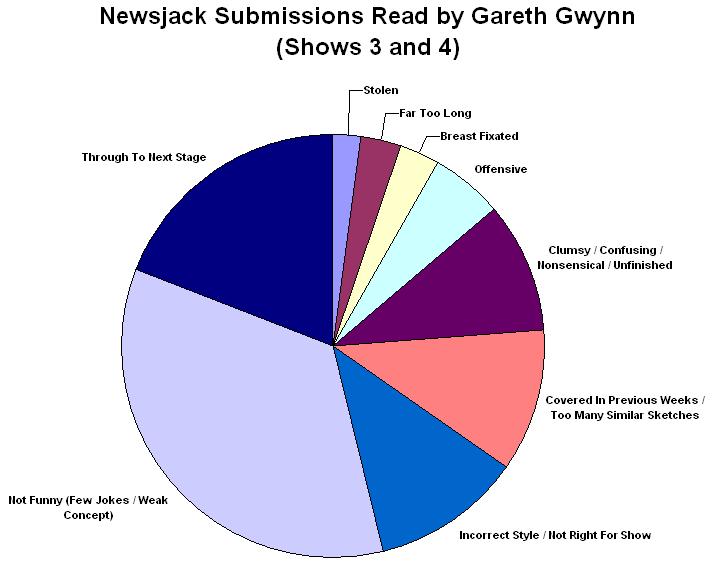
Yeah, graphs in a blog. I'm like Ben Goldacre.
Next time: Why Sketch Writing Is Like Jazz. No, come back, where are you going? It is. It is like jazz.
The new season of The Wire strand of original new dramas on Radio 3 starts this weekend with Alan Harris's play The Goldfarmer. The strand is in it's 10th season, has always been commissioned out of Writersroom by Kate Rowland and has always included commissions for writers brand new to radio and broadcast in general.
Eran Creevy's script for his low-budget film Shifty is now available to read. The film was developed through the Film LondonMicrowave scheme in partnership with BBC Films. As part of the BBC's support of the project, I spent some time with Eran and his producers looking at the story before he went away to do the final draft you see here. The resulting film was a fantastic first movie from a talented new writer-director and Eran has just been nominated for a BAFTA.
So, the year before last Russell T Davies puts this book out, right? All about writing Doctor Who. And to go along with it he published all of the scripts he wrote for Doctor Who that year.
Well, now that he's finished working on the programme, there's a new updated version. And that means he's also updated the website.
So you can now go and read all of Russell's Doctor Who scripts from Christmas 2007 through to his last ever shows That's five new Doctor Who scripts for you, right there, including this last Christmas/New Year double bill.
Have fun.
