

Lightning: Your best 2010 photos & video sought for BBC Weather Week
UPDATE: 4 AUGUST 2010: In addition to the still photos mentioned below, please note that we're now accepting any video shot this year too. Please email us at west.weather@bbc.co.uk if you've any great video you'd like to submit for consideration!
------------------------------
We're well into the season when thunderstorms are most prevalent across the West Country. It's been very quiet in our skies through spring and summer thus-far, but I'm expecting that to change this week...
A low pressure system moving up from the southwest during Wednesday has the potential to bring some thundery downpours across parts of the West Country - as well as some much-needed heavy rain for the parched landscape!
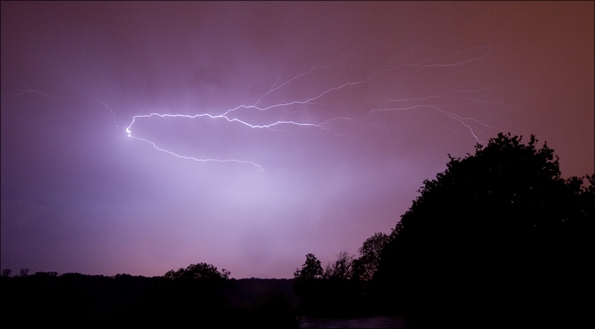 The prospect of thunderstorms is also welcome and timely news for us here at the BBC.
We're busy making an half-hour programme for BBC ONE, due to be broadcast on a Sunday as part of the BBC's Weather Week in September 2010.
I'll be presenting our regional documentary - Wild Weather of the West - and I'm hoping for your collective input!
Here's the plan:
In the documentary and online, we're keen to show some of the best lightning photographs taken this year across the West Country.
And from some of the wonderful photos sent regularly to us at the BBC Bristol weatherdesk, we're clearly blessed with some very talented photographers across the region, but even if you've never photographed lightning before, why not (safely!) give it a try - if the opportunity arises? I'll certainly be trying my best here in South Gloucestershire, but the more cameras across the region this summer, the better the chances!
I've just been interviewing Matt Gibson for the programme. He's a very skilled amateur local photographer from Hotwells, Bristol - check out some of Matt's wide diversity of images on his Flickr site.
Although not a specialist thunderstorm chaser (unlike some of you who read the blog!), Matt has successfully shot lightning before such as the image above, taken in Clifton, Bristol. He has some very handy tips for all other budding Storm Snappers:
Overall
- In rural areas you don't need to work so hard to get a good lightning picture
- In towns, light pollution is problematic, but the reward of a cityscape with lightning across it makes trying very worthwhile.
- Keep gear at the ready -- you never know when a storm will be along!
Tripod & Room Setup
- Tripod essential; shutter speeds will be very slow (explained later), so hand-holding will lead to a blurry mess.
- Doesn't need to be anything expensive. A small tabletop tripod will only set you back ten or fifteen pounds.
- With the right window sill, you can improvise camera support -- bean bags, bags of rice, etc.
- Keep your shooting room dark.
Camera
- The more control you have, the better chance you have of getting a shot, so DSLR's give you by far the best bet.
- However, even some lower-end compacts may have a scene mode (e.g. "Starry Sky") which allows longer exposures and might give you a chance.
Lens
- Zoom lens the best bet. Standard kit lens from most digital SLRs will do fine. Start with a nice wide angle to cover lots of sky, so you stand a good chance of getting the lightning. You can always crop a bit later.
Focus
- Manual focus.
- Focus on sky, or on buildings if you're getting them in shot.
- You can use auto-focus once if you can -- camera will have trouble finding focus on a dark sky -- and then switch to manual, once the camera's figured it out.
Exposure
Shutter Speed
- Perfect photo will be a bright lightning strike against a dark background
- Longer exposures get you the better chance of catching lightning. And I mean long -- 30 seconds isn't out of the question
- Shooting in the country will be easier -- less light pollution. In city more tricky. Use a shorter exposure time.
- The longer the exposure, though, the brighter and noisier the background.
- Use "Bulb" mode, so you can control when the shutter opens and closes.
- Open shutter, wait for a lightning strike, close the shutter
- If the lightning's coming thick and fast, keep the shutter open for a few strikes -- all of them will be on a single photo, which will look impressive!
Aperture
- Aperture will control the brightness of the lightning itself.
- Very difficult to predict. Start fairly open, as lightning is likely to be distant, maybe f/4 or f/5
- Adjust as necessary
ISO speed
- Start at 100 and adjust upwards - e.g., if you're trying for a cityscape, but all you're getting is the lightning.....even if using fairly long exposures!
Safety Guidance
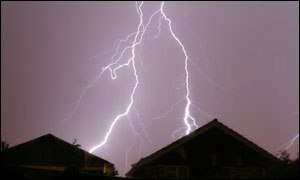 I've filmed in many severe thunderstorms before and trust me, it can get pretty hairy if you're caught out in the open away from safe shelter - especially in the dark. So before attempting any photography, we do insist that you read the Health & Safety advice below.
Making safety your first priority:
- No photograph is worth the risk of injury or death
- Lightning strikes the ground in Britain about 300,000 times a year. For the photographer considering lightning photography, this is a risk that must be considered. Although there is no absolute protection from lightning, measures can be taken to reduce the risk of getting struck and the injury severity
Do not go outside to photograph lightning:
- The safest place to be during a thunderstorm is inside a solid building - whether you're taking photographs or not
- If you find yourself caught in a thunderstorm unexpectedly - get indoors as quickly as possible
- Even when indoors stay away from plugged-in appliances (e.g. TV, computer, telephone), metal structures (e.g. window frames), and plumbing or tap water
Do not lean out of a door or window:
- Remain inside until at least half an hour after the last thunder is heard
- Taking photographs from indoors does not increase the risk of a lightning strike, but safety must remain your top priority, whether or not you are using a camera
- Lightning can strike more than 10 miles from the centre of a storm, so even if it's not raining, and the storm appears to be distant, if you can hear thunder rumbling stay indoors until at least half an hour after the last thunder is heard
What to do if there is no shelter available:
- If there is no building in which to shelter, the inside of a car is safer than staying outside - but even inside a vehicle, do not touch the metalwork of the car at all
- Do not stand close to tall structures or isolated trees, which have an increased likelihood of being struck by lightning
- Be aware of objects that can conduct or attract lightning, for example, tripods, umbrellas, motorbikes, bicycles, wire fencing and rails
- Seek shelter quickly if your hair begins to stand on end and nearby appliances begin buzzing - it may mean lightning is about to strike
- Further information on thunderstorm safety advice can be found on the following websites:
https://www.rospa.com/leisuresafety/adviceandinformation/leisuresafety/lightning.aspx
https://www.metoffice.gov.uk/weather/uk/advice/lightning.html
https://www.bbc.co.uk/weather/features/understanding/lightning_safety.shtml
Submitting Images
It's important you read this and the disclaimer to include in your accompanying email before sending photos to us.
- Take them in landscape format only (not portrait)
- Try to keep the lightning centrally and don't zoom tightly. This is because we have to crop the top and bottom of the photo to make it widescreen format (16:9) for TV - so keep the shot wider!
- Don't add false colours, gaudy effects etc., in photo manipulation software such as Photoshop. If a photo appears unduly tampered with or contrived, we simply won't use it.
- Send us a high-resolution version please, because we will re-scale it at our end. Small, grainy and pixelated photos taken on a mobile 'phone are of no use!
- E-mail your photo to us at west.weather@bbc.co.uk and include details of the photographer's full name, exactly when and where the shot was taken, and please give us written confirmation that the image is yours, with permission for the BBC to freely use it on TV and internet.
Meantime, if any of our more experienced storm chasing readers wish to share advice, expertise or such-like with other enthusiasts, please do so in the comments section here on the blog. Thanks!
Happy shooting! Keep an eye on the forecasts and keep safe!
 I'm Ian Fergusson, a BBC Weather Presenter based in the West Country. From benign anticyclones to raging supercell storms, my blog discusses all manner of weather-related issues. I also provide updated race weekend forecasts tied to our BBC coverage of Formula One. You can follow me on

Comment number 1.
At 08:31 23rd Jul 2010, Matt Gibson wrote:Well, I've been keeping my gear to hand, but not had much luck yet. Yesterday's Great Bristol Thuderclap was pretty amazing, but I don't think anyone could have caught what was basically one single flash of lightning...
On the plus side, I have caught some interesting cloud. This is what one of my friends tells me is orographic cloud, hitting the cliff face at Sea Wall: https://www.flickr.com/photos/matt_gibson/4819531774/
Complain about this comment (Comment number 1)
Comment number 2.
At 08:45 24th Jul 2010, Ian Fergusson BBC Weather wrote:Hi Matt! Yes, been disappointly quiet, hasn't it!? That lovely photo you took shows the plume of outflow from works over at Avonmouth. I use it daily as a 'visual barometer' of atmopsheric conditions and the amount of instability aloft! It's very handy! Cheers, Ian
Complain about this comment (Comment number 2)