

President Preaches Lightning Safety...
Alongside his many credentials as a skilled orator, the US President has now added a timely dose of weather wisdom to his portfolio.
I was duly impressed.
Yesterday afternoon (Monday) - in torrential rain and with lightning striking close by - Barack Obama attempted to start his Memorial Day speech, to huge crowds gathered at the Abraham Lincoln National Cemetery in Elwood, Illinois, some 50 miles south of Chicago.
With a severe thunderstorm booming directly overhead; squally winds from the storm's downdraft tugged at the President's large umbrella. Standing at the lecturn, the President immediately outlined a clear and present danger.
In order to see this content you need to have both Javascript enabled and Flash installed. Visit BBC Webwise for full instructions. If you're reading via RSS, you'll need to visit the blog to access this content.
"We are a little bit concerned about lightning... this may not be safe," he told the thousands listening. "A little bit of rain doesn't hurt anybody, but we don't want anybody being struck by lightning."
Urging everyone to return to their cars (and they're amongst the safest places to seek shelter in a thunderstorm), he was absoluely right to call proceedings to a halt.
In such circumstances, crowds standing close together in an open, exposed location, in wet clothes, is a recipe for lightning injury or fatality. In previous similar circumstances, multiple casualties have occurred simultaneously - including at soccer matches, affecting both players and spectactors alike. As well as direct cloud-to-ground strikes to humans, lightning can side-flash off stadium structures, trees and such-like to injure or kill people. Closer to home, we've seen some decidedly hazardous conditions from thunderstorms at the Glastonbury Festival in June 2005, for example.
Lightning is a major weather peril across the USA, something President Obama will have been acutely aware of as he called-off his speech. In fact, there's a Lightning Safety Awareness Week being held across Illinois later in June.
Indeed, in most years it causes more deaths there than hurricanes or tornados: typically, some 60 people are killed across the nation each year, with some 600 injured. Florida sees the highest number of casualties and in an average lifetime of 80 years, a US citizen has an estimated 1/6250 chance of being hit by lightning. However, only 10% of those struck are killed: 90% survive, albeit often with some form of disability.
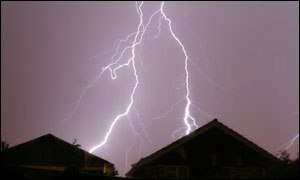 Back here in the UK, we're entering the period when thunderstorms tend to become most prevalent, as the transitional and often very variable phase of cooler to warmer conditions experienced in May leads (we hope!) into summer.
I'm concerned at the lack of lightning-savvy, reckless or extremely foolhardy behaviour sometimes seen in our country as threatening weather looms. For example, people continuing to shelter beneath trees during electrical storms; or insisting on playing a final round on a golf course; or continuing a hill-walking excursion towards a rain-lashed peak as thunder rumbles all around. In a later blog this summer, I'll expand on some of these safety issues and examine the statistics nationally for lightning-related deaths and injuries.
Meantime, in my BBC forecasts here, I am always at pains to highlight any threat of thunderstorms. However, I always talk of the "risk of lightning", rather than the "risk of thunder" I hear mentioned in some forecasts.
Yes, there have been some injuries and fatalities caused by thunder in the direct sense (e.g., riders suddenly dismounted by startled horses), but lightning is the potent threat (then resulting in the thunder), not the other way around!
I've seen first-hand, while working with Hertfordshire Fire & Rescue Service back in the 1990's, just how devastating lightning can be to people and property. I've witnessed major property fires resulting from it; house roofs virtually blown to smithereens; an entire herd of cattle killed overnight and on one occasion, we even had two of our firefighters struck.
They were hit simultaneously as they worked to extinguish a rooftop fire on a house north of Watford and were extremely fortunate to avoid major injury. Oh - and the cause of the fire they were tackling? A lightning strike, just a short time earlier...so much for "lightning never strikes twice", just one element in a broad spectrum of lightning-related mythology!
Have you ever experienced lightning strikes to your home, or even to you, your family or friends? I'd be fascinated to hear your stories in the blog comments section below.
 I'm Ian Fergusson, a BBC Weather Presenter based in the West Country. From benign anticyclones to raging supercell storms, my blog discusses all manner of weather-related issues. I also provide updated race weekend forecasts tied to our BBC coverage of Formula One. You can follow me on

Comment number 1.
At 16:56 2nd Jun 2010, Richard Craig wrote:I have never (touch wood) had my person or property struck by lightning, but I will never forget the night I was returning home from work at Heathrow which was under a huge and violent lightning storm. Our bus was heading along the perimeter road towards Terminal 4 when a fork of lightning struck the base of a streetlamp at the precise moment our bus passed by! Not only that it happened at the precise moment the window I was sitting at passed the lampost. It was as you expect a big bang and a flash of light, but bloomin' scary (and cool) all at the same time! So that is the closest I have ever gotten (and wish to get) to lightning
Complain about this comment (Comment number 1)
Comment number 2.
At 02:39 8th Jun 2010, dennisjunior1 wrote:Ian:
It is always good of the President preaches safety in the weather department!
(D)
Complain about this comment (Comment number 2)
Comment number 3.
At 21:31 14th Jun 2010, ianthomas wrote:Ian
I well rember an early morning thunderstorm at Dursley around 1962-63 time which struck our telivision aerial and melted a good part of the inside of the box.Another spur from the the same strike, believe it or not, struck our neighbours runner beans growing up their sticks, incredible but true.On May 17th 1965, a particularly violent storm saw a bungalow roof struck and set on fire at Cam and several reports of telly aerials struck at the same time.Fast forward to 1977, and a February day of Atlantic weather with heavy showers and hail. One storm saw lightning strike a cottage at Hornshill on the A38 near Cam, with a result of slates and debris all over the ground and sockets blown out of the walls! I also remember a storm in April 1983 when lightning struck and brought down a pinnacle on the south-west corner of St Georges church at Upper Cam. Said masonary crashed down on the footpath below (lucky no one was on the path). Indeed, the power unleashed in theses conditions is awesome and is not confined to the summer months only as the above incident can confirm. Ian Thomas...
Complain about this comment (Comment number 3)