

We never stop learning about the weather...
I spent yesterday at BBC Weather Centre in London, on a winter forecasting course. It's part of the continuing professional training we regularly undertake in partnership with the Met Office.
It's a 7am train departure from Bristol Parkway to Paddington. The early morning vista across the vales and fields of Wiltshire, Oxfordshire and Berkshire is beautiful: patches of radiation fog blanketing spots sheltered from the early sunshine.
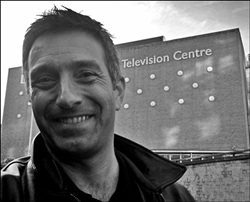 My ultimate destination in London is the iconic BBC Television Centre. For us visiting staff, it's inevitably a journey of discovery to try and find your way around this labyrinthine building: I feel like unravelling a ball of string, in the style of Theseus, to make sure I find my way back! Crucially however, I recall exactly where to collect an early cup of tea...
On the 2nd floor is the BBC Weather Centre, where I grab a seat as Duty Forecaster Laura Tobin briefs the team on weather conditions expected today across the British Isles - and indeed further afield. Weather Centre provides TV and online forecasts across the globe and so unsurprisingly, Typhoon Melor is a topic of considerable interest as it drenches Japan.
After Laura's briefing, there's just enough time to brew another quick cuppa and natter - as I often do to him from my desk in Bristol - with broadcast meteorologist John Hammond. We chat about his shifts on Radio 5 Live; he's forecasting for them all week. For me, presenting weather on the radio is one of the most enjoyable aspects of my job.
But no presenting for to do today: it's time to learn! Over the past two years, our Met Office tutor, Penny Tranter, has become like a familiar school teacher for me: indeed when I was appointed as a weather presenter, she was my original course instructor at the Met Office HQ in Exeter.
I'm here on today's course with a number of BBC weather presenters from across the country. February's snow features regularly in the classroom instruction and discussion, but also the noteworthy severe windstorms of recent decades, not least the Great Storm of October 1987 and the Burn's Day Storm of February 1990. We also look in detail at the Met Office's system of public weather warnings and the manner by which we broadcast these on the BBC. It's a critical element of our job and one we simply have to get right.
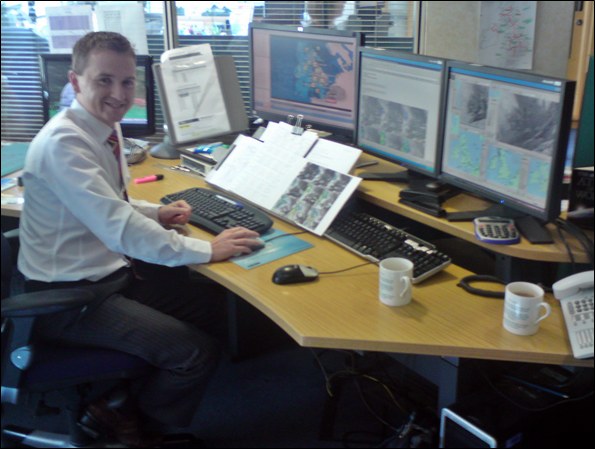
Broadcast Meteorologist Matt Taylor working at the Duty Forecaster Desk. He's busy adding key detail to the weather graphics soon to be used on the BBC's network and regional lunchtime TV broadcasts.
During lunch break, I chat with Matt Taylor, who has taken-over the Duty Forecaster shift from Laura Tobin. Matt gives me some useful advice about the Met Office's Global Forecast Model, and accessing data from it. It's an important tool for me when providing weather forecasts for BBC's 606 Forum ahead of - and during - each Formula One Grand Prix.
By 5.15pm, it's farewell to colleagues in London and I'm on the oh-so-busy train back to Bristol.
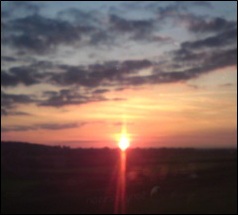 Passing through the fields of Wiltshire alongside the M4, I'm sky-watching. As a cloud aficionado, I'm pondering the difficulties some people have in discriminating between patchy formations of Altocumulus and Stratocumulus. I'm looking out the window here at some picturesque Stratocumulus perlucidus with a fairly high cloud base, virtually the only clouds visible here above the setting sun. Twenty minutes later and I'm arriving in Bristol to virtual darkness.
And it feels distinctly chilly, too. A reminder that winter continues to draw ever-nearer, so not long before some of the knowledge gained on today's course will be put into use!
 I'm Ian Fergusson, a BBC Weather Presenter based in the West Country. From benign anticyclones to raging supercell storms, my blog discusses all manner of weather-related issues. I also provide updated race weekend forecasts tied to our BBC coverage of Formula One. You can follow me on

Comments Post your comment